


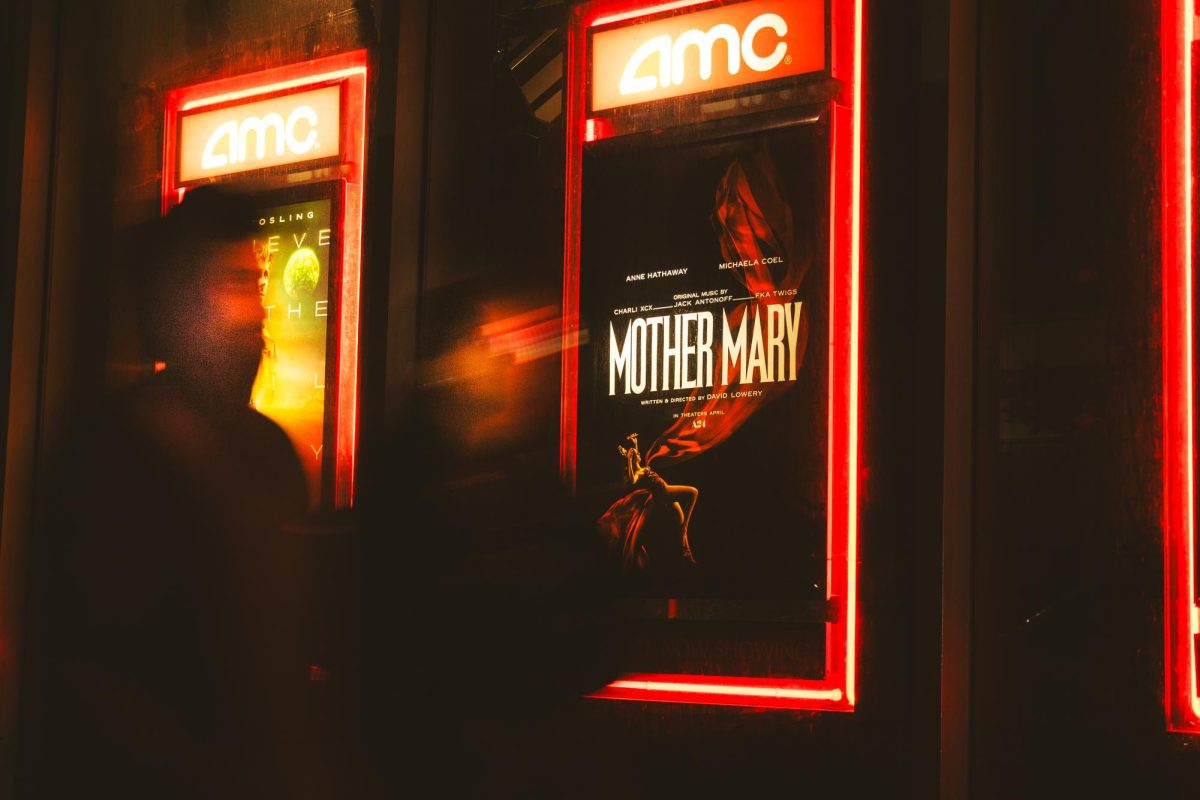
With music by Charli XCX, Jack Antonoff and featured artist FKA Twigs, A24’s “Mother Mary” uniquely immerses audiences into a concert-like atmosphere. Written and directed by David Lowery, the film tackles various themes through its all-woman cast, including friendship and spirituality.
Anne Hathaway plays Mother Mary, a Taylor Swift-esque pop star desperate for a new dress for her comeback performance. Michaela Coel plays Sam Anselm, Mary’s ex-fashion designer with a witty sense of humor, who holds a grudge against Mary for breaking their once-close bond and partnership. Nonetheless, Sam compromises by creating a dress that symbolizes Mother Mary’s true self.
As Sam sorts through a range of textures and fabrics, from dark lace to golden shimmer, none seem quite right, so she suggests the dress incorporate pieces of Mother Mary’s wardrobe history, ultimately transforming into a nude, plain dress. Such efforts would allow Mother Mary to symbolically rip up her past, giving way to a clean slate as the new version of herself is unveiled to the world.
Through intentional monologues, back-and-forth banter and playful jabs, including Sam admitting to not listening to Mary’s songs for a while, Sam and Mary’s lines allow the audience to flesh out the depth and personality of their minds. These moments also add comedic relief to intense moments, like when Mary practices her dance in silence for Sam, showcasing her authentic vulnerability and a deep tension between obligation and discomfort. Her body clearly hurts, but she pushes through the routine.
Hathaway gives a raw and compelling performance, showing not just the pressures of being a pop star, but the mental and physical toll of never being enough.
The film then shifts to a moment from Sam’s past, when she attends one of Mary’s concerts after their friendship has ended. That night, she sees a red ghost at the foot of her bed that quickly disappears. Later, Mary reveals that she has seen the same figure and believes it has begun to inhabit her body.
Hathaway gives a raw and compelling performance, showing not just the pressures of being a pop star, but the mental and physical toll of never being enough. Recognizing her ex-friend’s exhaustion, Sam decides to cast the spirit out of Mary as a final act of friendship before they both return to their separate lives.
Once it is released, the red spirit turns into luxurious fabric. Mary returns to her life of stardom and Sam uses the spirit fabric to create the dress, even though Mary never ends up wearing it.
As she walks up to perform in an outfit that no longer resembles her image, Mary thinks of Sam and rips her dress and halo off, revealing a bare, nude corset underneath. The movie ends with a scene of Sam’s completed red spirit dress, capturing the quietness of a friendship that can no longer be as it once was, and that distant love remains untouched by fame, resentment and the weight of the past.
The ensemble demonstrates how the depth of women’s friendships can bring someone out of that darkness, even at their lowest point.
Although the themes of “Mother Mary” are heartwarming, it is hard to ignore some evident faults in the production. An example of this is that many supporting characters lacked context, like Sam’s assistant Hilda, played by Hunter Schafer, and Mary’s team, including Kaia Gerber and Sian Clifford; these characters are shown on screen but given no background.
The film’s opening hooks viewers into the dynamics of Sam and Mary’s friendship, but once the supernatural spirit forms, they no longer feel as connected to the original plot goal of the “comeback clarity dress.” After 112 minutes, the dress was never even seen or touched by Mary, which was disappointing as a viewer. Why is there no end reward? They are not friends anymore, with no dress and two completely different lives forever. However, it seems as though this was Lowery’s goal.
Lowery is known for a mind-racing, medieval feel with both “Mother Mary” and his 2021 film “The Green Knight” using a halo glow around characters to create a sacred feeling, radiating themes of spirituality and inner struggle. He incorporates minor biblical references to the Christian image of Mary with the golden halos and shades of blue in the costume choices. The effects are electric, which feel like the front row at Swift’s Eras Tour. Throughout the film, fame is portrayed as something almost otherworldly, blurring the line between reality and fantasy.
Ultimately, the film raises the question: What if fame starts to feel supernatural?
As Lowery contrasts high-intensity crowds with luxury items, there is an undertone of a darker sacrifice through ghosts and the unknown. It puts forth the idea that high-profile careers carry their own spiritual weight through performance and that media attention can strip celebrities’ souls from them over time. The ensemble demonstrates how the depth of women’s friendships can bring someone out of that darkness, even at their lowest point.
Although its storyline can be confusing, “Mother Mary”’s underlying message of fame escalating to supernatural levels creates a compelling conversation about sacrifice and identity.