
Warning: This review contains spoilers.
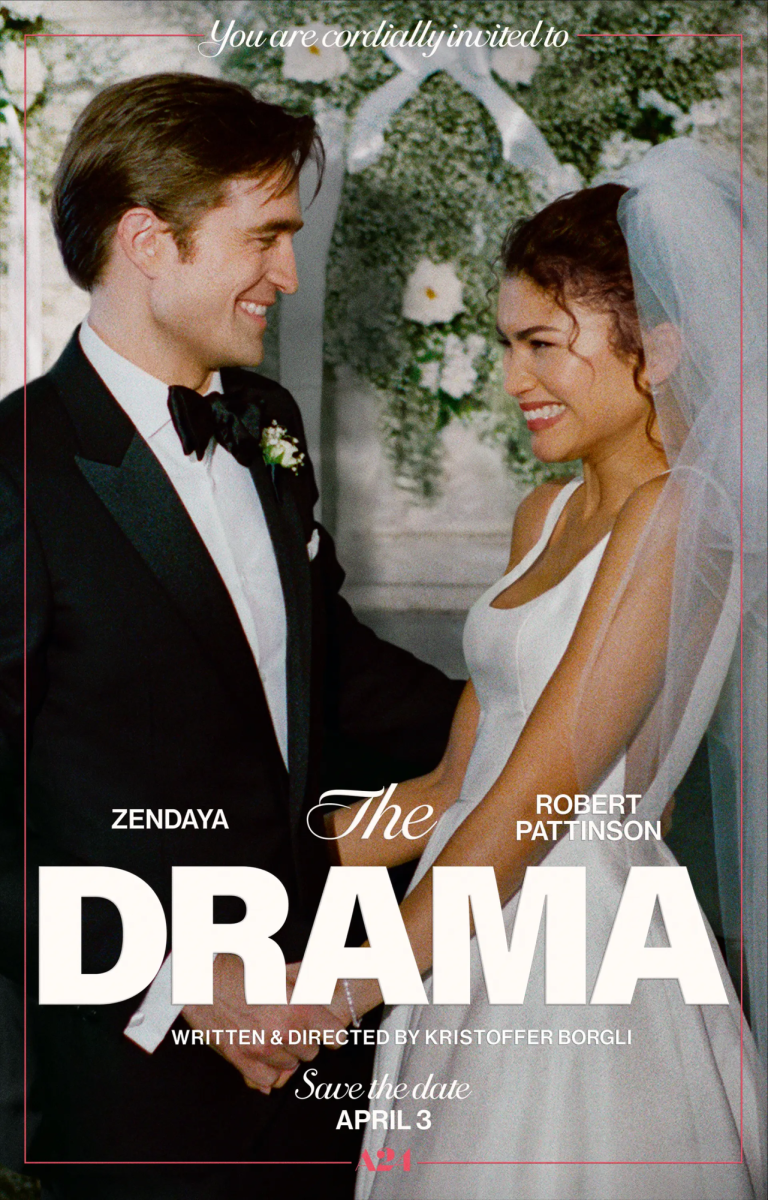
In his second film with A24 — following “Dream Scenario” (2023) — Norwegian director Kristoffer Borgli takes viewers on a hypnotically-absurd rollercoaster ride of a couple’s unraveling with his surrealist romantic dark-comedy “The Drama.”
Shot on 35-millimeter film, “The Drama” invites its audience into a deceptively dreamlike world, as Charlie (Robert Pattinson) deliberates over his wedding speech with his best man Mike (Mamoudou Athie). We move in and out of the present as Charlie recalls favorite memories with his bride-to-be Emma (Zendaya), including their coffee shop meet-cute that is so storybook it is almost nauseating.
The illusion of the Boston couple’s perfect relationship is quickly shattered when, a week before their wedding, Emma drunkenly reveals her darkest secret to Charlie, Mike and his wife Rachel (Alana Haim) — Emma’s maid of honor.
Inhibitions lowered by more than their fair share of wine samples from their wedding caterer, Emma and Charlie hesitantly agree to share the worst things they have ever done after being egged on by Rachel, who explains that she and Mike did the same before getting married. The friends all offer their confessions — Mike used an ex-girlfriend as a “human shield” to avoid being attacked by a wild dog, Charlie cyberbullied a classmate so badly his family moved away and Rachel locked a child she describes as “slow” in a closet of an abandoned RV overnight. This troubling admission by Rachel, who explains that she never told the boy’s parents where he was, even when the police were called to search the area (though he was eventually located), is immediately swept under the rug.
By offering an extremely limited view of Emma’s troubled past, the film never allows her to fully take shape.
What Emma reveals, however, is so shocking that it brings the buoyant evening to a screeching halt. As a teenager, she planned and very nearly carried out a violent act at her high school. Charlie and Mike react in quiet disbelief, while Rachel is disgusted and furious.
The remainder of the film unpacks the fallout of Emma’s admission, almost exclusively through Charlie’s eyes. Borgli’s choice to center Charlie is equally fascinating and frustrating — it forces audiences to consider what they would do if the person they were days away from committing to for eternity suddenly became unrecognizable. Pattinson’s performance as the weak-willed and spiralling Charlie is stunningly convincing, enhanced by jumpy, non-linear editing in which imagination and reality blur.
Zendaya shines as Emma, capturing her character’s instability and desperation to reconcile with (or at least suppress knowledge of) her darkest secret before it destroys her life and her relationship. However, the film’s structure and writing keeps viewers at more than an arm’s length from Emma, her inner world and basically everything about her.
By offering an extremely limited view of Emma’s troubled past, the film never allows her to fully take shape. Whether this is an intentional choice by Borgli in order to communicate that Emma is a stranger to herself — who understands the motivations that drove her to almost commit an unthinkable act no more than the audience does — or an indication of Borgli’s ability to effectively write complex female leads is up for critics to decide.
Alternatively, perhaps Borgli’s characterization of Emma (or lack thereof) is intended to force audiences to view her through Charlie’s limited, one-dimensional perspective of his fiancée. The film’s small details reveal just how little Charlie really knows about Emma (beyond the obvious) — he knows almost nothing about her childhood, even finding out for the first time that her father was in the military in the middle of their wedding. Though clearly deeply in love with Emma, Charlie loves an idealized, surface-level version of her that does not actually exist. He has put Emma on a pedestal since their very first interaction, and when the perfect fantasy he has made of her crumbles, so does he.
We come to understand the film’s other characters, especially Rachel, on a fundamental level through their responses to Emma’s admission. Haim flawlessly embodies Rachel’s snobbish, holier-than-thou attitude, bringing to life a character so satisfyingly unlikeable that the audience I viewed the film with regularly erupted in groans in response to her dialogue.
“The Drama” ultimately captures the moral superiority contest that dominates our modern culture, and raises questions that bring no clear answers.
Rachel’s strong reaction to what Emma confesses, while certainly understandable, demonstrates a deep hypocrisy. Moments after admitting she traumatized a vulnerable child — essentially leaving him to die — for the sole purpose of satisfying an “impulse,” Rachel is willing to condemn Emma for planning an act that, while horrific, she never actually carried out. Throughout the film, Rachel very transparently exaggerates her closeness to a cousin who was left physically disabled by a similar act of violence — using her cousin’s very real trauma to center herself in a situation that has little to do with her.
“White women are experts at weaponizing victimhood, especially against people of color, as a way to center themselves,” said social media commentator Frankey Smith.
Smith, who posts film and television reviews under the name @FantasticFrankey, spoke to how the film captures this phenomenon in her review “The Drama explores White Women tears.”
“If Emma were white, or if it was actually (Charlie) that brought up that deep dark secret, the receptions from people, specifically Rachel, would be completely different,” Smith said.
“It is clearly important that Emma is Black. … Black women in particular are not allowed to break any molds, or have any dark thoughts or mental issues. … We’re not allowed to be different, and ‘The Drama’ perfectly encapsulates why that is,” Smith said.
“The Drama” ultimately captures the moral superiority contest that dominates our modern culture, and raises questions that bring no clear answers. How much should we really know about the people we love? How long should we spend atoning for what we have done — or almost done — in the past? And with a subjective, constantly moving moral goalpost constructed through self-serving bias — can any of us be truly good?