
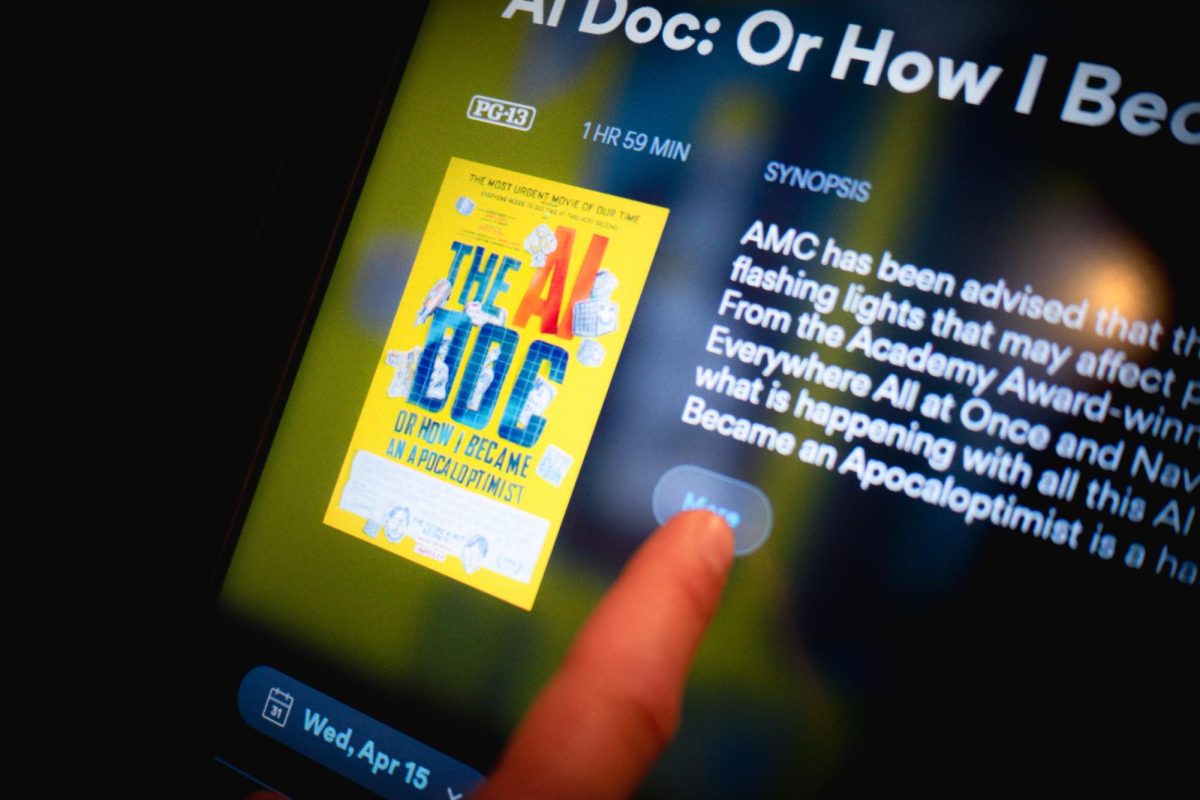
Exactly how scared should humanity be of artificial intelligence (AI), and is all of humanity inevitably doomed? Those questions are the central basis of Daniel Roher’s newest documentary “The AI Doc: Or How I Became an Apocaloptimist.”
The film follows a similar coming-of-age arc after he and his wife, Caroline, learn they are expecting a baby boy. That sends Roher into a slump, wondering if now is the right time to bring a child into a world defined by uncertainty. He fixates on how AI might reshape social, economic and cognitive life, and what it could mean for the next generation.
“The AI Doc” starts with Roher trying to find answers, which first requires him to understand the basics of AI and how it operates. When he posed the question of “What is AI?” to high-profile AI specialists, teachers, journalists and tech bros, everyone gave a different answer, underscoring how the term “AI” has become a matter of expertise.
These professionals generally agreed that AI involves systems trained to recognize patterns and follow instructions, and to predict which operation or action should come next. As these styles continue to grow and learn at an accelerated pace, they evolve towards a hypothetical level of AI known as AGI (Artificial General Intelligence), where the system can think at a human-level capacity or higher.
Anxious about the world his son might grow up in, Roher pivots to a more hopeful perspective. The tone shifts drastically, embracing the optimistic case for AI’s rapid growth and accelerating capabilities.
The first half of the film focuses on a new kind of arms race: an AI race among countries, each trying to reach AGI first. Domestically, the documentary frames the feud between Elon Musk and OpenAI CEO Sam Altman as another obstacle in the tech bros’ competition.
Roher highlights another fear: If AI systems are trained to adapt to human behavior, even extending to traits such as manipulation and greed, who knows what they will transform into and be used for.
Recently, the OpenAI chatbot was reportedly used as a tool in planning a school shooting. This raises questions about whether such uses should even be possible and what limits should be placed. As concerns about security and surveillance grow, debates and more fears arise about the future of technology.
Anxious about the world his son might grow up in, Roher pivots to a more hopeful perspective. The tone shifts drastically, embracing the optimistic case for AI’s rapid growth and accelerating capabilities. Experts featured in the second half of the film argue that if AI is used wisely, it could lift societies well beyond mere survival, powering breakthroughs in humanitarian relief and transforming healthcare.
Here, the emphasis is on AI as a tool for good. The film argues that, with unprecedented access to information and creative outlets at one’s fingertips, this can be a joyful, even lucky, time to be alive — the world in which Roher’s son will grow up will be filled with convenience.
One of the film’s highlights was Roher’s sit-down with three of the biggest CEOs from the most prominent AI tech companies featured in his documentary: Sam Altman of OpenAI, Dario Amodei of Anthropic and Demis Hassabis of Google’s DeepMind. However, Meta’s CEO, Mark Zuckerberg, and xAI’s CEO, Elon Musk, were invited to participate, but Zuckerberg declined, and Musk initially agreed but eventually got too busy.
Instead of Roher pushing harder on issues like regulation, accountability and even real-world harms, the documentary lets the CEO’s neutrality shine, normalizing their versions of an AI-driven future. It positions them as “middlemen,” grounded —at least from the film’s perspective — and unafraid of what the future holds. Calling into question what kind of narrative Roher is trying to tell, the interview questions were very surface-level and failed to truly inform audiences.
While the documentary offered a good scope of understanding and presented the topic in a simplified way for the average viewer, it ultimately lacked any real substance.
Roher ultimately lands in the middle, taking the “apocaloptimist” route. He finds both sides compelling but agrees with the neutrality that, to thrive, humanity needs to learn to build a society capable of handling powerful technology. Given that his stance is bluntly emotionally driven — after all, he is becoming a new dad — remaining optimistic for him and his family makes the most sense.
What makes “The AI Doc” a standout is Roher’s playful, striking and eye-opening use of cinematography along with his blending of cartoon animation to make abstract and conceptual ideas legible to general audiences.
While the documentary offered a good scope of understanding and presented the topic in a simplified way for the average viewer, it ultimately lacked any real substance. The film ended on a fairytale-like kumbaya note, even after exploring the genuine and serious risks and underlying factors at play. The buildup of major tensions and expectations only settles on unrealistic solutions. Particularly, the idea that pushback through unions could set the terms of AI’s expansion.
Although encouraging public awareness is admirable, relying solely on collective human maturity feels idealistic. The film gestures toward hope without offering tangible strategies, policies, or concrete steps for audiences to act on. It is better to be prepared than to remain caught between optimism and apocalypticism with nowhere productive to go.