

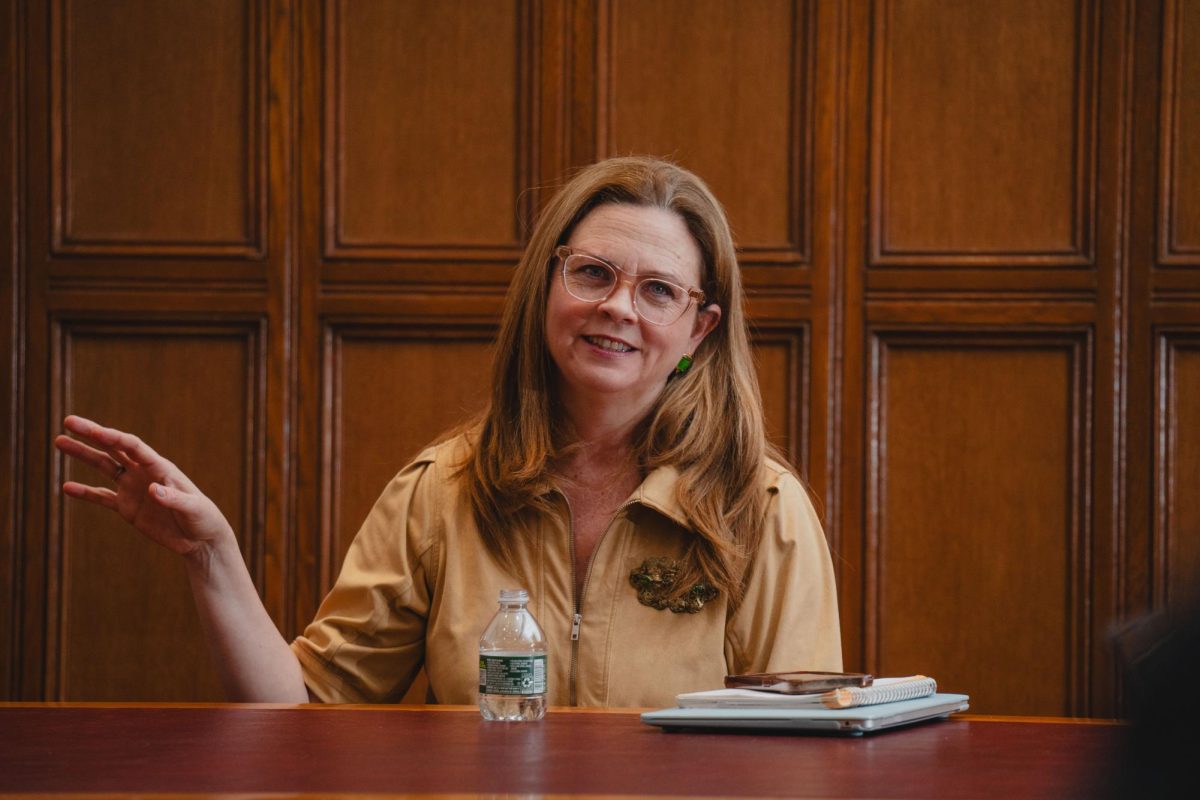
Student press convened with University President Tania Tetlow to discuss the administration’s point of view on contraception, curriculum changes, admissions for the incoming class and more at a conference on April 7.
Budgetary Measures
Tetlow confirmed at the presser that there would be a tuition increase for the 2026-27 academic year. Two days later, a university-wide email announced the 4.5% increase as well as a 3.0% increase to meal plan and average room fees. Tetlow said that financial aid remains the highest priority in Fordham’s budget and that the university will be increasing aid in tandem with the hike.
Tetlow referenced budgetary measures taken over the last year as evidence of the university’s efforts to cut unnecessary costs before choosing to raise tuition. These measures include a hiring restriction and a 10% reduction in departmental discretionary spending.
(The change comes) at a time where technology, I believe, has made the humanities more relevant — not less relevant — but also giving choice, also making us a little more friendly to transfer students. Tania Tetlow, Fordham University president
Some department heads have voiced concerns that smaller departments will feel the squeeze more than others, having smaller budgets already.
The Fordham Lincoln Center Honors program had its operational budget reduced by 60% in December 2025. Tetlow said she is “not aware of any other cuts to specific programs” beyond the university-wide reduction in operational budgets.
Contraception
Tetlow later addressed Rose Hill’s United Student Government’s recent proposal to amend the university’s student handbook to allow the distribution of contraceptives on campus.
Tetlow said that, irrespective of her personal feelings on the subject, the university’s policy would not change until the Church’s does.
“I will tell you that, like the vast majority of American Catholics, I disagree with the Church on its policy on contraception, but it is the Church’s policy and, as a Catholic institution, we don’t violate that,” Tetlow said.
This position is not new. Tetlow provided a very similar statement on Fordham’s contraceptive policy at a prior student press conference in 2023.
Core Curriculum
The ongoing revision to Fordham’s core curriculum recently moved to phase three and will be ratified by the Board of Trustees on April 23. Tetlow commented positively on the progression of the project.
“I know that the faculty put years of deep thought into what matters most to prepare students for a changing future,” Tetlow said. “(The change comes) at a time where technology, I believe, has made the humanities more relevant — not less relevant — but also giving choice, also making us a little more friendly to transfer students.”
Tetlow pushed back against the notion that the change marks a departure from the humanities – core to a Jesuit education.
Starting this past summer, the university conducted “risk assessments,” screening faculty and university webpages. According to the Fordham Faculty Senate, professors received reports from administrators proposing revisions to the content of their webpages, without faculty leadership having been consulted.
Tetlow said that science, technology, engineering and mathematics (STEM) initiatives like Fordham’s new STEM honors program would increase the number of STEM majors, allowing the university to grow the undergraduate class without changing the standards of admission.
“That would mean needing to hire more humanities faculty to teach the core curriculum to those students, so this is the quickest way to be able to invest in the size of those humanities departments,” Tetlow said.
Tetlow also provided an update on the $100 million donation for a new STEM research facility at the Rose Hill campus. The current estimated timeline for construction is four years, and the university is still formulating its official budget, talking to donors and assessing borrowing options. The Board of Trustees will vote on the budget this summer and the project will move into the design phase.
Shared Governance and Academic Freedom
Starting this past summer, the university conducted “risk assessments,” screening faculty and university webpages. According to the Fordham Faculty Senate, professors received reports from administrators proposing revisions to the content of their webpages, without faculty leadership having been consulted. This raised questions about infringements on academic freedom and shared governance.
In response to the assessment reports, the Faculty Senate requested full disclosure of all documents related to the risk assessments by the Jan. 23 Senate meeting. These requests were not met by the university.
When asked about the risk assessments, Tetlow said that the administration asked faculty to check if the descriptions of their research on their webpages were accurate, not that they change the content. This, Tetlow claimed, was part of a broader effort by the university to review the more than 8,000 pages on Fordham’s website so that, “as we prepare to defend academic freedom, we feel good about its accuracy.”
“There was, in the game of telephone tag, some misquoting of that instruction and that intention, and some faculty felt pressured to change the website, which we corrected,” Tetlow said.
We really want you (faculty) at the table, we want your help, but it can’t be that, (for) the 200 decisions made on any score in any given week, that we stop and create a committee and wait to decide until we talk to you because you don’t have time for that. Tania Tetlow, Fordham University president
Tetlow affirmed the university’s commitment to academic freedom and shared governance, saying that Fordham, as a Jesuit institution, has a religious freedom to teach subjects like racial justice. Regarding shared governance, Tetlow called it an issue of scale.
“We really want you (faculty) at the table, we want your help, but it can’t be that, (for) the 200 decisions made on any score in any given week, that we stop and create a committee and wait to decide until we talk to you because you don’t have time for that,” Tetlow said.
Tetlow confirmed that Fordham would not be fulfilling the Faculty Senate’s request. She said that the university has “bigger fish to fry in defending academic freedom” and that disclosure would be challenging and require a lot of time and resources. Tetlow added that the documents requested include communications with outside counsel. If the university gave them over, they would “be waiving privilege (so that) anyone else who wanted that information could also get it, and that would make us more vulnerable to outside interference,” Tetlow said.
Federal Government
Students may face pressure regarding the affordability of their education from the federal government, on top of the recent tuition hike.
President Donald Trump’s proposed budget for 2027 would eliminate the Federal Supplemental Education Opportunity Grant program and dramatically reduce the Federal Work-Study program. The proposal also seeks increased funding for Pell Grants while keeping the maximum award amount the same.
When asked how this could affect Fordham students. Tetlow said the proposal is still a long way from being approved.
Last summer, the university sent out an email to students, their families, alums and faculty asking them to contact Congress in support of federal financial aid. Tetlow said that Fordham continues to reach out to alumni and Congress members toward this end and is urging other universities to do the same.
For the incoming class of 2030, the university saw over 54,000 applicants, a 23% increase from the previous year. Fordham has also followed through on its goal to increase selectivity, having accepted 47% of applicants, an 11% decrease from last year.
Trump has pushed a number of other antagonistic measures against diversity, equity and inclusion (DEI) and higher education. On March 26, the federal administration passed an executive order (EO) requiring universities and federal institutions to add DEI-related clauses to their contracts or risk losing federal funding. The measure is to take effect by April 25.
Tetlow said that Fordham expects the EO to be litigated before it is implemented. The Association of Jesuit Colleges and Universities (to which Fordham belongs) has signed onto a letter written by the American Council on Education opposing the plan.
How the EO will affect Fordham remains to be seen.
Admissions
For the incoming class of 2030, the university saw over 54,000 applicants, a 23% increase from the previous year. Fordham has also followed through on its goal to increase selectivity, having accepted 47% of applicants, an 11% decrease from last year.
Tetlow said she is “extremely excited about the statistics” and credited them in large part to the university’s new marketing and communications team. This follows Fordham’s rebranding in the fall of this academic year.
At the previous student press conference in September 2025, Tetlow shared that the university had seen a small decrease in international graduate student applications due to the visa revocations in spring 2025 and the Trump administration’s overall anti-immigration stance. This year, graduate Gabelli applications are down by 15%, partly due to a decrease in international applicants.
However, this past summer, visa applications for Fordham students were approved at a faster rate than the previous year thanks to the university’s increased efforts to guide international students through the process.
This past academic year, Fordham made a couple changes to orientation in service of their “One Fordham” goal, including inviting students from each campus to go to the other.
On top of expanding its marketing team, Fordham has also hired a couple of new administrators in the last year, particularly expanding its fundraising personnel. With regard to how the university is balancing its budgets (administrator salaries cost a lot more than other faculty positions), Tetlow said that, while some new positions have been added, several others have been cut in the restructuring of the School of Arts and Sciences.
“On the top administrative side, we added two vice presidents who report to me, but we sunsetted two vice presidents who report to me. We had four (senior vice presidents), now we have two (senior vice presidents). We had 10 deans, now we have six. So, I think, when we add a position, that gets attention. When we sunset it, it gets less attention,” Tetlow said.
Orientation
This past academic year, Fordham made a couple changes to orientation in service of their “One Fordham” goal, including inviting students from each campus to go to the other. In the coming academic year, Student Affairs will continue this work of unifying the campuses, a “logistical feat” which Tetlow said was very well-received. They will also be adding an extra day of orientation, as well as combining the academic orientation and the Student Affairs orientation on the same day(s).
Tetlow recently extended her contract to remain the university’s president until 2030. Looking toward the end of this academic year, Tetlow said she is particularly excited for graduation and the coming of the new first-year class.
TIMOTHY JOSEPH TROTT • Apr 15, 2026 at 2:06 pm
I’m a CLC grad, class of 1981. I am eternally grateful to Fr. Finlay who kept a line on the price. I didn’t recommend FU to my children. Heck, at these prices. I wouldn’t have gone either. The value proposition doesn’t hold anymore.