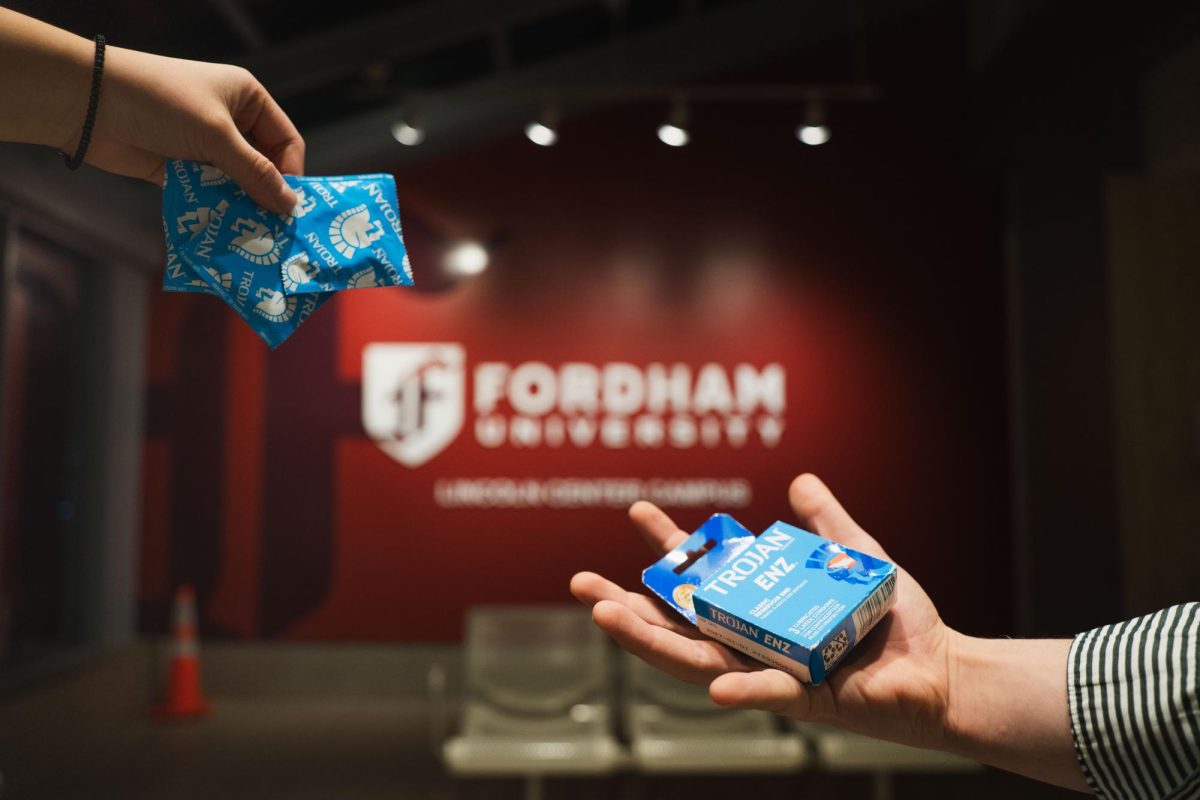
Fordham Rose Hill’s United Student Government (USGRH) proposed an amendment to the Fordham student handbook that would lift the ban on distributing contraceptives on campus, which has been a contested subject at Fordham for over 60 years.
Around 100 students, club leaders and administrators gathered in the McShane Student Center on March 20 for a “State of the Students” town hall to learn about and discuss the proposal, which saw near-unanimous agreement from the students and clubs who spoke.
Fordham’s current policy on contraceptives states that, although “personal possession of contraceptives, contraceptives devices and/or birth control, in any form, is not prohibited, distribution is prohibited on Fordham University property, using University resources, and at University-sponsored events,” according to the student handbook.
USGRH’s proposal would remove the phrase “prohibited on Fordham University property” in order to allow students and student groups to distribute contraceptives on campus, while still maintaining the ban on distribution using university resources and at university-sponsored events.
USGRH repeatedly emphasized that their proposed amendment does not ask Fordham to fund, endorse or distribute contraceptives, simply that students be allowed to do so. Aidan Costella, vice president of health and security at USGRH and Fordham College at Rose Hill (FCRH) ’26, said the change would be a “minor revision” to university policy that would not place undue burden on administration.
USGRH added that they are not seeking to reinterpret or challenge Catholic doctrine from the Vatican regarding contraceptives — which espouses the “intrinsic evil of contraception” — but rather to redefine Fordham’s relationship with said doctrine.
The event gave clubs and students time to voice their opinions.
Nearly all clubs present supported the proposal (including a statement from a theology professor), with the exception of Fordham Respect for Life, a student club promoting pro-life values. The club argued that the amendment would compromise Fordham’s Jesuit values and would open the door to further concessions by the university for contraceptive access.
Most, however, held the opposite view and maintained that cura personalis compels universities to support every part of students’ lives, including their reproductive health.
USGRH cited three primary reasons for the proposal. One, that the ban promotes a “culture of judgement, silence and internalized shame.” Two, that it discourages students from seeking sexual and reproductive care, does not result in abstinence and increases risk of sexually transmitted infections and rates of unintended pregnancy. And three, that there is a disproportionate impact on low-income and LGBTQ students, as well as those who have not received comprehensive sexual education.
USGRH added that they are not seeking to reinterpret or challenge Catholic doctrine from the Vatican regarding contraceptives — which espouses the “intrinsic evil of contraception” — but rather to redefine Fordham’s relationship with said doctrine. USGRH’s argument is that, as personal possession is allowed, the university has already diverted from the doctrine.
Domenick Fedele, USGRH’s first-year senator and FCRH ’29, spoke on behalf of USGRH and emphasized the importance of individual choice. Fedele said that the university should not create barriers to those choices, nor need it take a rigid stance of prohibition or endorsement.
The moral primacy of institutional purity has given way to the moral primacy of the common good, which is in line with Catholic principles of social justice. … Access to contraception is consistent with this theology Cristina Traina, Professor of theology
“(The current policy) conflates the lack of an explicit prohibition with endorsement, which is absolutely not true. However, this represents an ambiguity that falls hardest on students who are most in need of these critical resources,” Fedele said.
Cristina Traina, a theology professor at Fordham whose specialties include Catholic ethics and sexuality, wrote a letter supporting USGRH’s proposal and suggesting that the university remove language about contraception from the student handbook altogether. The statement was read on her behalf at the town hall by a student, as she was unable to attend.
Traina emphasized that the issue is a question of freedom of religion and conscience. She argued that, among many contemporary Catholics, “the moral primacy of institutional purity has given way to the moral primacy of the common good, which is in line with Catholic principles of social justice. … Access to contraception is consistent with this theology.”
Traina, members of USGRH and attendees also spoke to what they view as a stricter contraceptive policy at Fordham than most Jesuit universities.
Some have similar bans on contraceptives, though few are as comprehensive as Fordham’s, and 20 out of 27 Jesuit schools do not police contraceptive distribution at all, Henry Carstens, USGRH first-year senator and FCRH ’29, said during USGRH’s presentation.
USGRH also cited a 2019 survey of 315 students by The Observer, which found that 26.7% of respondents felt financial barriers impeded their access to contraceptives, and 98% believed the university should provide contraceptives.
Prior to the event, USGRH sent out a survey assessing students’ access to contraceptives. Of the 170 students that responded by the event’s start time, 36% said they had “considered not using contraceptives because of cost, lack of availability on campus, or other barriers.” 58.7% said it is “extremely important” that contraceptives be distributed on university campuses, with another 32.2% saying it is “very important.” 63.6% said access to contraceptives at Fordham is poor or very poor.
USGRH also cited a 2019 survey of 315 students by The Observer, which found that 26.7% of respondents felt financial barriers impeded their access to contraceptives, and 98% believed the university should provide contraceptives. USGRH said this demonstrates “clear and overwhelming student support across campuses for this change,” which is a “necessary evolution for a safer Fordham.”
This issue has been raised at Fordham long before 2019. In 1967, The Fordham Ram published an article detailing a student petition at Thomas More College (Fordham’s women’s college, which existed until its merging with Fordham Rose Hill in 1974) asking the university to provide information about contraceptives and direct students to off-campus resources. The petition received 175 signatures and, according to a 1967 article by The New York Times, the university agreed to start a sex education lecture series.
The issue of education and distribution of contraceptives has continued to be raised at Fordham since then. In 2014, the Students for Sex and Gender Equity and Safety Coalition (SAGES) was formed as an unofficial student club that distributed contraceptives to students via a hotline colloquially known as the “SAGES condom fairy.” They also organized petitions and demonstrations regarding Fordham’s contraceptive policy.
Since 2024, Fordham’s chapter of the Young Democratic Socialists of America (an unofficial student club) has held several contraceptive distributions just off campus, despite administrative pushback.
Leading up to the March 20 event, USGRH had previously attempted to plan a town hall in December, which was postponed due to an issue booking the room.
USGRH will vote on the proposed amendment this week before bringing it to the university administration, though they do not yet have a timeline for what this review process might look like.