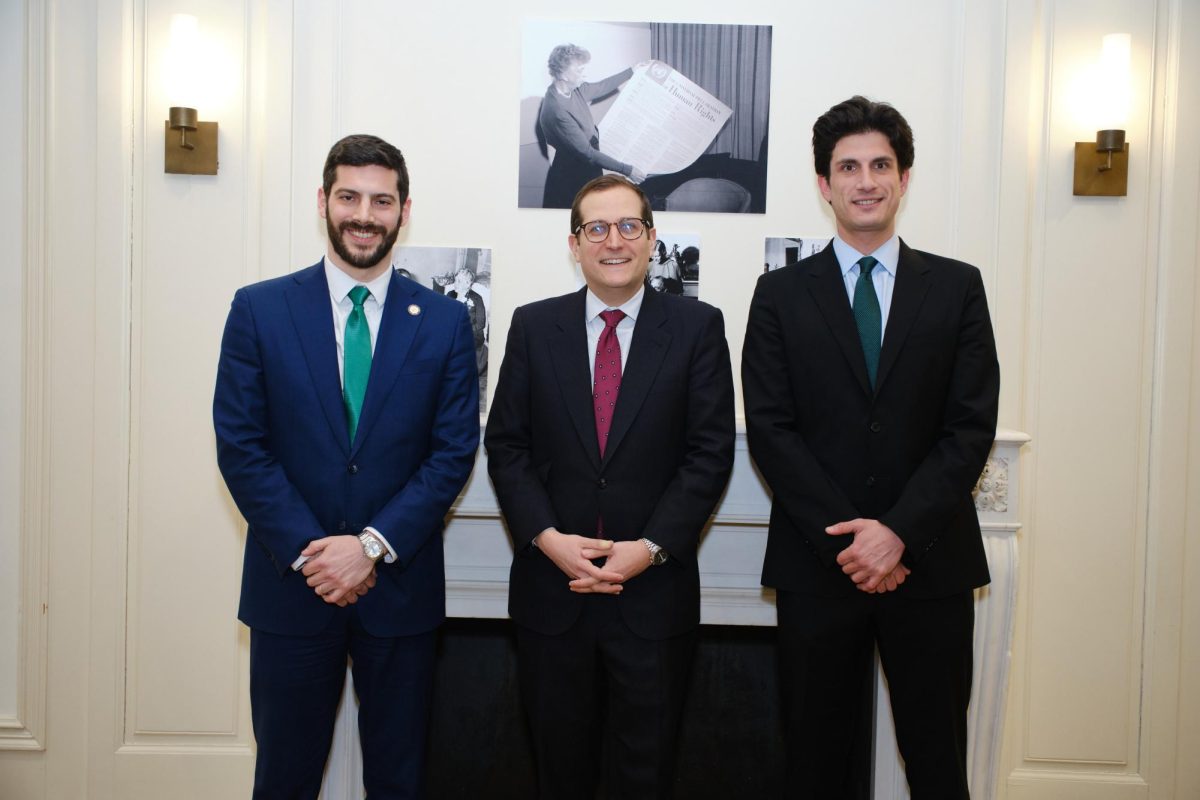
Three leading candidates in the coming election for New York’s 12th congressional district (NY-12) found common ground at an environmentalist forum on March 17: East Side assemblymember Alex Bores, West Side assemblymember Micah Lasher and political commentator Jack Schlossberg.
NY-12 represents central Manhattan, including Fordham’s Lincoln Center campus.
Transportation
All the candidates agreed on the success of congestion pricing and advocated for solar and wind energy over nuclear power (while not ruling out the latter as an alternative). They also supported expansions to public transportation, such as the Second Avenue subway project.
The Second Avenue subway is an ongoing Manhattan transit expansion. Phase one extended the Q line up to 96th Street, costing $4.45 billion. Phase two would cost an estimated $7.7 billion, $3.4 billion provided by a federal government grant. In August 2025, the project’s tunneling contract was approved to extend the line up to a new station at Lexington Ave and 125th Street, adding stations at 106th Street and 116th Street.
The candidates were later asked if they thought the Democratic party’s recent push to ban gerrymandering was a “tactical mistake.” While none of the three said it was, they did offer slightly different perspectives on the issue.
The Metropolitan Transportation Authority (MTA) sued the federal government on March 17, alleging that it is wrongfully withholding $58.6 million in funding for the project. The MTA announced plans to move forward with the project despite the ongoing lawsuit.
When asked what reforms candidates would support to get transportation projects built effectively and within a reasonable budget, Lasher said he would advocate for design-build (a method in which design and construction are contracted to a single company) and increasing in-house MTA staff on engineering design and construction. Bores concurred and said that the MTA has historically spent more money on outside consultants than engineers on several projects. He also declared his desire to join the House Committee on Transportation and Infrastructure should he be elected.
Gerrymandering and Federal Policies
The candidates were later asked if they thought the Democratic party’s recent push to ban gerrymandering was a “tactical mistake.” While none of the three said it was, they did offer slightly different perspectives on the issue.
Schlossberg took a hard stance against gerrymandering. Bores and Lasher argued that, given the ongoing political redistricting in many Republican states, they must “fight fire with fire” now and only implement a national ban on gerrymandering after the midterm elections are over. Both Bores and Lasher said the stakes are particularly high given the razor-thin Republican majority in the House now and what they deemed to be aggressive political tactics encouraged by the Trump administration.
Another major point regarding the federal government, which emerged unanimously, was the challenges posed by the Trump administration’s environmental policy decisions. President Donald Trump’s second term has seen rollbacks on government regulations of fossil fuels and pollution, as well as increased focus on oil and gas over clean energy. Government funding for environmentalist projects in New York City will be difficult to obtain, the candidates said.
The SPEED Act
The Standardizing Permitting and Expediting Economic Development (SPEED) Act, which was passed by the House in December 2025, aims to streamline environmental reviews of infrastructure projects. It limits the scope and scale of such reviews by the National Environmental Policy Act (NEPA), introduces litigation caps and regulates what projects must undergo full NEPA review.
Bores and Lasher both said they would have voted no on the SPEED Act if they had been in office. While both are supporters of permitting reform, neither saw the SPEED Act as the right strategy. Several environmentalist groups have spoken out against the bill, saying it expedites the approval process for fossil fuel infrastructure projects, a concern shared by the candidates. Schlossberg also opposed the bill and held a slightly more ardent stance for stringent environmental reviews than his counterparts.
However, after being prompted by Dan Rivoli, a moderator and political reporter with NY1, about his financial disclosure documents, Schlossberg revealed he inherited an investment in an oil well in Oklahoma, although he said he cannot sell the oil.
While answering a question about the SPEED Act, Bores harkened back to a point Schlossberg made earlier in the forum: The future of environmentalism is in new, large-scale infrastructure developments as opposed to an older model focused on conservation and stopping harmful developments. Bores agreed and said that permitting reform must distinguish between different types of infrastructure projects to streamline reviews for clean energy initiatives, while not allowing oil and gas companies to take advantage of deregulation.
Public Housing
The candidates’ public housing discussion centered around the New York City Housing Authority’s plan to tear down and replace the Fulton and Elliot-Chelsea houses. The decision came after decades of neglect, which caused deep structural issues to the buildings and was quite controversial, sparking protests and lawsuits from some tenants. An appeals court temporarily halted the demolition in February in response to one suit.
Schlossberg said that after attending tenant meetings, he can no longer fully support the plan, but agreed on the importance of building new housing and emphasized the complexity of the issue. Lasher disagreed and said “there is no viable near-term alternative plan” to solve the problems in the buildings, as they would require incredibly costly, difficult renovations.
Personal Oil and Gas Investments
Another point of contention emerged during the lightning round when candidates were asked if they own stocks in oil and gas. All initially answered no. However, after being prompted by Dan Rivoli, a moderator and political reporter with NY1, about his financial disclosure documents, Schlossberg revealed he inherited an investment in an oil well in Oklahoma, although he said he cannot sell the oil. Schlossberg is the grandson of John F. Kennedy and inherited the investment from that side of his family.
When Rivoli asked him about his stocks in Exxon and Hess, two major oil companies, Schlossberg said he no longer owns them. He justified his decision by saying he does not think it is a “bad thing for someone to understand how private markets work in (the) energy (industry).”
Schlossberg emphasized that his campaign financing is composed of small donor contributions and that he does not accept money from corporate political action committees (PACs), super PACs or billionaires.
“I think the most important question that you should want to know is not whether or not I used to own stock because I knew that the war in Ukraine would send oil prices up and I’m very interested in energy, I think it’s what money is funding my campaign,” Schlossberg said.
Schlossberg emphasized that his campaign financing is composed of small donor contributions and that he does not accept money from corporate political action committees (PACs), super PACs or billionaires.
Bores said he avoids investing in index funds due to potential exposure to oil and gas companies and has taken extra steps to divest from them. Lasher said he has some target-date index funds through his 401(k).
Also in the lightning round, Schlossberg said he supports the Williams pipeline (or the Northeast Supply Enhancement Project) which would expand the existing natural gas pipeline. Bores and Lasher said they do not support the project.
Hudson and East River Clean Up
Despite some disagreements, the forum had a congenial atmosphere and several lighthearted moments, such as when Schlossberg discussed his hobby of paddleboarding in the Hudson River during a question on clean-up projects in the Hudson and East rivers. All the candidates supported greater investment in such programs.
Lasher cited combined sewer overflow as the biggest challenge to such a project and acknowledged the necessity for state and federal involvement, as New York City is downstream of the rivers’ flows. Nonetheless, the candidates expressed optimism for the possibility of clean up, with Lasher citing the PlusPool project — a series of netted, swimmable pools in the Hudson in the early 20th century — as an ideal goal for what the Hudson could one day become.
Student Civic Participation
In an interview with The Observer after the forum, Bores reflected on how solving environmental problems requires long-term solutions, which young people (including Fordham students) will feel the effects of for many years to come.
“You’re going to have to live with the decisions on the environment far longer than most, and so we need people who are thinking, who are forward-looking in terms of not just what the budget will look like in one year or two years, but how we can solve this problem over the long term,” Bores said.
Lasher shared a somewhat similar hope that Fordham students “see themselves as full participants in this election” and exercise their voting rights.
Bores reflected on his participation in an artificial intelligence summit at Fordham University School of Law and said he has been “so thrilled by Fordham students’ ability to bring both data and policy with a deep values alignment that isn’t always shared at every campus, and so I guess the one thing I would say is please get involved.”
Lasher shared a somewhat similar hope that Fordham students “see themselves as full participants in this election” and exercise their voting rights.
Looking Forward
The democratic primary will take place on June 23, with early voting opening between June 13 and 21, ahead of the general election on Nov. 3.
The NY-12 seat is being vacated by retiring Representative Jerry Nadler, who endorsed Lasher, his former longtime aide, in February. Lasher was also endorsed by former Mayor Michael Bloomberg.
Bores has received endorsements from former NY-12 congresswoman Carolyn Maloney and other New York state assemblymembers, while Schlossberg was endorsed by Representative and former Speaker of the House Nancy Pelosi.
The primary is a crowded field so far, with over a dozen candidates including George Conway, former Republican attorney and now Trump critic. Conway was not invited to the forum but attended a reception afterward.
Laura Dunn, a candidate and attorney, passed out campaign fliers in front of Roosevelt House before the forum began. Around the same time, Schlossberg arrived at the venue, stopping to hug a small group of supporters carrying signs that read “Jack for New York” and “No PAC Jack.”
According to organizers, candidates either had to have raised at least $250,000 as of the last filing or be an elected official to be invited.
The event, held at Roosevelt House, was co-hosted by Hunter College and the New York League of Conservation Voters Education Fund, a nonprofit dedicated to educating New Yorkers about environmental issues and advocating for civic reform.