

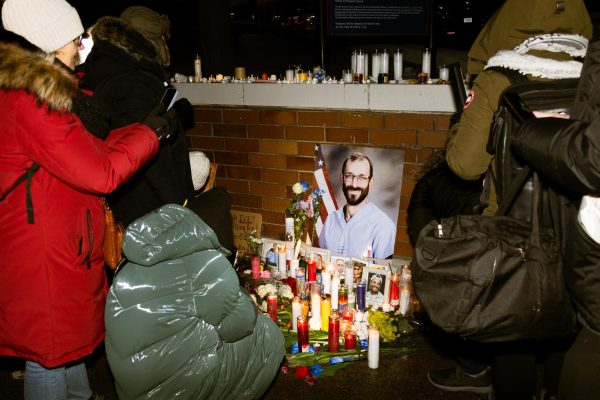
In the week following Alex Pretti’s fatal shooting by two Customs and Border Protection agents on Jan. 24 in Minneapolis, New Yorkers gathered in frigid temperatures to honor Pretti’s memory and demand “ICE Out.”
Pretti, a 37-year-old nurse for the United States Department of Veteran Affairs (VA), was seen filming the agents and standing between them and a fellow protestor who had been pushed to the ground. Pretti was then wrestled to the ground and shot. Homeland Security Secretary Kristi Noem said in a statement following the incident that Pretti had been “brandishing” a gun, which has been disproven by multiple eyewitness videos. Pretti was a legal gun carrier, and his weapon was removed by the agents before he was shot. The two agents involved have been placed on leave in an ongoing internal investigation by the Department of Homeland Security (DHS).
Pretti’s death follows almost a month of upheaval in Minnesota, including the death of Renee Good, a 37-year-old poet and mother of three, on Jan. 7, among several other violent altercations between citizens and CBP agents. Multiple other people have died in 2026 in Immigration and Customs Enforcement (ICE) custody and in detention centers. ICE’s aggressive conduct toward protestors, wrongful detainments of U.S. citizens and warrantless arrests have sparked backlash across the nation.
Pretti’s family released a statement in hopes of “get(ting) the truth out about (their) son,” who they called a “hero.”
I cried a few times. I always do. I always feel very moved by community and solidarity.,cite> Francesca Williams, FCLC ’28
“We are heartbroken but also very angry. Alex was a kindhearted soul who cared deeply for his family and friends and also the American veterans whom he cared for as an ICU (intensive care unit) nurse at the Minneapolis VA (Veterans Affairs) hospital. … I do not throw around the hero term lightly. However his last thought and act was to protect a woman,” the statement said.
On Jan. 30 and 31, several student groups at the University of Minnesota led an “ICE Out of Everywhere National Day of Action,” involving student walkouts across the country. In New York City, thousands of students gathered in Foley Square on Jan. 30 and marched to Washington Square Park.
Francesca Williams, Fordham College at Lincoln Center ’28, attended the protest with some friends, fellow Fordham students. She grew up in Mexico, so the topic of immigration is “very close to (her) heart.” Williams said she has attended many similar demonstrations over the last month, but this one stood out to her because of the volume and youth of those in attendance.
“(This protest) just felt so much bigger. … The students being there was specifically what really got to me because they’re kids. They’re 13- to 17-year-old kids. They’re all very young, and seeing them chant as loud as they possibly can … they’re mad. You know when kids are mad about something, that something is wrong,” Williams said. “I cried a few times. I always do. I always feel very moved by community and solidarity.”
Maintaining morale through community was a sentiment widely shared by activists and organizers at various demonstrations. Ashley Gonzalez-Grissom, special projects coordinator at the Episcopal Diocese of New York, has been deeply engaged with migrant advocacy through her work organizing the Diocese’s public affairs work, and concurred. She was in Minneapolis — which she described as an “occupied city” — last week on behalf of the Diocese to show solidarity for demonstrators and support some local mutual aid programs. Gonzalez-Grissom said ICE’s presence has “seeped into every aspect of life” for the citizens of Minneapolis and that there is an “overall sense of heaviness” in the city.
There’s this looming sense of, ‘At what moment might I just see someone get ripped from their car?’ Ashley Gonzalez-Grissom, Special Projects Coordinator for the Episcopal Diocese of New York
“Kids aren’t going to school. Parents are patrolling schools during school hours in order to keep their kids safe. People have been trapped in their homes for months because they’re scared to leave. I don’t think that there is one person in Minneapolis that’s not engaged in some way,” Gonzalez-Grissom said. “There’s this looming sense of, ‘At what moment might I just see someone get ripped from their car?’”
The overall experience was, she said, “unlike anything (she had) ever experienced before.” However, Gonzalez-Grissom added, she was “really impressed by the sense of neighborliness.” While working with a mutual aid organization, she saw someone walk in every 10 minutes to offer donations, groceries and other necessities.
“Neighbors were just walking in constantly being like, ‘What do you need me to do? How can I help?’ and offering themselves up. That was really beautiful,” Gonzalez-Grissom said.
The day before the student walkout on Jan. 29, various labor unions, including those representing VA nurses like Pretti, organized a vigil in front of the Manhattan VA. Around 1,000 people showed up, many of whom were nurses wearing red hats and scarves marking them as part of the New York State Nurses Association. Many attendees bore signs with statements like “Defund ICE. Defund greed. Protect nurses,” “Care not Cages” and “ICE is Trump’s Gestapo.” The organizers passed out hand warmers, whistles, glow sticks and candles for the hour-long evening vigil. A makeshift memorial was set up in front of the hospital with photos of ICE victims, flowers and hundreds of candles.
Alex Pretti was one of those caretakers. In his last moments, he chose to put himself in harm’s way at the defense of another. In our community, that is one of the most honorable things one can do in their life. Michael Matos, President of 5 Borough Veterans
New York City Public Advocate Jumaane Williams, union leaders, healthcare workers and migrants’ rights activists delivered speeches about Pretti and the change they would like to see.
Michael Matos, a veteran and president of 5 Borough Veterans (an organization dedicated to supporting veterans and their families’ public voice), receives essential care from nurses at the Manhattan VA hospital. Matos said his experience serving in the U.S. Coast Guard — the only military branch under the DHS — informs his perspective on Pretti’s death and his view that there is a “better way forward” to reform the DHS and replace ICE raids with civil processes.
“(Nurses) are caretakers. They mean as much to us (veterans) as those who we stood shoulder to shoulder with when this nation called upon us to defend it. Alex Pretti was one of those caretakers. In his last moments, he chose to put himself in harm’s way at the defense of another. In our community, that is one of the most honorable things one can do in their life,” Matos said.
The crowd interrupted Matos’ speech, echoing his calls for justice with cries of “shame” and “murder,” as they would at several other points throughout the night.
We veterans took an oath to support and defend the Constitution, and that Constitution belongs to each and every one of you: not a masked agent, not a government agency and not a sitting president. Michael Matos, President of 5 Borough Veterans
“We veterans took an oath to support and defend the Constitution, and that Constitution belongs to each and every one of you: not a masked agent, not a government agency and not a sitting president,” Matos said. “But to survive as a constitutional nation, ICE must be shut down.”
Audrey Seeley, a nurse, union member and veteran of the U.S. Army Nurse Corps, followed Matos’ words. Seeley’s speech was emblematic of the shared sentiment of the night, which supported both immigrants and the ongoing New York City nurses’ strike. A study by the New York City Healthcare Department found that 47% of healthcare workers and technicians in the city are immigrants.
“Despite their service to their communities, they are under attack by the federal government. Next week, almost 350,000 Haitians will lose their temporary protection status, including their means for caring for patients in this country,” Seeley said. “Tonight, we remember Alex, but tomorrow, we will organize; we will resist.”
Seeley referred to a decision made last year by the federal government to end Temporary Protected Status — an immigration status provided to those fleeing armed conflict or natural disasters — for countries including Haiti, Venezuela and Afghanistan. Several healthcare workers have filed a lawsuit for Haitians to retain their protected status. The decision could result in the deportations of the approximately 50,000 migrants with protected status working in healthcare. The DHS has argued that this status, which is meant to be temporary but can be renewed if conditions in someone’s country of origin remain unsafe, has become an indefinite benefit. On Feb. 3, a federal judge ruled to halt the termination — which would’ve taken effect that day — while the lawsuit proceeds.
Meanwhile, even closer to Fordham, people from various faith-based organizations have been gathering every Monday from 5:30-6 p.m. at Columbus Circle to bear witness to what the group said they view as threats to democracy in America. Each week, 50-100 attendees sing songs, pray and receive a call to action.
Brennan Peacore-Brink is the director for Migrant Outreach at the Interfaith Center of New York, a secular nonprofit dedicated to connecting multifaith and civil organizations for grassroots advocacy. He helps organize the Monday vigils and said they have never “felt more important than in the last month.” A recent vigil on Jan. 26 specifically advocated against ICE in response to Pretti’s death and ICE’s other acts of violence. Attendees chanted statements like “Stop funding ICE.”
We need to look around at our communities, at our neighbors, and build strong, bottom-up people power. … The power we can build by doing that is profound and can stand up to the power (of the federal government). Brennan Peacore-Brink, Director for Migrant Outreach at the Interfaith Center of New York
“Hey ICE, your ancestors are watching and they’re horrified. Hey ICE, take off your mask and be identified. Hey ICE, we people here are unified. We don’t want you. We don’t support you. Hey ICE, how will God forgive you?” said one song.
Despite the somber mood at the vigil, Peacore-Brink shared in a later interview that, at every demonstration he has attended, the people he saw felt anger or “despair or righteous indignation or sadness, but the one unifying feeling — that every single person had at least a sliver of — was hope.”
“ICE has not historically been around for all that long. There will be classmates at Fordham who are older than ICE, and so it’s totally within our power to either abolish ICE or find a way for ICE to be an enforcement agency that acts with less cruelty,” Peacore-Brink said. “We need to look around at our communities, at our neighbors, and build strong, bottom-up people power. … The power we can build by doing that is profound and can stand up to the power (of the federal government).”
Since Pretti’s death, Gregory Bovino, the Border Patrol commander who was in charge of operations in Minneapolis, has been removed from the city and will be replaced by “border czar” Tom Hozman. Nonetheless, the Trump administration has continued to defend ICE’s actions in Minnesota, with a report by the DHS saying ICE has arrested over 10,000 “dangerous criminal aliens.”
Contention over DHS spending and restrictions on ICE caused the federal government to partially shut down this past weekend. It reopened on Feb. 3 after the House voted to pass a government spending plan providing funding for several major departments for the rest of the fiscal year, and a two-week measure to keep the DHS funded. Lawmakers in both chambers must agree on a deal by Feb. 13 to maintain DHS funding. This may prove difficult as disagreements continue over Democrats’ demands to require ICE agents to wear body cameras, identify themselves and obtain warrants for enforcement operations.