The Trump administration implemented the Migrant Protection Protocol (MPP) or “Remain in Mexico” policy in January 2019, which required non-Mexican asylum seekers who crossed the U.S.-Mexico border to return to Mexico to await immigration court hearings.
Skidmore College teaching professor and border studies expert Diana Barnes traveled to Ciudad Juárez, Mexico, in August of 2019 with the hope of giving some of the youngest asylum seekers trapped in Juárez a fun day — a chance to just be kids amid trauma and uncertainty. Local children’s author and World Organization for Peace representative Lucero de Alva organized the project to take place at the Rodadora Interactive Space in Juárez, a nonprofit organization and museum where young migrants staying in shelters could play, eat pizza and make art.
El Paso muralist and graffiti artist Jesús “Cimi” Alvarado crossed the border into Juárez alongside Barnes, armed with plenty of paints, palettes and canvases to give kids the opportunity to paint their experiences based on a single question posed by Alvarado: “¿Qué opinas de la frontera?” (“What do you think of the border?”).
“You’re here at the border … you’ve left your grandparents, you’ve left your bed … you’ve left your friends, your teachers, your classroom, the grass outside your house … and then you walked and walked … people spat at you, and they didn’t like you … they told you you had an awful accent. They told you they knew you didn’t belong there. You got robbed, you had to run away and hide … (and) behind that question is, and now you’re at the border. Well, what do you think about all this? Without saying all of those things,” Barnes said.
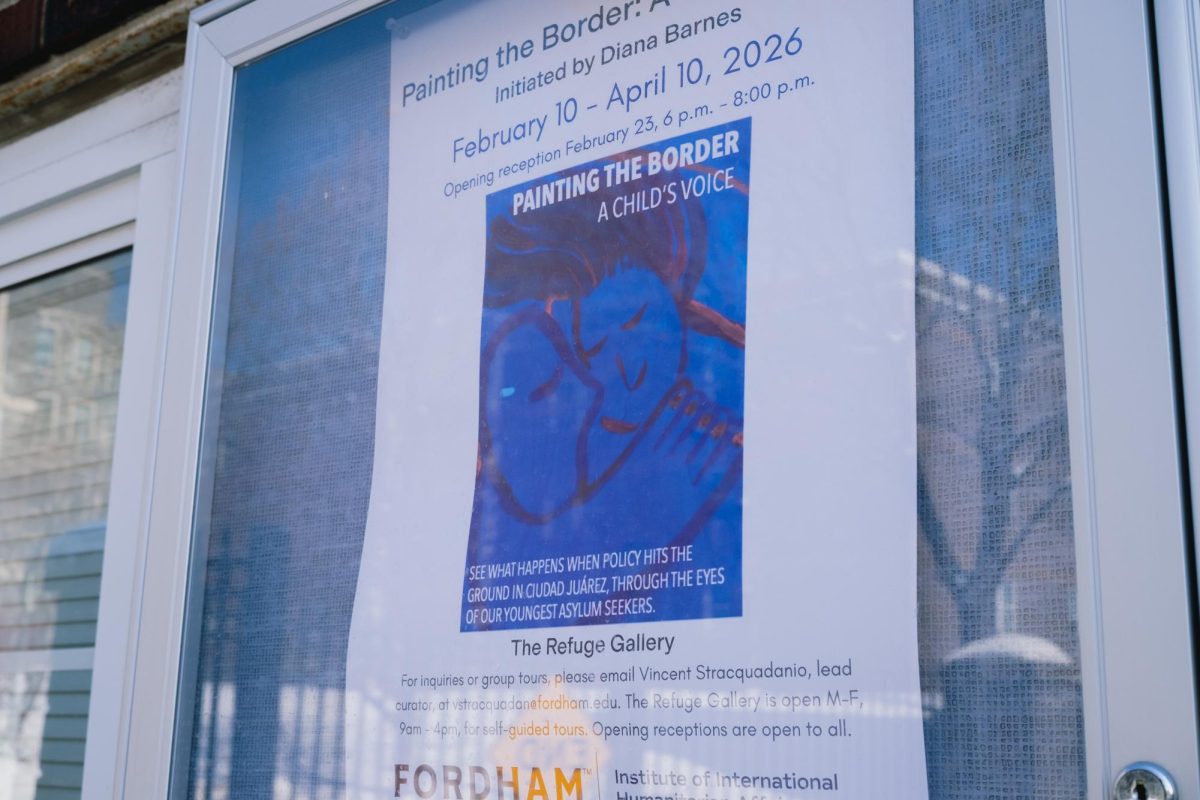
Their paintings and short written responses became the traveling exhibit “Painting the Border: A Child’s Voice,” curated by Barnes with the help of her students at Skidmore College, who translated the descriptions into English and gave the exhibit its name.
In response to Alvarado’s question, 33 young migrants, ages four to 21, most of whom had come from Guatemala, Nicaragua, Honduras and El Salvador painted their stories, feelings and experiences from both sides of the border. Their paintings and short written responses became the traveling exhibit “Painting the Border: A Child’s Voice,” curated by Barnes with the help of her students at Skidmore College, who translated the descriptions into English and gave the exhibit its name.
“To have a student take the words of a child … and be charged with conjugating the verbs, and using the appropriate vocabulary, is really important. It’s a big responsibility, and I felt like the students really did take it very seriously,” Barnes said.
The exhibit is currently on view at the Institute of International Humanitarian Affairs (IIHA) Refuge Gallery, located in Canisius Hall at Fordham College at Rose Hill (FCRH).
“What happens with this exhibit … is you have practice that evolves into theory that evolves into practice,” Barnes said on the functionality of art.
I am happy in this museum and that’s why I have a smile but outside of the museum I am not happy José, 4
She explained the process began with the practice of giving a child the means to tell their story under extremely traumatic circumstances — with gentle guidance from Alvarado, who explained the power of a paintbrush. Those stories came to fruition through the paintings they created.
Barnes then brought the paintings back to the United States to be curated, which “was a mesmerizing concept to the children, because they could not cross, but I promised that their stories would cross, and I would tell their stories,” Barnes said.
The project took place on Aug. 21, 2019, less than three weeks after a gunman opened fire in an El Paso Walmart, killing 23 people in an attack targeting Mexican shoppers. Some of the young artists were aware of the attack and referenced the violence in their paintings.
“My drawing represents Mexicans trying to get to a better place in their lives, but what is sad is that there are people who discriminate against them, mentally ill people, who are killing them,” wrote Brithany, then 18 years old.
Her painting depicted migrants on either side of the border wall, with some attempting to swim across the Rio Grande River, which flows through both Mexico and the United States and has claimed the lives of thousands of migrants since 1998. On the U.S. side of the wall, Brithany portrayed the El Paso shooting, painting small figures of gunmen and victims covered in blood against a background of tall buildings.
Confusion, confusion. The black heart represents the sadness for my mom who is still in Guatemala, ‘G.’ And the red heart represents the happiness that I have while being in Mexico Alejandra, 12
“Painting the Border” is organized in three sections: “Nuestra Realidad” (“Our Reality”), “La Esperanza” (“Hope”) and “El Viaje” (“Journey”). Some of the paintings capture excitement and hope for a better future, others express the pain of leaving home, but many fall in between.
“I am happy in this museum and that’s why I have a smile but outside of the museum I am not happy,” José wrote, who was four years old at the time.
Alejandra, a 12-year-old from Guatemala, represented the complexity of her emotions through a black and red heart with a “G” and “M” written on either side.
“Confusion, confusion. The black heart represents the sadness for my mom who is still in Guatemala, ‘G.’ And the red heart represents the happiness that I have while being in Mexico,” she wrote.
When the exhibit debuted at Skidmore College’s case gallery in 2019 in the throes of the Trump Administration’s MPP, the student response was incredibly strong, with hundreds coming to view the gallery.
“People really wanted to know what was going on at the border, and so many students came through there. … I would find them just sitting in there every day, just sitting, looking at the paintings. It had a tremendous impact on them,” Barnes said.
“Painting the Border: A Child’s Voice,” has since traveled to various galleries throughout the Northeast, and its message remains poignant in the midst of the second Trump Administration’s attacks on migrants.
“The essence of division … it is still very much alive, and these paintings are still very relevant. I don’t know if the children are in this country. I don’t know if they went back to their home country. What I do know is that their stories continue to be told,” Barnes said.
“Painting the Border: A Child’s Voice” is on view at the IIHA Refuge Gallery in Canisius Hall, Fordham Rose Hill, until April 10.