
Almost 100 members of the Fordham and St. Nicholas of Tolentine Church communities gathered for a prayer procession to bear witness to the suffering of immigrants and advocate for their protection through prayers, songs and testimonies on Nov. 13. The procession moved from Fordham’s Rose Hill campus to the St. Nicholas of Tolentine Church, passing an Immigrations and Customs Enforcement (ICE) facility on their way.
The event began at 5:30 p.m. at the University Church Plaza with scripture readings and opening prayers, including the first of five decades of the rosary given alternately in English and Spanish. A decade of the rosary consists of an Our Father, 10 Hail Marys, Glory Be and a Fatima Prayer, recited while meditating on a specific mystery of Jesus’ life. Members of Campus Ministry, professors and several Fordham students were in attendance, with a leader beginning each prayer and everyone reciting the second half together.
The procession then walked off campus to Fordham Plaza, where they were joined by a much larger group of parishioners from St. Nicholas of Tolentine, rousing cheers and embraces. The group held signs, rosaries and flameless candles aloft, bearing messages like “Jesus was a refugee,” “Somos una nación de inmigrantes” (“We are a nation of immigrants”) and Bible verses. People of all ages attended despite the cold weather, far exceeding the turnout the organizers were expecting.
“(The procession) wasn’t loud, but (with) our presence walking through the community, we say, ‘Please have mercy, and please stop this. It’s time.’ And whoever is living in this situation at least sees ‘Someone is walking with me. I’m not alone.’” Juan de la Rosa, Director of the food pantry and soup kitchen at St. Nicholas of Tolentine
Diego Lopez, an attendee and Fordham College at Lincoln Center ’26, described the atmosphere of the event as “beautiful, very reverent, very prayerful.”
Juan de la Rosa is the director of the food pantry and soup kitchen at St. Nicholas of Tolentine — which serves over 600 families — and is an immigrant himself from the Dominican Republic. He delivered a testimony during the procession. Later, he spoke to the significance of the procession given the climate of fear across his parish, many of whom are undocumented, due to the Trump administration’s crackdown on immigration.
“I would say 70% (of the parish) are immigrants, and most of them are undocumented, and they are living in fear. They don’t want to go into the church because they have fear that ICE can take them,” de la Rosa said. “(The procession) wasn’t loud, but (with) our presence walking through the community, we say, ‘Please have mercy, and please stop this. It’s time.’ And whoever is living in this situation at least sees ‘Someone is walking with me. I’m not alone.’”
“We are truly one family, and we are responsible for each other. It is not in my power to change the horrors of what is happening, but it is in my power to care, to pay attention, to create relationships, to be together.” AnnaMarie Pacione, FCRH ’26
Despite this, de la Rosa remained hopeful about the future and shared a message of unity and solidarity.
“We’ve got to make sure that we cry together, we laugh together, and we’re going to celebrate our victory together. We’re going to see it, that’s our hope. We’re going to see it,” de la Rosa said. “We are together in this. … I’m not going to (just) speak for me, I’m going to speak for my community. And if I have bread, I’ve got to share it with them, and if I have documents, I’ve got to share my documents with them. I’ve got to take care of them.”
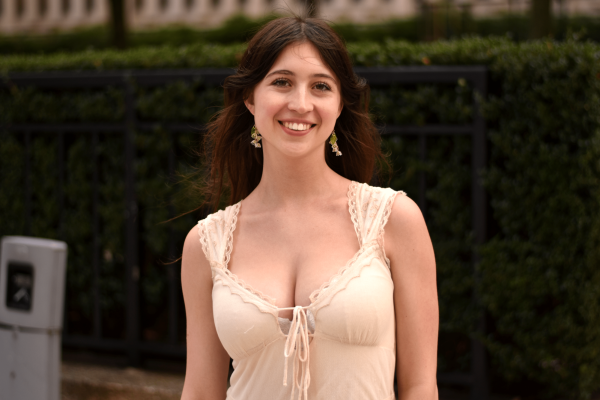
AnnaMarie Pacione, Fordham College at Rose Hill (FCRH) ’26, helped organize the demonstration. She echoed the importance of solidarity and said that, while it may seem “silly or small to just gather and to pray and walk together, (she) think(s) that is a facilitator for hope and for community and for faith, which is needed right now.”
“We are truly one family, and we are responsible for each other. It is not in my power to change the horrors of what is happening, but it is in my power to care, to pay attention, to create relationships, to be together,” Pacione said.
“(I feel) frustrated because sometimes the only thing that we have — and it is powerful, don’t misunderstand – (but) the only thing we have is prayer.” Juan de la Rosa, Director of the food pantry and soup kitchen at St. Nicholas of Tolentine
De la Rosa shared a similar perspective on the power of prayer. As a parish leader, he is keenly aware that, while he can offer his parishioners reassurance, they are all still subject to federal immigration policies. This does not, however, diminish the value of hope, he said.
“(I feel) frustrated because sometimes the only thing that we have — and it is powerful, don’t misunderstand – (but) the only thing we have is prayer,” de la Rosa said. “But this is powerful, and we have hope that God is with us, and as a leader, I’ve got to transmit to them the hope that we have in God, and we’re going to continue fighting until we have the right answer.”
Pacione also reflected on the relatively small turnout of Fordham students compared to those from St. Nicholas of Tolentine.
“There were way more people from the parish than Fordham students, and those are people that are at high risk, so what does that say to our community, of our need to show up as allies, as people that don’t need to worry about our citizenship status? I think it’s a call to action for us to put ourselves on the line more,” Pacione said.
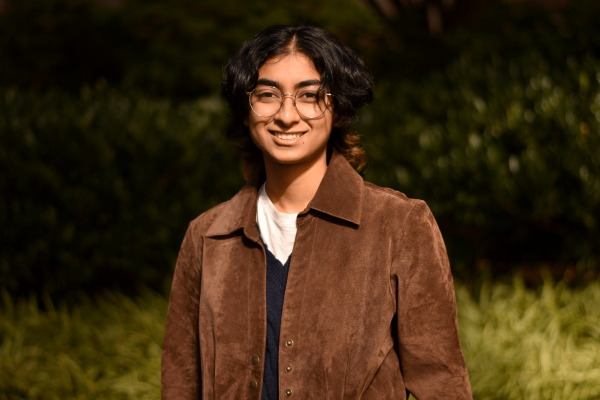
Anne-Sophie Gray, FCRH ’28, attended the procession and said it was “absolutely beautiful.” She had already been planning to attend when she was asked by Pacione to come and “bring (her) guitar to strum along to some of the songs that they were going to be singing.”
“I was kind of planning on coming because I come from an immigrant family, so I get it. I have family that’s just applied for asylum and all this, so I want to stay involved, stay supportive,” Gray said. “I think it’s horrible that we’ve got ICE picking up people right outside our campus, and a lot of people don’t know about it.”
The procession paused in front of an Intensive Supervision Appearance Program (ISAP) facility located beside the Rose Hill campus. The facility provides routine check-ins for immigrants and has reminded Fordham community members of the current crackdown. This is part of a nationwide trend of ICE arrests being conducted with unprecedented frequency, such as during check-in meetings for migrants seeking asylum.
As the group walked, they sang songs like “Una Mirada de Fe” (“A Glimpse of Faith”) and “Santa Maria del Camino” (commonly translated in English to “Come as We Journey”). The latter was part of the program, while the former was unplanned. “Santa Maria del Camino” is an uplifting hymn reflecting the ethos of the procession: to show people that they are not alone. The lyrics preach that Mary walks alongside every person throughout their lives and includes a call to action to fight for a better, more just world.
“We oppose the indiscriminate mass deportation of people. We pray for an end to dehumanizing rhetoric and violence, whether directed at immigrants or at law enforcement.” USCCB Statement
The procession concluded around 7:30 p.m. at the St. Nicholas of Tolentine Church, where group songs and prayers continued well into the evening.
The event was part of a broader Catholic reaction to recent mass deportations. At this year’s United States Conference of Catholic Bishops’ (USCCB) plenary assembly held from Nov. 10 to 13 in Maryland, immigration was a central focus. The bishops elected a new president and vice president, both of whom have been outspoken in favor of better treatment of immigrants and announced a “You Are Not Alone” migrant initiative focused on accompaniment.
Most notably, they voted almost unanimously to issue a “Special Message” (which can only be issued during plenary assemblies with a two-thirds vote) on immigration on Nov. 12. The rare statement is the first since 2013, when the bishops critiqued a federal mandate requiring all employers to include contraceptives in employee healthcare plans as part of the Affordable Care Act.
“We bishops advocate for a meaningful reform of our nation’s immigration laws and procedures. Human dignity and national security are not in conflict,” the statement said. “We oppose the indiscriminate mass deportation of people. We pray for an end to dehumanizing rhetoric and violence, whether directed at immigrants or at law enforcement.”
Carol Gibney, Director of Campus Ministry for Solidarity and Leadership, also helped organize the event and reflected on the Church’s response thus far.
“I honestly have been saddened by the silence. The silence is deafening. And so I’m very happy now that there’s more of a movement to … ask officials in the church to begin to be not silent,” Gibney said. “At Campus Ministry, we take it very seriously, our call to action. Love is an action word, it’s not something that is (for) bystanders and quiet.”
As a campus minister, Gibney gives pastoral counseling, during which she said she has spoken with Fordham students and staff that “have been affected and are afraid.” She characterized the ongoing mass deportations as “barbaric” and emphasized the importance of “visibility, imagination and dialogue” in response.
“Visibility: to not look away at these images that are painful and the reality of what’s happening to people and how people are treating others. Imagination: imagine what it’s like to be in someone’s footsteps that doesn’t have papers and documents and how fearful that is. And imagine what it would be like on the flip side to have communities that are more accepting and loving. … And dialogue: to talk about it and … invite our leaders, our elected leaders and our church leaders, to take action,” Gibney said.
Per this call, Gibney led a letter-writing campaign from 3:30 p.m. to 5:00 p.m. on Nov. 13 at the McShane Student Center. Students were provided postcards to send to congressmembers, senators, the USCCB or the Archdiocese of New York, urging them to take stronger action toward the just and humane treatment of migrants.
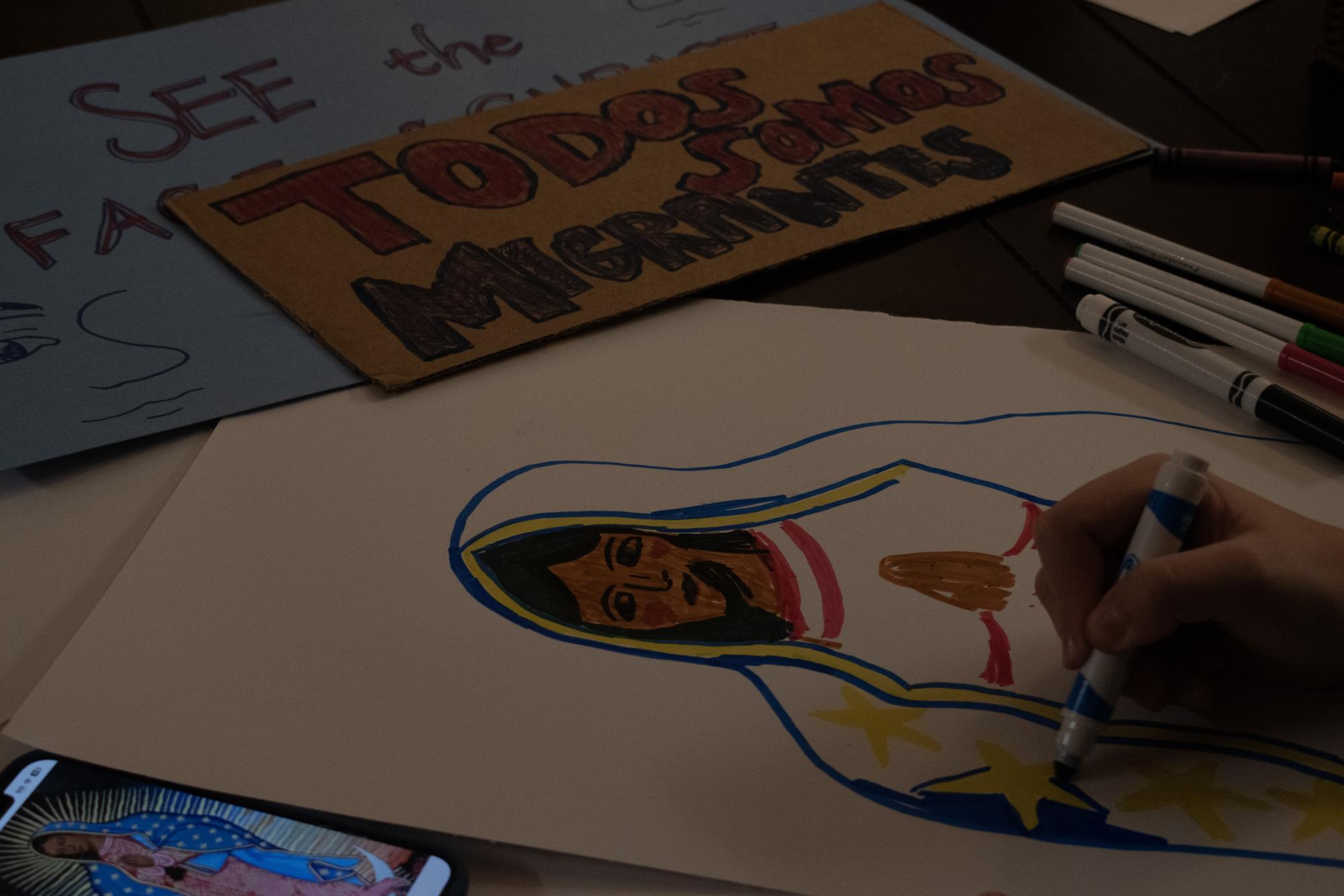
There were also two sign-making events leading up to the procession. The first was on Nov. 11, and the second was at 4:30 p.m. on Nov. 13, right before the event began in the basement of the university church.
The procession was part of a broader “One Church, One Family” movement building on the Oct. 12 binational mass at the U.S.-Mexico border in San Luis. Religious communities and institutions across the nation participated in public days of witness on Oct. 22 and Nov. 13 — the feast day of Saint Frances Cabrini, patron saint of migrants. At Fordham, there was a small rosary vigil on the Rose Hill campus on Oct. 22.
Big or small, the events all speak to solidarity between Catholic and immigrant communities, and a call for government and church officials to protect immigrants.