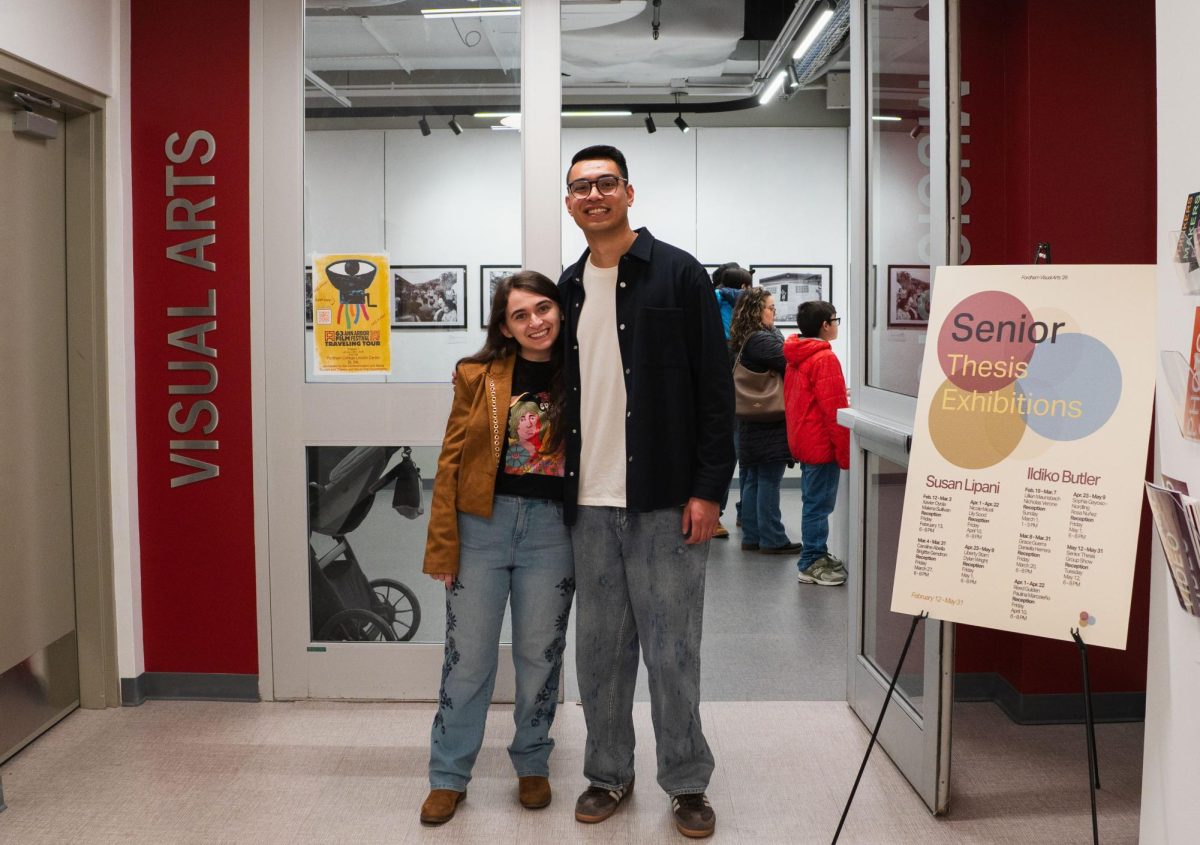
On a Friday evening, gentle chatter is reverberating through the visual arts complex. In the Susan B. Lipani Gallery, painters mingle with animators, instructors reconnect with former students and artists of the hour Malena Sullivan and Xavier Oyola chat animatedly with family and friends. The pair seems energized, and for good reason; tonight, their senior theses have been presented publicly for the first time.
In keeping with departmental tradition, a handful of student-artists in the class of 2026 are slated to display their work in Senior Thesis Exhibitions, the culmination of many months’ worth of coursework mounted in either the Ildiko Butler or Lipani Galleries. Sullivan and Oyola, both FCRH ’26, are two of the emerging artists who will, in due time, enjoy similar celebrations during the months of March, April and May. (The final event of the season will take the shape of a group show scheduled for commencement weekend, in which all participants are featured.)
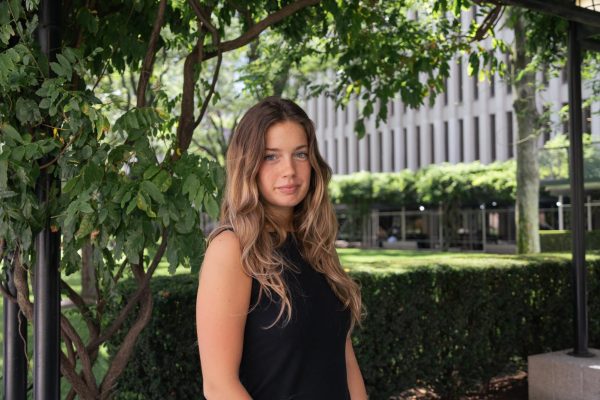
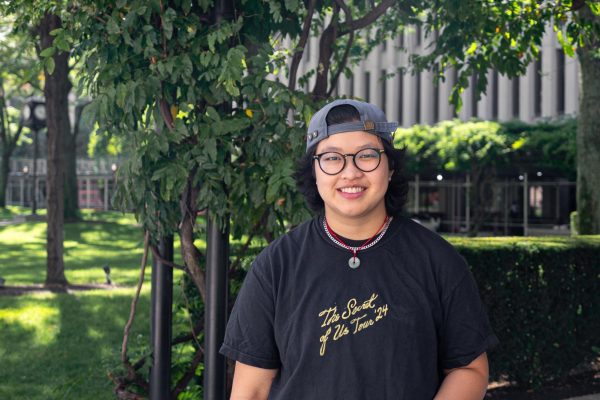
For Lillian Maunsbacher, a senior double majoring in art history and visual art soon to be spotlit in a dual exhibition of her own, Fordham’s storied gallery spaces are a tremendous asset.
“It’s very cool that I get to exhibit in Butler, because that’s a space that everyone at Fordham walks past,” Maunsbacher said. “I’m very honored. And the Susan Lipani Gallery has this amazing history, so every time something gets held there, it’s an homage to her. Fordham deeply cares about its visual art community.”
I think both of these artists are following their nose into these territories that people know a little bit less about than the primary story. Stephan Apicella-Hitchcock, Director of Fordham’s Visual Arts Program
Stephan Apicella-Hitchock, who has long overseen FCLC’s Visual Arts program, cites visits from practicing artists, some of whom are Fordham alumni, as an especially meaningful facet of the program; of particular note was a discussion with Theresa Baker, Fordham College at Lincoln Center (FCLC) ’08, whose practice largely centers around large-format abstraction. Baker has enjoyed an especially exciting few years, having been selected as a participant in the 2026 Whitney Biennial and awarded a Guggenheim Fellowship the year prior.
With specialties ranging from digital design to photocollage to painting, this year’s graduating cohort comprises 16 students grouped into eight pairs for the exhibition series. Many are double majors, triple majors or otherwise work with an impressive plurality of media. Dynamism, dedication and a proclivity for experimentation are the traits which bind together this collective.
While their fortes are varied, a certain thematic preoccupation appears to underscore the springtime programming. According to Apicella-Hitchcock, the group fell into a steady routine of conversing, eating and, of course, working as a collective. Such cooperation might explain the subtle but perceptible resonances between various artists’ work.
“It’s not programmatic,” Apicella-Hitchock said. “It’s something that organically emerges, and sometimes it’s more opaque than others. But nonetheless, this group as a whole seemed to be very interested in the concept of home and what that might represent in its various interpretations.”
There is much to gain from exhibiting in pairs. For one, Lipani and Butler are both decidedly large galleries by New York City standards, more conducive to the presentation of large-format works than that of their small-format counterparts. Thoughtful pairings can account for this fact and negotiate the division of spatial real estate accordingly. But independent of logistical considerations, and perhaps more importantly, a duo show allows for artists working with disparate mediums and subject matters to present alongside each other. Oftentimes, these juxtapositions yield revelatory insights or reveal unexpected commonalities, as in the case of Sullivan and Oyola.
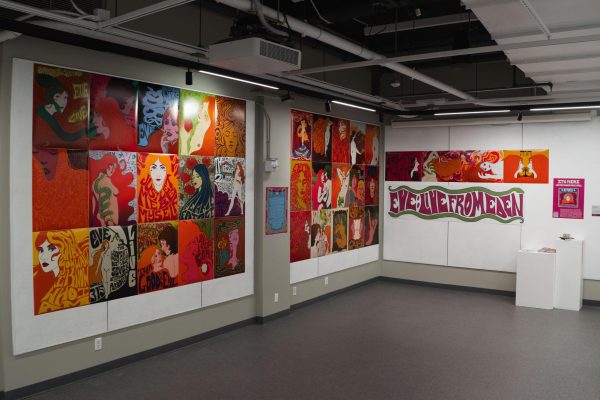
Born and raised in New York City, Sullivan describes herself, first and foremost, as a storyteller. Her skill for translating beloved motifs and narratives — like Eve of biblical fame — into a legible visual language evidences itself in her inventive thesis presentation. Employing clever witticisms and a psychedelic illustration style inflected by an era past, Sullivan aims to foreground Eve’s agency and tenacity.
“‘Eve: Live from Eden’ features a series of large-scale posters inspired by 1960s concert flyers reimagining the biblical Eve on a redemption tour to confront her past,” Sullivan said. “As a symbol for the human experience, Eve is able to act autonomously and engage with the world around her as her authentic self. This project emulates the feeling of the psychedelic ’60s posters and calls attention to the underrepresented women artists who defined the visual language of the era.”
Apicella-Hitchcock lauded Sullivan’s sensitivity to historical and cultural contexts, which likely has much to do with her multifaceted academic background; a triple major studying classical languages, art history and visual art simultaneously, Sullivan’s studies lend nuance to her creative practice. In a nod to the real look of twentieth-century psychedelic music venues, “Eve: Live from Eden” is installed in a grid format spanning the entire wall, which is complemented with a playlist containing rock classics from that era to which Eve might have head-banged had she had the opportunity.
Across the room, a series of black and white photographs by Oyola demand meditative scrutiny. Having spent the summer between his junior and senior years participating in a global outreach program in rural Panama, Oyola documented the patrons and material landscape of local medical clinics, and, in his words, “highlight(ing) the everyday realities of communities facing poverty, economic inequality and limited access to healthcare.”
These photographs, lucid and stunningly beautiful, insist on telling stories which often escape the camera’s gaze. One features a seated boy in the moments before a tooth extraction; on his forearm rests the hand of an onlooker, perhaps a family member or healthcare worker. In another, the residents of Calabazo #2, roughly three hours outside Panama City, stand erect and regard the camera with great intensity.
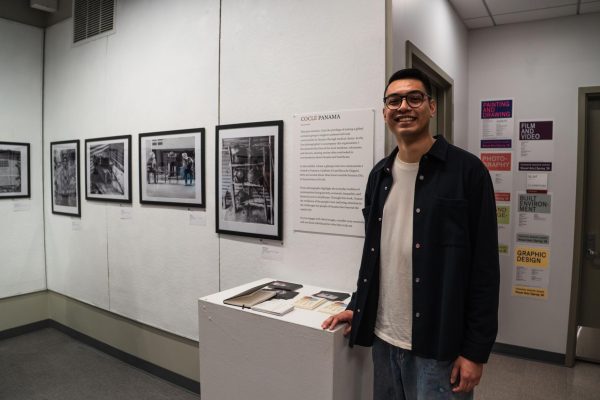
Apicella-Hitchcock described Oyola as “a super talented image maker and … a very likable person, which, if you’re kind of just kind of going into places where you’re not from, sort of making friends and gaining a level of trust, I think is really a part of the skill set. And the images show these different towns in all their specific, rich complexity.”
A biology student with experience in various medical research organizations, Oyola’s academic focus clearly informed the subjects to which his camera gravitated. The vitality of the Panamanian community surges off the prints, while the stakes of medical practice — of triage, of checkups, of the aforementioned dental procedure — feel unignorable.
The chromatic saturation of Sullivan’s posters might seem a world apart from Oyola’s restrained photographs. Still, Apicella-Hitchcock astutely notes that both artists take interest in stories untold and erased histories.
“They’re looking beyond the standard story to find out … what they need to fill in themselves through primary research,” he said. “I think both of these artists are following their nose into these territories that people know a little bit less about than the primary story.”
Sullivan echoed that sentiment, writing that “(both projects are) about having conversations that have long been overlooked and dispelling preconceived notions, whether about Eve in religious and secular culture or about healthcare and individuals in other countries. Both shows are about individuals, reclaiming one’s voice, and seeing humanity’s spirit and resilience. While the pairing might seem odd at first, I feel that it is representative of how we got here and who we are.”