


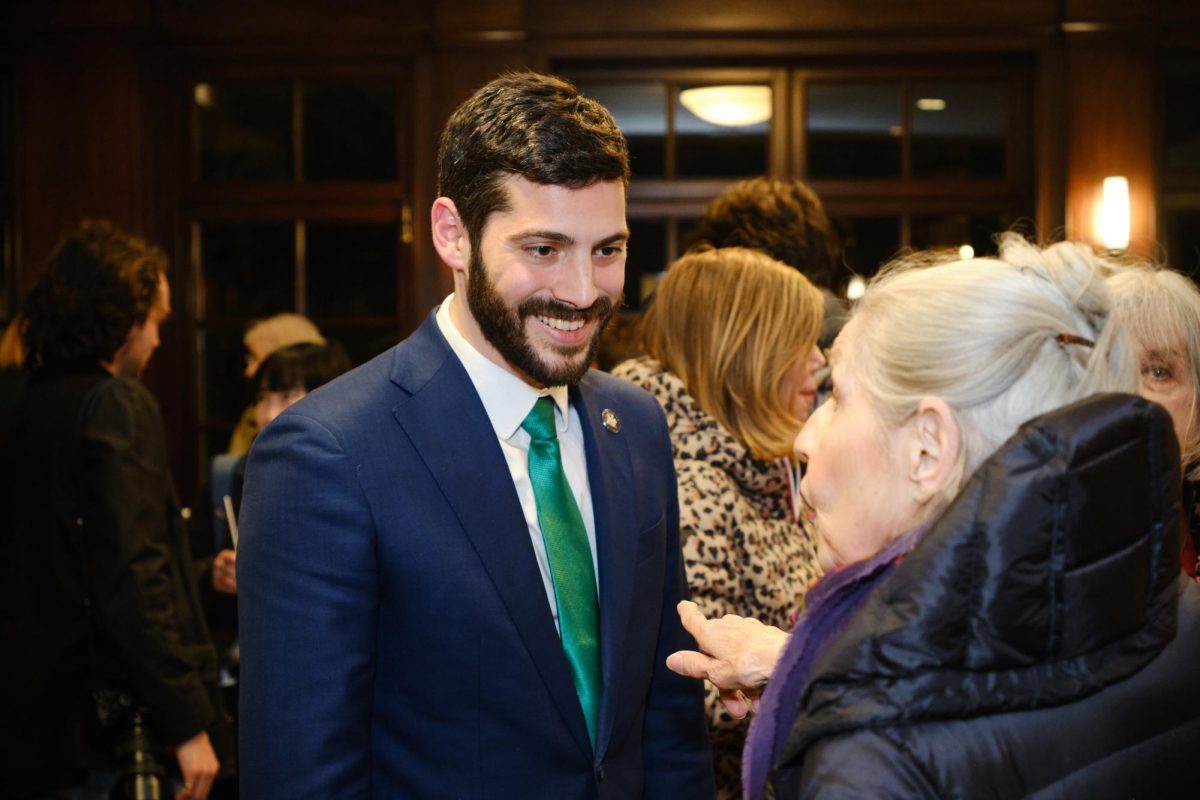
At an April 8 candidate forum at Fordham University School of Law, the race to replace Jerry Nadler felt less like a typical forum and more like a pressure test for how Democrats are defining this political moment.
For nearly two hours, candidates in the coming race for New York’s 12th congressional district — Assemblymember Alex Bores, Attorney George Conway, Assemblymember Micah Lasher and public health expert Nina Schwalbe — returned again and again to the same conclusion: The stakes in this race are not abstract. They are immediate, structural and, in their view, existential.
Still, what separated them was how they think Congress should respond and what kind of leadership that requires.
From the start, Bores framed his campaign in terms of both personal narrative and his legislative experience. Recounting how he protested outside of Disney’s building as a child after his father was locked out during a labor dispute, he positioned politics as requiring both strategy and collective action.
Healthcare is the number one reason why people fall into povertyNina Schwalbe, Public health researcher
“I learned both the power of having the right message and the fact that the only way we win is when we do it together,” Bores said.
Bores repeatedly returned to his record, noting that he has passed 30 bills in the State Assembly and emphasizing coalition building as his defining skill.
Lasher’s legislative priorities centered on affordability. He proposed tying federal funding to housing development, raising the minimum wage and expanding child care support. His argument was that Democrats must demonstrate that the government can improve daily life.
Schwalbe focused on healthcare, calling it a leading cause of poverty and outlining plans to lower drug prices and expand access.
“Healthcare is the number one reason why people fall into poverty,” Schwalbe said.
That tension between policy and urgency carried into the final portion of the event, where candidates were asked how they would approach constituent services and day-to-day representation.
Bores emphasized affordability as well but paired it with ethics reform and tech regulation. He called for a ban on stock trading by members of Congress and warned that the United States is “missing the boat on artificial intelligence” without stronger federal oversight.
That tension between policy and urgency carried into the final portion of the event, where candidates were asked how they would approach constituent services and day-to-day representation.
Here, the tone shifted: Conway acknowledged his lack of direct experience but emphasized building a strong staff and learning from existing offices.
Lasher highlighted local quality-of-life issues, pointing to scaffolding as a persistent problem he has already worked on.
Schwalbe focused on accessibility, proposing expanded constituent offices and systems to track responsiveness.
Bores described a more hands-on approach, saying he spends Fridays outside subway stops talking to constituents.
“There’s no substitute for shoe leather,” Bores said.
Get involved … You don’t know the power that you have. Alex Bores, Assemblymember
That emphasis on accessibility carried into the individual interviews conducted after the forum, where candidates were asked directly about their messaging to students and young voters.
Bores’s answer was blunt.
“Get involved,” Bores said. “You don’t know the power that you have.”
He pointed to low youth turnout as both a problem and an opportunity, arguing that young people are already experiencing issues like housing costs and workforce disruption firsthand.
Fordham students should feel a real stake in this election and make your voice heard in the primary. Micah Lasher, Assemblymember
Lasher framed youth engagement as essential to the election itself.
“Fordham students should feel a real stake in this election and make your voice heard in the primary,” Lasher said.
Schwalbe’s response focused on reaching out to youth through social media. She encouraged students to reach out and explained that one volunteer on her team is readily available to answer questions.
“Everybody needs to vote in this election. If you don’t vote, you can’t be heard,” Schwalbe said.
Conway, who spent much of the forum focused on national crisis, returned to a more personal framing in the closing moments. He emphasized accessibility and visibility, criticizing the distance many voters feel from their representatives and promising a more present approach.
I’m the only one who mega donors are spending millions of dollars to defeat. Alex Bores, Assemblymember
Bores later emphasized his ability to work across the aisle, noting that every bill he passed has received at least some Republican support.
He also framed himself as already in direct conflict with President Donald Trump’s interests. Bores has made artificial intelligence (AI) regulation a big part of his campaign, such as through his work on New York’s Responsible AI Safety and Education Act last December, a New York state AI safety regulatory law. As a result, Bores has been the subject of an over $1.1 million attack ad campaign by AI super politician action committees.
“I’m the only one who mega donors are spending millions of dollars to defeat,” Bores said, arguing that opposition from those groups signals effectiveness.
Conway, by contrast, made it clear that he is not running a traditional policy campaign. His focus was singular and blunt. He described Trump as a threat to the rule of law and democratic institutions, calling the current moment “very, very dangerous.”
For Conway, everything else comes after that. He said that “nothing can happen on those issues until (Trump) is gone,” arguing that impeachment and removal should be Congress’s top priority.
Measles right now is exploding in the United States. A flashing red warning sign that our systems are failing. Nina Schwalbe, Public health researcher
Lasher positioned himself somewhere in between. He echoed the urgency but focused more on sustained, tactical resistance.
“We have to fight Donald Trump in the courts. We have to fight him in the halls of Congress and we need to fight him in the streets,” Lasher said.
At the same time, Lasher emphasized that Democrats need to rebuild trust on economic issues. He pointed to housing, wages and childcare as areas where the government has failed to keep up with voters’ needs, arguing that legislative wins must be tangible.
Schwalbe brought a different kind of authority, grounding her campaign in public health and global experience. She warned that institutional failures are already visible.
“Measles right now is exploding in the United States,” Schwalbe said. “A flashing red warning sign that our systems are failing.”
Her approach throughout the forum was systems-focused. Rather than framing issues as isolated debates, she described them as interconnected breakdowns across healthcare, governance and international cooperation.
All four candidates called for aggressive investigations into the Trump administration, though their tones varied.
Despite their different styles, the candidates largely agreed on the limits of relying on courts alone to counter federal overreach. Conway described current legal efforts as insufficient, arguing that judges are “playing whack-a-mole” and cannot replace congressional action. Bores added that vague legislation has handed too much power to the executive branch, allowing abuses to expand.
That consensus extended to oversight. All four candidates called for aggressive investigations into the Trump administration, though their tones varied.
Bores argued that while oversight may not directly change Trump’s behavior, it can influence those around him.
“He cannot do this alone. The people around him are afraid of accountability,” Bores said.
Conway went further, calling the administration a “criminal regime” and pushing for investigations that could lead to both impeachment and state-level prosecutions.
All four agree the moment is urgent. What they disagree on is what kind of leadership that urgency demands and what Congress should prioritize first.
Lasher framed oversight as both accountability and political strategy, saying it is critical to “put on full display for the American people what this administration has done.”
Schwalbe focused on structural fixes, arguing that accountability mechanisms themselves are broken and proposing new systems to track government performance.
By the end of the event, the contrasts were clear.
Bores is running as a technocratic legislator with a focus on effectiveness and emerging issues. Conway is running on undertaking a constitutional intervention centered almost entirely on removing Trump from power. Lasher is offering a blend of aggressive resistance and economic policy. Schwalbe is framing the race through systems failure and public health expertise.
All four agree the moment is urgent. What they disagree on is what kind of leadership that urgency demands and what Congress should prioritize first.
At Fordham University’s forum, that question was left open. The answer now shifts to voters.