


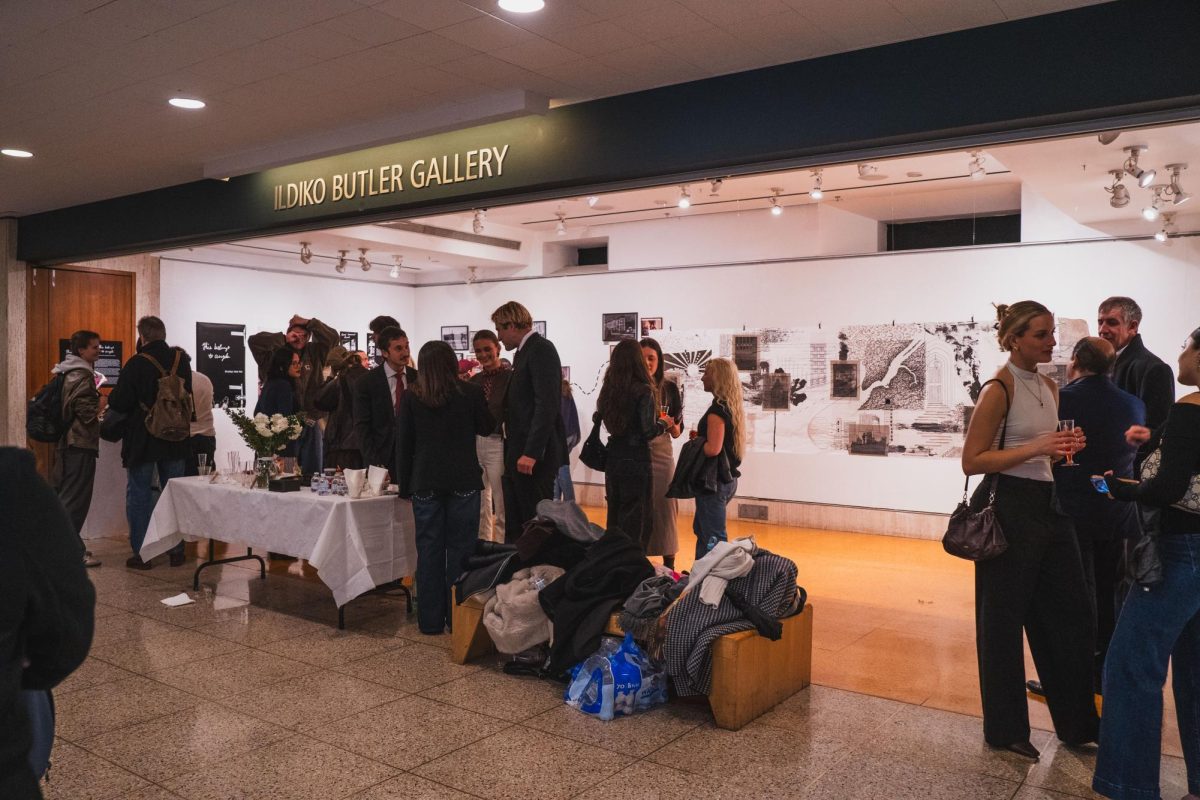
The Ildiko Butler Gallery steadily filled with groups of students, professors and family members weaving between walls lined with memories on March 20. The reception revealed two new senior thesis exhibitions and marked the culmination of work by visual arts students Grace Guerra and Daniella Herrera, both Fordham College at Rose Hill ’26.
Though different in their mediums, both thesis projects share a message: home, not as a singular location, but as something inherited, remembered and constantly evolving.
Guerra’s piece, “this belongs to angela: Cypress Hills, a walking tour with my mom,” is a stroll through the past and present. Installed as a series of graphic posters and new and old photographs, the exhibit guides viewers through Cypress Hills, Brooklyn, where Guerra’s mother grew up.
Viewers start at a big poster displaying a map of the walking tour, and then smaller ones zooming in on the three locations and their importance. Then, viewers embark on a walk themselves, as new black-and-white photographs taken by Guerra during the walk are clustered together with archival photographs in color that were preserved by Guerra’s mother.
“The streets in which she was raised were ones she chose to protect me from and spaces she longed to revisit,” her artist’s statement reads.
Guerra is a double-major in visual arts and new media and digital design, with a minor in peace and justice studies — but her favorite medium is graphic design. She used these skills to highlight the most significant places in the tour. As Guerra said, “Brooklyn’s big,” and people tend to stay near the same block they grew up on.
“I wanted to be able to make my own map,” Guerra said. “Not a basic map you see across New York City, but one that’s really personal to me and the walk that I went on.”
That idea of personalization is central in Guerra’s piece. Rather than wide-ranging documentation, Guerra narrows the focus down to three sites her mother frequented growing up: her old high school, the parish where she was baptized and married, and the home she grew up in. The result leaves viewers with an intimate feeling of these places.
“The streets in which she was raised were ones she chose to protect me from and spaces she longed to revisit,” her artist’s statement reads.
Guerra wants viewers to leave her exhibition with the desire to truly discover New York City.
The resulting compositions are like a maze — topographic lines overlapping the layered drawings of personal structures, like her childhood home, a map of the town in Colombia that her family comes from and the New York City skyline.
“I hope that people who are new to the city…take time to know about the culture and history that’s been here for generations,” Guerra said. “That’s super important in general.”
Her thesis advisor, Fordham Clinical Professor Abby Goldstein, was a big help in Guerra’s creative process, which started all the way back in March 2025 when she first applied for the senior seminar. What began as mixed-media collages turned into a graphic display, slowly molded through mentorship and experimentation. Goldstein said she was proud of Guerra’s work, and lauded her ability to get inside of the narrative to tell a story.
Across the gallery, Herrera’s “Traces of Permanent Ink; An exhibition on ink, home, & infrastructure” approaches similar ideas, but from a different perspective rooted in architecture, drawing and inherited archives.
Herrera is a double major in urban studies and visual arts with a concentration in architecture. She created this project from a collection of photographs taken by her father in 1988 for an introduction to photography course he took during his time at Fordham Lincoln Center. The images, rediscovered decades later, became the foundation for large-scale ink drawings that layer spatial elements with personal history.
Herrera’s averts a single path. Instead, it makes viewers navigate the layers and consider how different environments can imprint themselves across generations.
“I dug through hundreds,” Herrera said, recalling the moment her father handed her a long-abandoned bin of photographs. From that archive, she selected around 20 to center her exhibition around.
The resulting compositions are like a maze — topographic lines overlapping the layered drawings of personal structures, like her childhood home, a map of the town in Colombia that her family comes from and the New York City skyline.
“It was a little bit of a story about how space shapes identity and narratives,” Herrera said. “It was about generational identity.”
Where Guerra’s work moves linearly, as a guided walk, Herrera’s averts a single path. Instead, it makes viewers navigate the layers and consider how different environments can imprint themselves across generations.
Despite these differences, the pairing feels intentional. When Guerra and Herrera realized the shared message in their pieces, they knew they needed to be exhibited together.
Guerra’s structured, graphics-driven layout contrasts with Herrera’s wide, hand-drawn compositions, yet both rely on archival photographs that were preserved, rediscovered and reinterpreted.
Both artists engage with New York City not as a simple backdrop, but as a character that engages with family, memory and a personal narrative. As Goldstein noted, the works “bounce off each other,” connected by their focus on home and shared space.
There’s also an underlying dialogue between their chosen mediums. Guerra’s structured, graphics-driven layout contrasts with Herrera’s wide, hand-drawn compositions, yet both rely on archival photographs that were preserved, rediscovered and reinterpreted.
Emotionally, Herrera’s goal is to spark curiosity or recognition in those new and old to the city.
“Hopefully, for the older crowd, it’s a little nostalgic,” she said. “We talked about some places that have been here a while and have changed over time, so hopefully it rings a bell with a few people.”
Guerra, on the other hand, hopes for reflection; she hopes for people to pause and consider the histories embedded in these everyday spaces.
Both artists described the experience of exhibiting in the Ildiko Butler Gallery as surreal and rewarding.
“It’s awesome,” Herrera said. “I feel like we took so long to get here.”
That sense of time and effort is clear in their works. The pieces are not just final projects, but accumulations of family histories lived out in this city.
The exhibition will be on display until March 31.