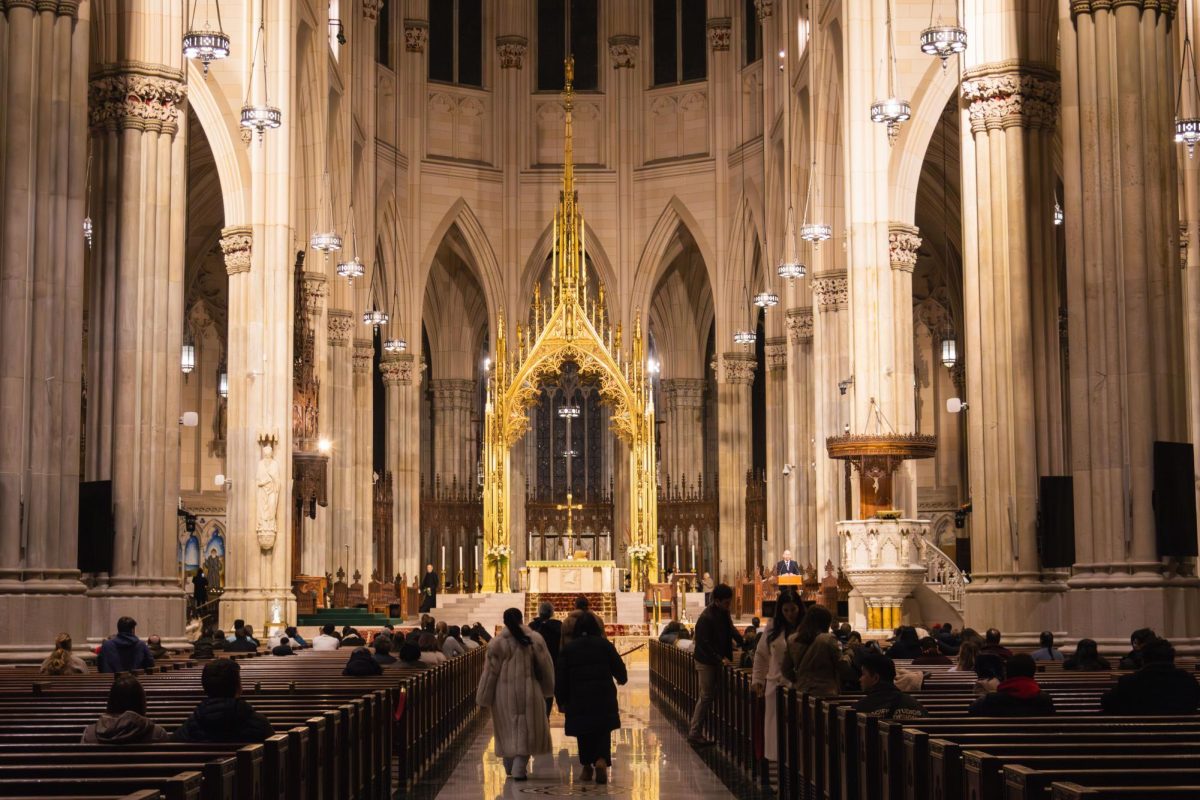
On Feb. 6, Ronald Hicks was installed to the office of archbishop in a Mass at St. Patrick’s Cathedral, following his appointment by Pope Leo last December. Several members of the Fordham community see this as a shift in the leadership style of the Archdiocese of New York toward an on-the-ground pastoral presence and firm voice on key issues like migration.
Hicks succeeded Archbishop Emeritus Timothy Cardinal Dolan, who turned 75 (the mandatory age of retirement for bishops) earlier last year.
Hicks now leads the Archdiocese of New York, one of the largest archdioceses in the United States, which includes three boroughs (Manhattan, the Bronx and Staten Island) and seven counties (Dutchess, Orange, Putnam, Rockland, Sullivan, Ulster and Westchester). According to the archdiocese’s website, it serves over 2.5 million Catholics in almost 300 parishes throughout the region.
The role of the archbishop is to be both an administrator and a pastor. He guides the priests and deacons serving in specific parishes in the region, performs sacramental duties and oversees the Archdiocese of New York’s other ministries. These ministries include its Catholic school system, Catholic Charities, ArchCare (its healthcare system) and The Good Newsroom (its in-house digital news platform).
The role of the Archbishop is to listen, to get the pulse of what’s happening at parishes and communities throughout the Archdiocese. Katie Anderson Kuo, Director of Catholic Life at Fordham’s Office of Campus Ministry
Katie Anderson Kuo, director of Catholic Life in the Office of Campus Ministry at Fordham, explained that the Archbishop “sets the tone” for the Archdiocese and serves as “a pastor of all of the people in the Archdiocese.”
“The role of the Archbishop is to listen, to get the pulse of what’s happening at parishes and communities throughout the Archdiocese,” Anderson Kuo said.
Michael Lee, professor of theology and director of the Francis and Ann Curran Center for American Catholic Studies at Fordham, detailed Hicks’ particular pastoral capabilities.
“From what I hear, he’s a good listener, a good administrator. He’s a person who’s not necessarily going to grab the headlines or the spotlight. He’s more focused on service on the ground,” Lee said.
Thomas McCarthy, Fordham College at Rose Hill (FCRH) ’29, attended the installation Mass and echoed this sentiment of pastoral presence. He described how Hicks was “high-fiving one person per pew and going through all of the pews.”
Whether you see Dolan’s ministry in a positive light or a negative one, I just think there’s a difference in personality — and we’ll see what that translates (to) in terms of a difference in priorities as well. Michael Lee, Professor of theology
Zander Flint, FCRH ’26, agreed with Lee’s comment that Hicks is quiet, but present with the people.
“I’m looking forward to a leadership style that is more reserved, a little bit more common(ly) pastoral,” Zander said.
Several people have pointed out that this more reserved character is a notable contrast to Dolan, who previously served the archdiocese with a louder personality.
“(Hicks’) personality is less boisterous and loud and exciting,” Zander said.
Lee shared his perspective on the differences in temperament between the two archbishops and how this could yield different priorities.
We are called to be a missionary Church that takes care of the poor and the vulnerable, upholds life from conception to natural death, cares for creation, builds bridges, listens synodally, protects children, promotes healing for survivors and for all those wounded by the Church, and shows respect for all, building unity across cultures and generations Ronald Hicks, Archbishop of the Archdiocese of New York
“I think these will set Hicks’ days differently than they did (for) Cardinal Dolan. Whether you see Dolan’s ministry in a positive light or a negative one, I just think there’s a difference in personality — and we’ll see what that translates (to) in terms of a difference in priorities as well,” Lee said.
Zander shared a similar view and compared Dolan’s reserved demeanor to that of Pope Leo.
“The approach is similar. Even his history is very similar to Pope Leo. … Other than that, there’s definitely similarities to be drawn, more reserved than Dolan, and still closer to Leo,” Zander said.
One distinct priority of Hicks’ that he has already made clear is his attention to the Spanish-speaking communities in New York and his emphasis on reaching out to the poor and marginalized.
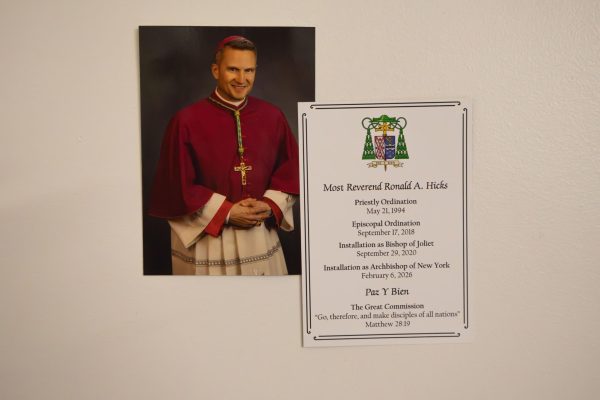
Hicks, speaking in both Spanish and English during his homily at the installation Mass, shared his excitement to minister to the people of New York. He referenced popular New York City-themed songs and thanked those that have influenced his faith before turning to a more serious discussion of the day’s Gospel reading and his hopes for the Church in New York.
“We are called to be a missionary Church that takes care of the poor and the vulnerable, upholds life from conception to natural death, cares for creation, builds bridges, listens synodally, protects children, promotes healing for survivors and for all those wounded by the Church, and shows respect for all, building unity across cultures and generations,” Hicks said in his homily.
He emphasized that the Church exists to serve all, not just its members. Hicks concluded his homily by encouraging Catholics to be a missionary Church that reaches out to the margins and shares the Gospel widely.
“Brothers and sisters, I believe the world always has and always will need a missionary Church. A Church that proclaims Jesus Christ clearly and without fear. A Church that forms missionary disciples, not passive spectators. A Church that goes out to the peripheries,” Hicks said.
Flint said that this more serious discussion of Hicks’ vision of the Church in New York surprised him.
“The tone, when he got more serious, was actually a little bit more proselytizing than I was expecting,” Flint said. “Obviously, he did spend plenty of time thanking people, but I guess I didn’t think he would get as intense as he did, and so I found that kind of interesting.”
Some appreciated this clear intention for a missionary Church and claimed it reflected the strong voice they expected from Hicks.
Lee described Hicks as having “the kind of necessary voice that our society needs today,” comparing his firm tone to that of Oscar Romero, Hicks’ favorite saint, who was martyred in El Salvador for his public criticism of the government and his ministry to the poor.
“If his favorite saint and perhaps model is Archbishop Romero, maybe the circumstances will dictate that we see more boldness that might surprise everyone, just as Romero surprised everyone around him,” Lee said.
Both Pope Leo —who is originally from Chicago — and the U.S. Conference of Catholic Bishops (USCCB) have publicly criticized the current treatment of migrants in the U.S.
Hicks’ new coat of arms bears a rosemary sprig on the right side, which recognizes Romero and celebrates Hicks’ five years of work in El Salvador. His episcopal motto, depicted at the bottom of his coat of arms, is “paz y bien,” Spanish for “peace and good.”
In an Instagram post to his official account, @apbnewyork, Hicks explained that the rosemary sprig honors Romero, “whose courage inspires me and recalls my ministry in a country close to my heart.”
Hicks’ homily and priorities align with the Church’s recent attention to migrants. Both Pope Leo —who is originally from Chicago — and the U.S. Conference of Catholic Bishops (USCCB) have publicly criticized the current treatment of migrants in the U.S.
In November 2025, the USCCB issued a “special message” condemning the inhumane treatment of migrants in the U.S. and calling for practices that uphold their inherent human dignity. Pope Leo has similarly called out recent anti-migrant measures and expressed his support for the USCCB’s special message.
Archbishop Hicks will represent a fidelity to what the tradition of the American Catholic Church has been, say, in its position on human rights, on migrants, on those who are poor and what the duty of the Church is in respect to how it should behave in the American public sphere Michael Lee, Professor of theology
The Church has expressed support for migrants locally in New York as well. In August 2025, St. Patrick’s Cathedral unveiled a mural commissioned by Dolan titled “What’s So Funny About Peace, Love, and Understanding,” which celebrates the rich tradition of immigration to New York City and its contributions to the Catholic Church.
In this context, Lee hopes that Hicks will remain true to what he sees as broader themes in American Catholicism.
“Archbishop Hicks will represent a fidelity to what the tradition of the American Catholic Church has been, say, in its position on human rights, on migrants, on those who are poor and what the duty of the Church is in respect to how it should behave in the American public sphere,” Lee said.
While Hicks brings a new personality to New York, many emphasized that what remains consistent is that the heart of the Church will always be the people.
“No matter who is the leader, we don’t change, right — we’re still the body of Christ. We are always being called to continue to build up the body of Christ, and to preach the gospel, and to share the good news, and to act on our call to works of mercy,” Anderson Kuo said.
Lee hopes that Hicks will empower the people of New York to be an active Church.
“The Church is the people of God. And when you have a leader in place like Hicks, I think people can also embrace that sense of their own dignity and be Church, not just look to the guy at the top to make (the) Church better, but to feel empowered to be Church in a better way. And I think Hicks has the personality and the pastoral experience and the support, even from Rome, to make that kind of church a reality, and that can be very inspiring,” Lee said.
As Hicks takes the helm, many Catholics are excited to share their local Church life with him and see what he will bring to the city.