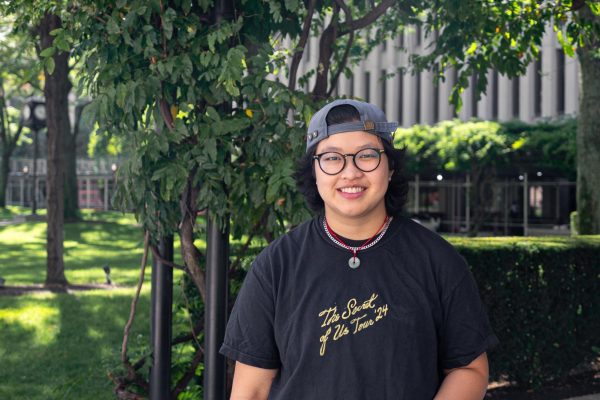

It happens again. The dreaded elevator door opens to someone already standing inside. Our eyes meet with a sense of unexplored recognition. Our friends know each other. We’ve commiserated over the concerningly loud smoke alarm. We once talked in a class I ended up dropping. Now, we are headed down 10 stories together, with the only sound being the elevator slowly beeping through every floor, each tone signaling the light at the end of this unfortunate, agonizing tunnel.
After checking the weather app and pretending to scroll through my nonexistent notifications, a wave of relief envelops me as we step off the elevator and part ways. “Until next time,” I think to myself, knowing next time will likely be behind them in a Ram Café line or viewing their Instagram story later that night.
Throughout my time at Fordham Lincoln Center (FLC), a campus objectively full of expressive and creative students, I’ve had a great deal of warm and friendly encounters. Yet, I’ve also experienced a handful of immensely awkward moments.
Silence has become the default setting for many of us in uncomfortable social situations, both as FLC students and as a generation. While awkwardness itself is inevitable, leaning into these moments with courage and without self-judgment can create a stronger sense of community.
These small, mundane moments are what bond us as a Fordham community.
I’ve begun to wonder how many times I have pretended not to recognize someone for the sake of convenience. Choosing silence requires minimal effort, and there’s a guaranteed outcome of the scenario: nobody talks, so nobody’s at risk of embarrassing themselves or initiating an awkward moment. Vulnerability, regardless of the magnitude, is needed whenever we greet someone, and I believe harnessing that vulnerability can be daunting. The easiest choice I’ve found is to put in my AirPods and watch the elevator number descend. Realistically, it’s difficult to navigate a minute-long interaction with someone you barely know, especially when there is no clear script for how that interaction should go.
I don’t believe unease or discomfort are simply moral failures on our part. The structure of our university doesn’t always allow for total ease of connection. In fact, the small size of the FLC campus amplifies these sorts of interactions. With only a few hallways and limited on-campus dining options, there’s always someone I vaguely know “out in the wild.” Classes, most with no more than 30 students, allow for that brief connection between classmates for a semester, and once it’s over, it feels like there’s an uncharted area there. Eye contact and a hazy recollection of our eccentric professor are all that’s left if we didn’t form a lasting bond.
The campus is structured to move efficiently from point A to point B, and asking a friend about their weekend in a tunnel of wind isn’t my preferred mode of communication.
I’ve personally found that silence has become my comfortable default. Even though my friends would describe me as relatively outgoing and sociable, I often feel like a shell of my more authentic self when walking through the hallways alone. I find that I’m typically in my head, preparing for the moment when I pass an acquaintance. I’ve noticed this pattern isn’t unique to my experience or even to students at FLC — it’s common among our entire generation. We exist in a time where the phrase “you don’t owe anyone anything” has made its way into our collective subconscious.

Drawing our boundaries and asserting independence is not inherently harmful. This mindset is understandable, as mental health and our finite energy are becoming more prioritized, especially within this generation. “Main character energy,” a term popularized through the internet, describes a self-assured demeanor, encouraging one to become the lead protagonist of their life as if it were a movie. I tend to channel this energy when listening to music on the way to Saxbys, dressed in a leather jacket and Doc Martens. I imagine I’m alone when in actuality I’m surrounded by a sea of students I may or may not know. When being the “main character” becomes hyperindividualistic and is combined with creating strict boundaries, there is a large risk that we begin closing ourselves off from others, assessing what people can offer us transactionally rather than engaging with them simply as human beings. There’s an emphasis on “protecting our peace,” but self-made isolation in the name of convenience begins to sever the veins of community.
When we default to silence, we lose something integral to our existence as human beings —-spontaneity and our sense of togetherness within it. There is value in low-stakes connections. These moments require effort, a willingness to reach out, a willingness to be rejected and a willingness to try again.
I’ve been working to change my natural silence with people I barely know, operating under the belief that I will gain more than I lose from an awkward interaction. Knowing I tried to reach out after a conversation that fell flat feels better than the unease and uncertainty of metaphorical crickets chirping around us. Everyone is navigating challenges we ourselves don’t know about, which only adds to the hesitation of starting a conversation while feeling unsure whether another person would even want to be engaged.
In many instances, I’ve been starting with compliments — as a conversational tactic, but also because I truly mean them. While that reads like a tutorial on small talk, complimenting anything from a piece of clothing to someone’s handwriting has led my conversations into lovely, unexpected places. Just by finding the courage to talk, I’ve learned fun facts about others like a classmate of mine who shared that they took up scuba diving and is using those skills in her internship with National Geographic, or some other classmates who performed Irish dances at high school assemblies.
For first-years, going to the events hosted by the resident assistants is an extremely low-pressure way of breaking the ice, despite the sound of its cliché nature. Playing trivia or making vision boards has turned familiar faces into friendly ones. When we encounter each other now, there is a foundation of comfort between us.
These small, mundane moments are what bond us as a Fordham community. The overarching concept is that we’re not shutting people out. A wave or a smile maintains those friendly acquaintances, emphasizing that we can find comfort in those around us.
This is not to advocate for a future where everyone in the elevator participates in a group hug at 8 a.m. No world exists where everyone is extroverted, nor should it. Social fatigue is real, and not everyone wants to or needs to talk all the time. But this doesn’t mean our voluntary silence needs to be normalized.
Ultimately, awkwardness is a fact of life. In the same way, a barista may make your drink wrong, it’s not always ideal, but there’s the decision of whether you accept it or ask for a change. Ungraceful moments filled with unease or tension aren’t going anywhere, but meeting them with courage and with less self-judgment may be the first step toward becoming more connected. Maybe next time the anticipated elevator door opens to someone standing inside, our eyes meet with recognition, we wave and we finally say hello.