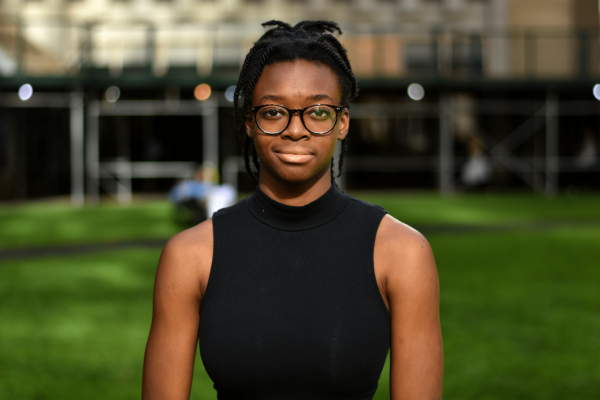

Aysha Ames, a professor at Fordham University School of Law (LAW) and a proud Brooklyn native, works to shed light on the dark racial histories that underscore Jesuit universities. She is uniquely driven to this research as her ancestors were forcibly sold with profits used to fund another active Jesuit institution, Georgetown University.
While eventually making their way to Brooklyn, Ames’ ancestors are originally from Barbados. Her great-grandmother, Ann Joice, was brought to colonial Maryland with the third Lord Baltimore. Joice left the island with the understanding that she would work as an indentured servant for seven years and pave her own way in the colonies thereafter. Instead, Lord Baltimore forced her into enslavement. Subsequently, her children were enslaved, along with their children and their children after that.
Joice told her children the story of her forced enslavement, making sure they knew she was a free woman and that they should be, too. The story of Joice’s true status was preserved, passed down and told from parent to child. With this truth, Joice’s great-grandchildren were able to sue in a court of law and became legally free.
Her scholarship, under the Fordham umbrella, affords her a degree of academic freedom that is principal in the Jesuit doctrine of education.
The persistence of Ames’ ancestors in preserving and passing down their history led to their eventual freedom. Knowing this, Ames feels an obligation to tell the stories she uncovers in her research.
Her scholarship, under the Fordham umbrella, affords her a degree of academic freedom that is principal in the Jesuit doctrine of education.
Fordham repeatedly advertises that Jesuit education “examines the history of injustices, often subtly embedded within systems and cultures, while also generating hope so that students feel called to address significant world problems,” as per Fordham’s “Living the Mission” webpage.
By allowing this level of curricular freedom, the institution accepts the risk that faculty work may blow back on the school, causing controversy for the institution while simultaneously doing overall positive work for the world.
Solano Is Leveling up With AI
A professor receiving a range of attention is Visual Arts Professor Gabriel Hernandez-Solano, who is working with artificial intelligence (AI) in his design course, allowing students to produce designs without typical skills. With the permission of his department head, Solano became one of the first Fordham professors to run a fully AI-integrated course. Solano currently teaches the architecture course Ecology for Designers, and this year, he took the once-traditionally taught course and incorporated AI throughout the entire body of coursework. In the newly designed course, Solano is requiring his students to become proficient in a whole host of AI tools to advance the outcome of their work.
“For me, it was a bit natural along the lines of design professions,” Solano said. “You always need to stay up to date with the latest technology. Let’s at least talk about it and let’s at least start exploring and flirting with it so that you guys aren’t completely steamrolled once you leave university.”

Before teaching with AI as a student resource, Solano was an early follower of this new age of tech, frequently using AI in his own work. Seeing the ease with which he could craft high-level projects in his personal life, he realized he had to raise his expectations for his students. In his AI-integrated course, he tasked his design students with creating an architectural portfolio using almost exclusively AI-powered tools and expected them to walk away with first-year architecture intern-level work.
“I think for me, an important part is empowering students and making them realize (that) if you have an idea and you’re willing to explore some of these tools, you can go that much further,” Solano said. “AI is one of the many tools that can do that.”
As an institution, Fordham has allowed professors to engage with AI as they deem fit for their courses. However, most have opted to keep it out of their classes almost entirely. Julianne Welby, a journalism professor, chose a policy that totally banned AI in her classroom, even though she acknowledged its possible benefits.
“There are AI tools that make some journalism easier, such as transcribing audio,” Welby said. “But I am still a blanket absolute ‘no’ on writing or crafting any journalism using AI. I still want our journalism brains to do that.”
While there are critics of AI in the classroom among Fordham faculty, Solano is aware he is an outlier and continues to experiment with his teaching style. After observing the amount of class time he was able to retrofit to address each student’s distinct design issues, he was sold, as these new applications were similar in their interactions with the AI-powered tools and relatively shallow learning curve.
Although his work sets him apart at Fordham, when speaking with Solano about his work with AI, he made clear that what he was doing was not groundbreaking. He emphasized his belief that this is just another step in the evolution of tech.
“I want to not decouple AI from technology in general. Digital literacy is necessary in today’s world,” he said.
Fordham’s commitment to the constant evolution of educational models aligns with magis, the concept of continually striving for excellence rooted in the Jesuit educational tradition. The adherence forms a foundation prepared to handle Solano’s major demolition of how a university course ought to be taught.
Ames Tells the Stories of Many, Fueled by Her Own
Professor Ames exemplifies Jesuit values — particularly the principles of reflection and discernment — at LAW. Alongside Dr. Jeannine Hill Fletcher, a theology professor at Fordham, Ames has worked to help uncover the numerous trails of evidence beginning with the sale of enslaved Africans and ending with that same amassed wealth funding the start of Jesuit universities across America.
In April of 2025, Ames and Fletcher led an event hosted by LAW titled “A Conversation on Race and Slavery at Fordham.” The event was an all-day symposium on the topic of their research. Ames spoke about the unique experience of putting on the event, expressing how they are the only two researchers at Fordham studying the topic in an already relatively small field.
“It feels heartbreaking in many ways; it feels empowering in many ways, and it feels like you have an obligation to tell the stories of people who could not tell their own story.” Aysha Ames, Professor at Fordham University School of Law
“One of the benefits of having such a grassroots event was that we were able to get so many different departments and mentors at the university involved, because we started off with no money,” Ames said. “It really helped us to understand that there are people in the university who support our work, who want to know this history.”
Through her work with Fletcher, she has been able to bring light to the family histories of many descendants of enslaved people present at the event. Ames spoke about the complex emotional basis she holds for the investigative work as a descendant.
“It feels heartbreaking in many ways; it feels empowering in many ways, and it feels like you have an obligation to tell the stories of people who could not tell their own story,” Ames said. “I think that’s why this work is so important to me.”
The work, being housed under the Fordham name, creates a particular sense of intersectionality because of the university’s assertions denying the exact relation to slavery that Ames publishes about. In 2016, groundbreaking investigative journalism done by New York Times reporter Rachel L. Swarns was published about the link between slavery and Jesuit universities. After an internal investigation, Fordham spokesman Bob Howe denied that Fordham participated in the practice Swarns brought to light. Staff writer for The Tablet, Bill Miller wrote about Fordham’s stance that it had no part in slavery.
“Bob Howe, spokesman for Fordham University, said officials on the Bronx campus determined in 2017 that no direct connection to slavery existed,” Miller wrote.

When asked about the dissension between her research and the 2016 statement, Ames maintained that her work shed light on the questions regarding Fordham’s connections that were left unaddressed. Moreover, she spoke about the freedom she was granted by the university’s culture of not interfering with faculty research.
“One of the good things we can say is that we were given academic freedom,” Ames said. “We got a lot of positive feedback both within the university, but also from other people around the community.”
When Ames and Fletcher held the event after a year of planning, it was in defiance of a national push to sweep difficult histories concerning race under the rug and not contend with the present implications of that troubled past.
“By the time the event rolled around, the event was a form of resistance that we hadn’t thought about the year before,” Ames said.
Chapman Leads With Integrity Alongside Morehouse Men
While Solano and Ames are making a difference within the university, Professor Mark L. Chapman, Associate Professor of African and African American Studies at Fordham, is causing a stir outside of Fordham. Chapman is well-known within the Morehouse College community, a close friend to many faculty members and administrators and a confidant for active students. Chapman caused a huge stir within the community when he took an official stance against controversial actions taken by longtime friend and Dean of the Martin Luther King Jr. International Chapel Lawrence Carter.
The Morehouse controversy concerned the presence of an honorary oil painting of Joseph Smith, founder of the Church of Jesus Christ of Latter-Day Saints. The portrait unveiling ceremony was held on Feb. 1 to mark Black History Month. The painting is in Morehouse College’s Martin Luther King Jr. International Hall of Honor, a display room within the chapel. It shares the room with champions of civil and human rights like Nelson Mandela and Mahatma Gandhi. Chapman spoke about the immediate shock he felt when he was made aware of what he saw as a buck from tradition.
“Joseph Smith was a polygamist. He had more than 20 wives, some as young as 14 years old. In addition to that, he was pro-slavery,” Chapman said. “He is not a standard bearer of morality who I think is worthy of having a portrait hung in the Martin Luther King chapel.”
When asked, Chapman expressed a common sentiment, shared by both Solano and Ames, that the personal nature of his work drove him to speak out.
Along with two other alumni of the college, C. Vernon Mason Sr. and Rashad Raymond Moore, Chapman penned a sharp opinion against Dean Carter that was published in The Atlanta Journal-Constitution titled “Morehouse should not have honored a man who owned slaves and married children.”
“That’s three generations, and so, we got ourselves together and we drafted that op-ed,” said Chapman. “Our hope was to support the students because there were students at Morehouse who were protesting.”
When asked, Chapman expressed a common sentiment, shared by both Solano and Ames, that the personal nature of his work drove him to speak out. Chapman felt that his friend and mentor was publicly taking actions that were wrong and antithetical to the character of a Morehouse Man, seemingly for monetary gain.
“Dean Carter — who published a book in honor of the legendary Benjamin Mays, titled ‘Walking Integrity’ — for him to accept money from the Mormon Church and lift up Joseph Smith as some pioneering abolitionist who was in favor of Black people, is not only historically inaccurate but it causes me to question Dean Carter’s own integrity,” he said.
However, Chapman made sure to exclaim that the reason he spoke out publicly was to support the current students at Morehouse. He spoke about the history of the original Jesuits and their goal of displaying the teachings of Jesus. Chapman made clear that he stood with the students, in loud opposition of a close friend, because that is what Jesus taught and would have done.
“Commitment to others, especially to the marginalized, the overlooked, and the voiceless, that’s a very important aspect of the Jesuit notion, that you live a life for others, especially those that do not have the support of mainstream society,” Chapman said.
Alvarez Creates Community Through Conversation
Professor Catalina Alvarez, a visual arts professor working in the medium of short film, has created provocative bodies of work with her students for years. For the past several years, Professor Alvarez taught a course titled The Art of the Interview. The course focused on interviewing past residents of the San Juan Hill neighborhood, also referred to as Amsterdam Hill, the residential area that was present before Fordham’s Lincoln Center campus was built. This year, Alvarez focused the interviews on the current and future state of the Lincoln Center community, while acknowledging the area’s history.
“Students interview elders who recount the history of the Lincoln Square neighborhood, which was demolished in the 1950s to build Lincoln Center,” she said. “This semester, we started more heavily focusing on the present and the future of the neighborhood.”
Alvarez’s choice to hone in on the present has forced an uncomfortable light on the establishment and present existence of the Lincoln Center campus.
Current and past Lincoln Center community members, like Jackie Brown Richardson, spoke with Alvarez’s class about the loss of their neighborhood to gentrification and the construction of a Fordham campus in Manhattan.
Alvarez’s choice to hone in on the present has forced an uncomfortable light on the establishment and present existence of the Lincoln Center campus. Consequently, students have become increasingly aware of the campus’s isolated situation within the Upper West Side, which stands in stark contrast to the formerly interconnected community that previously occupied the space.
The Art of the Interview, alongside Alvarez’s fastidious attention to the integrity of the research, has led her to brainstorm ways in which Fordham could be woven into the local community, fighting the university’s insistence to keep the public out. Alvarez spoke about her thoughts for a campus that was part Fordham, part a public space.
Alvarez said that “if there were several places that are both Fordham and open to the public, where you didn’t have to show ID right at the street level,” to foster a connection between the local community and members of the campus.
The Fordham Brand of Academics
Across Fordham’s departments and campuses, professors are navigating the tension between being a member of the Fordham community and answering a call to action. Along with the passion they pour into their service, they have faced public contention and friction with the university’s administration.
University professors’ scholarship addressing important social questions is not unique to the work of Fordham faculty members. The values held in Jesuit academia have created a space that provides resources specifically for academics tackling hard debates. As members of Jesuit academia, they have demonstrated how possessing such values allows for a special brand of fortitude in the face of scrutiny.

Professors seeking to hold academia to higher standards of justice have often bristled with the narratives held by the institutions they work within. In spite of those setbacks, the persistence of those willing to question the history and decisions of their home institutions has led to larger conversations about the role of the academic within their workplaces.
Whether through AI-integrated education, fearless research, published opinions or provocative art, completed scholarship from Fordham’s faculty within the past year has displayed the fruits of a Jesuit academic tradition, even when the university’s implemented decisions are occasionally unaligned with its heritage. With both the strength of will that is present in its particular sort of academics and the university’s tendency to buck its touted values, the continued efforts of professors to explore their work despite risking possible controversy for their institutions is a foregone conclusion.