

March is officially recognized as Women’s History Month in the United States — a month to honor women’s contributions to American history that continue to shape every aspect of American life, including what many would consider a cornerstone of American society: sports.
The Women’s National Basketball Association (WNBA) reached a monumental collective bargaining agreement (CBA) with their players’ association (WNBAPA) on March 23. One of the main points during the bargaining process was increasing the WNBA salary cap, a demand the WNBAPA believed was proportional to the growth the league has seen in recent years.
“The moment is the result of years of work and a shared belief that as the league rises, so must the players,” Nneka Ogwumike, president of the WNBAPA said in a statement.
Years of work and advocacy for visibility is not exclusive to the WNBA, but indicative of women’s athletics as a whole, and especially women’s collegiate athletics.
In 1970, Fordham University introduced its first women’s varsity athletic program with the addition of the women’s basketball team. Women’s swimming and diving, tennis and volleyball teams were added soon after in 1971, 1973 and 1974, respectively. The following two decades rounded out the women’s athletic teams at Fordham that have competed in the Atlantic 10 Conference (A10) league of the National Athletic Collegiate Association (NCAA), with cross country, track and field, and softball in the ’80s and rowing and soccer in the ’90s. Dance and cheerleading are the final two of the 11 current Division I women’s athletic teams at Fordham, which comprise over 250 female student-athletes according to Scott Kwiatkowski, associate sports information director.
“There were a number of women who played basketball and there were really no sports for women at the time, so we went to talk to the athletic director about getting a women’s basketball team, and they were surprisingly open to it.” Barbara Hall, Thomas More College ’68
Although 1970 marks the official start of women’s varsity sports at Fordham, women’s athletics had an established presence on campus at Fordham Rose Hill before the turn of the decade. In 1964, Fordham opened the all-women’s Thomas More College (TMC). One of the members of the first graduating class, Barbara Hall, TMC ’68, etched her name in Fordham’s athletic history by co-founding the women’s basketball club.
“It was great; it was fun. There were a number of women who played basketball and there were really no sports for women at the time, so we went to talk to the athletic director about getting a women’s basketball team, and they were surprisingly open to it,” Hall said in a 2018 oral project Fordham conducted TMC students. “A lot of the guys from ’68 say, ‘I remember you, I remember seeing you play basketball.’ And that shocks me. It really does.”
The 1970s proved to be a monumental decade — not just for Fordham but for collegiate athletics across the country. Title IX of the Education Amendments of 1972, widely known simply as “Title IX,” was passed by Congress and signed into law by former President Richard Nixon. The legislation states the following: “No person in the United States shall, on the basis of sex, be excluded from participation in, be denied the benefits of, or be subjected to discrimination under any education program or activity receiving Federal financial assistance.”
“I’m loving how much more recognition women’s sports is getting now and how people are kind of realizing how much less what female athletes were getting before.” Hope Nolan, FCRH ’26
Title IX has been fundamental to the expansion and the fiscal support of women’s collegiate athletics programs in the U.S. The NCAA divides the application of Title IX in collegiate athletics into three sections: participation, which requires equitable opportunities to participate in sports across women’s and men’s programs; scholarships, which requires that athletic scholarships are received by female and male student-athletes proportionate to their participation; and a general consensus that athletic programs will treat female and male programs equally in regards to equipment, scheduling, facilities and other provisions.
Over half a century since Title IX was officially passed, women’s collegiate sports in the U.S. have seen a 14% increase in participation in the NCAA women’s championship and emerging sports over the last decade. This trend of national growth has not gone unnoticed by members of the women’s Fordham Athletic community, including Hope Nolan, Fordham College at Rose Hill (FCRH) ’26, co-captain of the swimming and diving team and president of the Student-Athlete Advisory Council.
“I’m loving to see how it’s growing. I’m loving how much more recognition women’s sports is getting now and how people are kind of realizing how much less what female athletes were getting before, and especially with women’s basketball and the (WNBA’s) CBA getting passed and all this stuff, just looking out for female athletes and giving them the attention they deserve, because everyone watches women’s sports,” Nolan said.
For Anne Gregory-O’Connell, FCRH ’80, a lot has changed in women’s collegiate sports since her time with the women’s basketball program.
“When I turn the TV on and I see the crowds at the women’s college games, that’s fantastic. They get so much more support from fellow students, from alumni, from everybody. They packed the arenas, which I think is a wonderful thing,” Gregory-O’Connell said.
The platform for women’s sports has evolved since 1974, when Gregory-O’Connell first took the court in the Rose Hill Gym. Gregory-O’Connell was the first female athlete inducted into the Fordham Hall of Fame and holds the records for all-time leading scorer for the women’s basketball program with 2,548 points, as well as the leading rebounder with 1,999. Her career with the Rams is illustrative of the talent and dedication that have always existed within women’s collegiate sports.
“We played around the time when things were just getting off the ground … right from the get-go, we were trying to make it an important sport,” Gregory-O’Connell said. “We had such a good time, but at the same time, it wasn’t all fun and games. We worked really hard and we were very dedicated, but it was an amazing experience for me. It was the best I could ever ask for.”
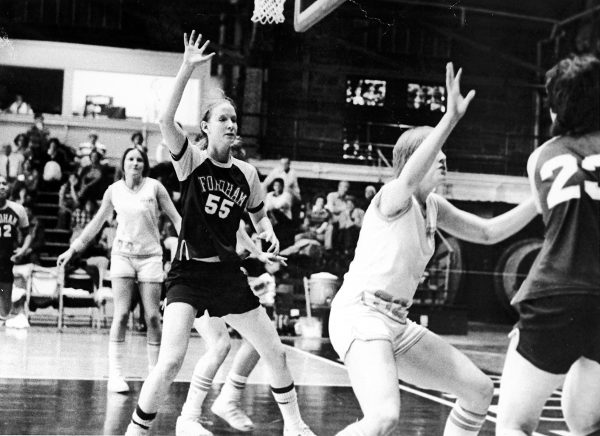
Gregory-O’Connell is not alone in her athletic excellence; the Fordham Athletics Hall of Fame and record book is full of incredible female athletes. Some of these incredible women include, but are not limited to: Fordham softball’s Jen Mineau, FCRH ’12, who set 16 records during her time with the program, including career marks for wins at 101 and 1,390 strikeouts; track and field’s Lauren Gubicza-Brennan, FCRH ’93, who qualified for the NCAAs and the U.S. Olympic trials in 1992; and Brienne Ryan, FCRH ’13, who also made it to the Olympic trials and in 2012 became the first female Fordham swimmer to compete at both the NCAA Championship and U.S. Olympic trials. Recently, former women’s rower, Fiona Murtagh, FCRH ’16, won gold medal in women’s single sculls at the World Rowing competition representing the Irish National team.
Fordham University currently has 13 A10 Championship wins by women’s teams: women’s basketball in 2014 and 2019; softball with 9 in 2022, 2019, 2018, 2017, 2016, 2015, 2014, 2013 and 2011; swimming and diving in 2010; and tennis in 2023.
“To me, being a female athlete means being strong and confident and being a leader within your community.” Shannon Lulley, FCRH ’16
Over the last 56 years, student-athletes at Fordham have been a cornerstone of Fordham’s athletic success. This stardom goes beyond the athletes; from administrative roles, to the Sports Medicine and Strength and Conditioning Departments, to Fordham’s coaches, there are women in every corner of the Athletics department.
Fordham currently has three female head coaches within the Athletics department: Kayla Armfield, for cheerleading, Jenna Stamps for dance and Melissa Inouye for the women’s softball program, who just won her 300th game with the program.
Before Shannon Lulley, FCRH ’16, was the senior associate athletic director for Strategic Initiatives at Fordham, she was a member of the Rams’ swimming and diving program. One of the projects Lulley worked on for the Athletics department is Fordham’s National Girls and Women in Sports Day (NGWSD), an annual youth clinic for young girls within the New York City community hosted by student athletes across the department. NGWSD has given female student athletes the opportunity to be role models for a younger generation.
“Being a female athlete means redefining strength as a characteristic usually reserved for men. To me, being a female athlete means being strong and confident and being a leader within your community,” Lulley said.
“You learn to challenge stereotypes about what female athletes ‘should’ or ‘shouldn’t’ do in the weight room. That shared mindset of proving strength, resilience and capability creates a strong bond.” Brittany VanderGroef, assistant strength and conditioning coach
Through Lulley’s transition from student-athlete to administrator within the Fordham Athletics department, Lulley has found a new way to create opportunities for women in sports.
“Graduating as a student-athlete from Fordham to now working as an administrator has allowed me to see the inner workings of an athletic department and experience firsthand how we are creating opportunities and spaces for women within our department,” Lulley said. “I love being able to share my experience with current student-athletes and help guide them through their journey at Fordham.”
Creating space for female athletes to grow and improve is on the forefront of Assistant Strength and Conditioning Coach Brittany VanderGroef’s mind. VanderGroef has been part of Fordham’s strength and conditioning team for five years and works with both the men’s and women’s athletic teams at Fordham.
“There’s also a different kind of motivation that comes from training alongside other women. It can feel less intimidating and more encouraging, especially in spaces that have traditionally been male-dominated,” VanderGroef said. “You learn to challenge stereotypes about what female athletes ‘should’ or ‘shouldn’t’ do in the weight room. That shared mindset of proving strength, resilience and capability creates a strong bond.”
Working with female athletes in strength and conditioning, for Vandergroef, is about growth, accountability and mutual empowerment.
“You’re not just getting stronger individually. You’re helping build a culture where strength, in every sense, is supported and celebrated,” VanderGroef said.
Women’s collegiate athletics has seen a lot of changes over the course of the last 50-plus years and the women within the Athletic Department at Fordham have not only empowered these changes but have highlighted their necessity.
“The biggest change I’ve seen is this: Women’s sports have gone from fighting just to exist, to now competing for equal respect, investment and visibility. At Fordham, that looks like steady institutional progress with room to grow,” VanderGroef said.