


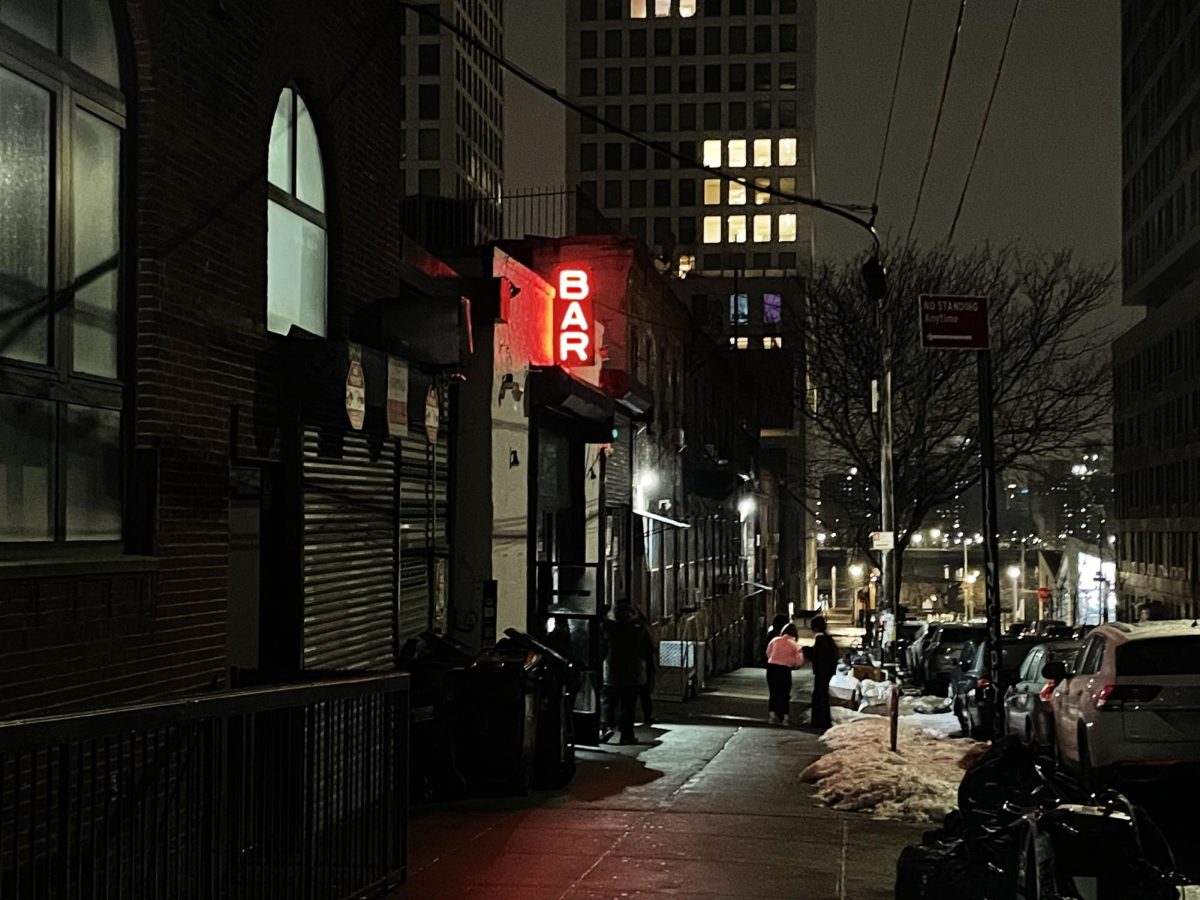
Every Wednesday, a Williamsburg bar called The Woods changes form. Lesbians travel from far and wide; as they flow through the bar’s entrance, what was a regular Brooklyn bar in the daytime transforms into what lesbians know as a “Wednesday at The Woods.”
The Woods and I have a weird relationship. I swing back and forth from forbidding myself from ever going back to then planning a night out two weeks in advance. Our turbulent past goes back to when I first moved to New York City, and among other Fordham lesbians, I started to hear the mumblings of the two W’s. After first being introduced to The Woods, I felt a pull to go back every week. Now, any mention of a “Wednesday at The Woods” sends me back into a dizzying frenzy under neon lights as I’m sandwiched between a former lover and a Hinge date.
Despite my love for The Woods, it isn’t a lesbian bar. This was a revelation to me. According to The Lesbian Bar Project, there are only 36 lesbian bars across the United States, six of which are in New York City: Henrietta Hudson, Cubbyhole, Ginger’s Bar, Boyfriend Co-Op, The Bush and Gladys Books & Wine. This made me think, “What bars should I go to when it’s not a “Wednesday at The Woods”? And what are the ramifications of prioritizing “lesbian nights” rather than brick-and-mortar locations?
I hate to take the tone of an ignorant Gen Zer, but I like to get a little lit, and Cubbyhole’s relatively older crowd and small space make for a night more relaxed than lit.
I’ve always considered Manhattan to be a very queer place — especially the West Village and Hell’s Kitchen. However, a majority of the bars in this area are catered to queer men. While Henrietta Hudson and Cubbyhole are lesbian bars based in Manhattan, the other four bars are scattered around Brooklyn. I’m located on the Upper West Side, so it would be a lie to say that going to Brooklyn for a night out isn’t a trek. Usually, I make that trek for The Woods because I know that I’ll be satisfied with the night. There’s a great sense of excitement knowing that if I spend a “Wednesday at The Woods,” I’ll likely meet other young lesbians who go to Columbia University, Pace University and even Fordham. Most of them run in the same circles I’m in, but we never had a chance to formally introduce ourselves until then. After considering my struggle to reach Brooklyn, I started to realize there aren’t that many bars where I can find people like me and have a good time out.
One of the nights that I ventured out from The Woods, I ended up finding myself in the West Village. Along with a friend, we decided to go to Cubbyhole. The famous bar has a rich history involving the queer rights movement of New York City in the 1970s. Living up to its name, it sits at only 824 square feet. The intimacy I found myself in wasn’t what I initially had hoped for: squished between other bodies during the summer night heatwave. It didn’t help that when I tried to flirt with someone and then attempted my great escape with a classic Irish goodbye, I only made it a couple of inches until I was absorbed into the massive crowd as if it were gay oobleck. I hate to take the tone of an ignorant Gen Zer, but I like to get a little lit, and Cubbyhole’s relatively older crowd and small space make for a night more relaxed than lit.
I was so used to my nights at the Woods; with two bars, a dance floor and even a backyard, I couldn’t be more satisfied. So, I continued to go to The Woods on Wednesday nights. It wasn’t until I did my own research into Cubbyhole and the history of its lesbian nightlife scene that I realized a “Wednesday at The Woods” was never really serving my community. This entire time, we were dancing on borrowed ground like gay couch surfers. The Woods hosted us only for one night, and then let us scatter across the different boroughs in an attempt to find our next space.
The precarious nature of nightlife is that it’s the people that make a space what it is, but we are as impermanent as spaces themselves. Think of Studio 54: Despite being open for only 33 months, stories of the space and its wild nights live on through those who encountered it firsthand. So while I adore the charm of a “Wednesday at The Woods,” a singular night creates a complacency where its guests inherently know what to expect. The whimsy and spirit are taken from the experience. On the same note, the crowd that congregates every Wednesday is a concentrated version of other lesbian bars’ regular crowds. But if it is the crowd that makes it undeniably special, in 20 years, when the crowd has long moved on, will there be anything worth remembering about it?
The nascence of the Radicalesbians and the group’s tribulations on that day persist into the present day as queer people continue to fight to have dedicated spaces for our community.
In 2022, when lesbian bars hit a record low, it was Cubbyhole, Henrietta Hudson and Ginger’s Bar that kept lesbian nightlife afloat. It wasn’t until 2023 that The Bush opened, followed by the opening of Gladys Books & Wine and Boyfriend Co-Op. But 38 years ago — when Cubbyhole had just reopened its doors to the public — one of Cubbyhole’s patrons and bouncers was queer rights activist Stormé DeLarverie, a butch lesbian drag king. Compared to other queer activists of the time, DeLarverie has never gained much recognition despite being rumored to have thrown the first punch during the Stonewall Uprising of 1969.
It wasn’t until the early 2000s, when DeLarverie was in her 90s, that this historic event and her name came to share the same sentence. In a 2008 interview with Patrick Hinds for the magazine Curve, Hinds asked DeLarverie about the “Stonewall Lesbian” and she outright debunked any suspicion of it being a rumor, stating, “they were talking about me.”
Without queer figures like DeLarverie and their stories being publicized, it may take one a long Google search and time sifting through historical moments in order to finally learn about the lesbians that have been discounted and left out to dry by their own community. Take the Lavender Menace action on May 1, 1970, as an example. Lesbian defectors from the Gay Liberation Front formed a group called the Radicalesbians, who stormed a conference. Excluded from the second-wave feminist movement by the National Organization for Women, in fear that they would bring about the stigma of being “man-haters,” their disruption of the conference was a call to action for their inclusion. The nascence of the Radicalesbians and the group’s tribulations on that day persist into the present day as queer people continue to fight to have dedicated spaces for our community.
This issue is even more pressing under the Trump administration, with the recent removal of the pride flag from the Stonewall Monument. It raises the troubling thought that queer spaces are easily malleable to external forces, possibly jeopardizing the spaces themselves. Queer activists of the 1970s, like DeLarverie, fought for the security of these spaces and their history should be respected. While the monument is still holding strong in the West Village, the physical presence was missed for the time that it was removed.
Although I’ve had one poor experience at Cubbyhole and a couple of great experiences at The Woods, I’ll never dismiss the relevance of Cubbyhole as a safe haven for lesbians and queer people. The fact that it has withstood the test of time since the 1980s is commendable. Its space is always there for lesbians, old and new. Permanent spaces will afford my community an insurmountable amount of support that it desperately needs right now. While new lesbian bars continue to pop up in Brooklyn, and The Woods will always have Wednesday nights, if there’s one thing we should prioritize right now, it’s the history and permanency of the spaces we share.