


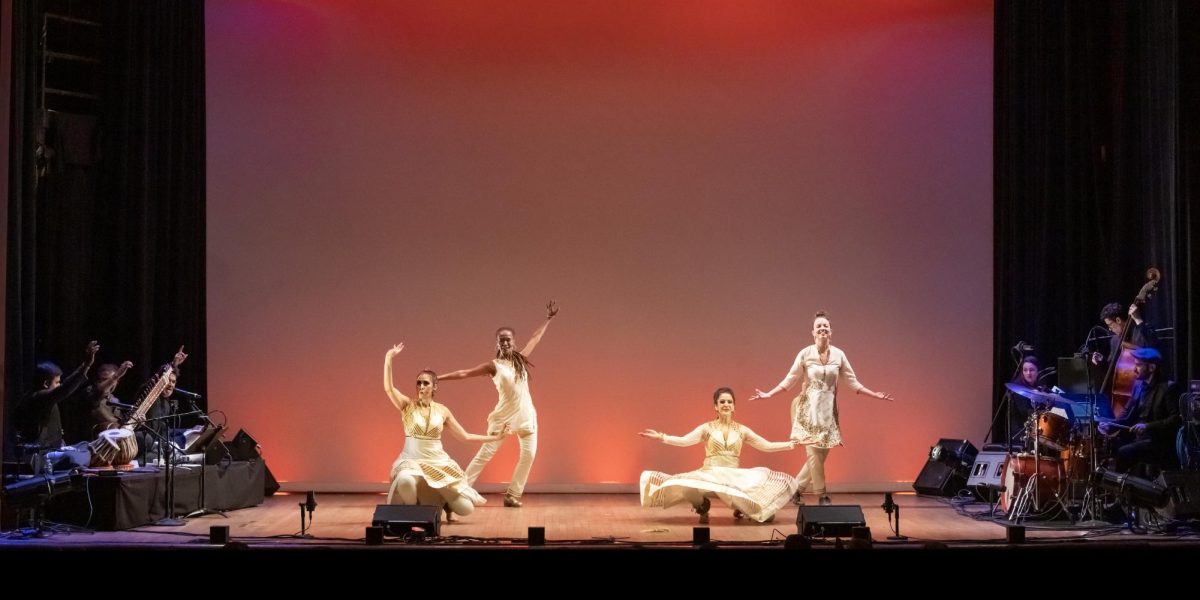
To understand the magic of the “What Flows Between Us” dance festival, just look at its name. Held on Feb. 21 at 92NY — an over 150-year-old cultural center and performance space on the Upper East Side — the event showcased the profound impact that mutual, cross-cultural appreciation and conscious collaboration can offer.
Dancer, educator and activist Rachna Nivas curated the festival’s lineup of female performers as part of 92NY’s season titled “Women Move the World.” The event highlighted the connection between traditional Indian Kathak dance and American tap, as well as the broader interaction between traditional Indian arts with global and newer works. The result: a day for both honoring tradition and utter joy.
“Nobody is trying to change one another. No one culture is trying to dominate another culture. No culture is absorbed into another culture,” Nivas said on how the event exemplified what “multiculturalism should look like.”
The day-long program included dance and music performances, an arts market, Indian buffet-style meals and “SPEAK,” an unforgettable culminating performance featuring Nivas herself, alongside fellow Kathak dancer Rukhmani Mehta and tap legends Michelle Dorrance and Dormeshia. Attendees could purchase separate tickets to the morning and afternoon performances, as well as the evening performance of “SPEAK.” Lucky attendees attended multiple, or all, parts of the festival.
The highlight of the day, however, was undoubtedly ‘SPEAK,’ an extraordinary showcase of the connection between kathak and tap, accompanied by classic Indian vocals and tabla, and American jazz piano, kit drums and bass
At morning and afternoon performances, each artist was preceded by a short video of Nivas proudly introducing the performer and subsequently sneaking in a crash course in Indian music and dance. In between shows and at intermission, attendees strolled through the artisanal marketplace and treated themselves to a hot chai. The catered dinner provided an opportunity for audience members and the artists themselves to come together, sharing what brought them to the festival that evening — whether they traveled across Lexington Avenue to experience a new form of dance or across state borders to see their cousin perform.
The highlight of the day, however, was undoubtedly “SPEAK,” an extraordinary showcase of the connection between kathak and tap, accompanied by classic Indian vocals and tabla, and American jazz piano, kit drums and bass. For Nivas, the piece serves as an example for her belief in what cross-cultural collaboration should look like. It’s strictly not “fusion,” Nivas said, but instead, “a very calculated type of expansion.”
That expansion began many years ago, when Nivas’ guru, Chitresh Das, collaborated with tap artist Jason Samuel Smith. A connection between a 65-year-old Indian dance guru and a 24-year-old Hell’s Kitchen tapper is unexpected, but it highlighted something special between the two styles and brought Nivas into the tap world, where she met female tappers and developed her interest in exploring the cross-genre connection from the female perspective. When Das passed, Nivas said it made it feel all the more important to continue his legacy.
There are many elements on the stylistic level that lend themselves to kathak and tap’s fruitful combination (notably, their percussive feet movement and use of improvisation), but Nivas said it is a lot deeper than that.
The only way to have that ability is to study it is to have knowledge. … If you don’t have knowledge, then it’s easy to discard things Rachna Nivas, Dancer and activist
The connection involves a “common reverence that we have for lineage, a reverence that we have for elders, and for rigor of practice and rigor of philosophy, and being cultural historians,” she said.
Alongside her appreciation, however, Nivas is conscious of her relationship with the word tradition.
“The word tradition can be abused a lot. It can be used as a way of hanging onto something that’s actually not good. … It can be used as a way to lean on it despite it being a form of oppression, despite it being something that’s causing harm,” Nivas said.
That awareness is why she prefers to call herself a “radical traditionalist.” She said that figuring out how to honor one’s traditions requires a “fine-tuned brush” and a deep understanding of not only tradition itself, but of one’s own intention in highlighting it.
“The only way to have that ability is to study it is to have knowledge. … If you don’t have knowledge, then it’s easy to discard things,” she said.
I think collaboration is very powerful, very transformative, and can be a profoundly spiritual experience, and that can only happen if you are deeply deeply rooted in your own form Rachna Nivas, Dancer and activist
This intensity of study was the source of “SPEAK”’s magic. For Nivas, as well as for Mehta, Dorrance and Dormeisha, their collaboration was never about compromising.
“We are the purists,” Nivas said. Experimenting with each other’s movement styles was about deepening their own work, not trying to dull it down in any way.
“I think collaboration is very powerful, very transformative, and can be a profoundly spiritual experience, and that can only happen if you are deeply deeply rooted in your own form,” Nivas said.
The performancer’s complete assurance — a willingness to share the stage and appreciate, while simultaneously moving with complete ease and grace — was obvious on stage throughout “SPEAK.” The choreography, which contained solos and duets and culminated with the whole cast onstage, felt more like a conversation than a performance. As they improvised, impressed and inspired the performers next to them, the faces of the dancers and musicians alike were plastered with genuine and contagious smiles.
“We are finding commonalities that remind us of our shared humanity,” Nivas said.
Is that humanity not the backbone of all art? At “What Flows Between Us,” it definitely was. Whether over dal at dinner, between dancers and drummers or among excited audience members during the dancer’s final bow, every attendee left the festival knowing that the only true way to judge good art is by the connection it creates. In that measure, “What Flows Between Us” was off the charts.