


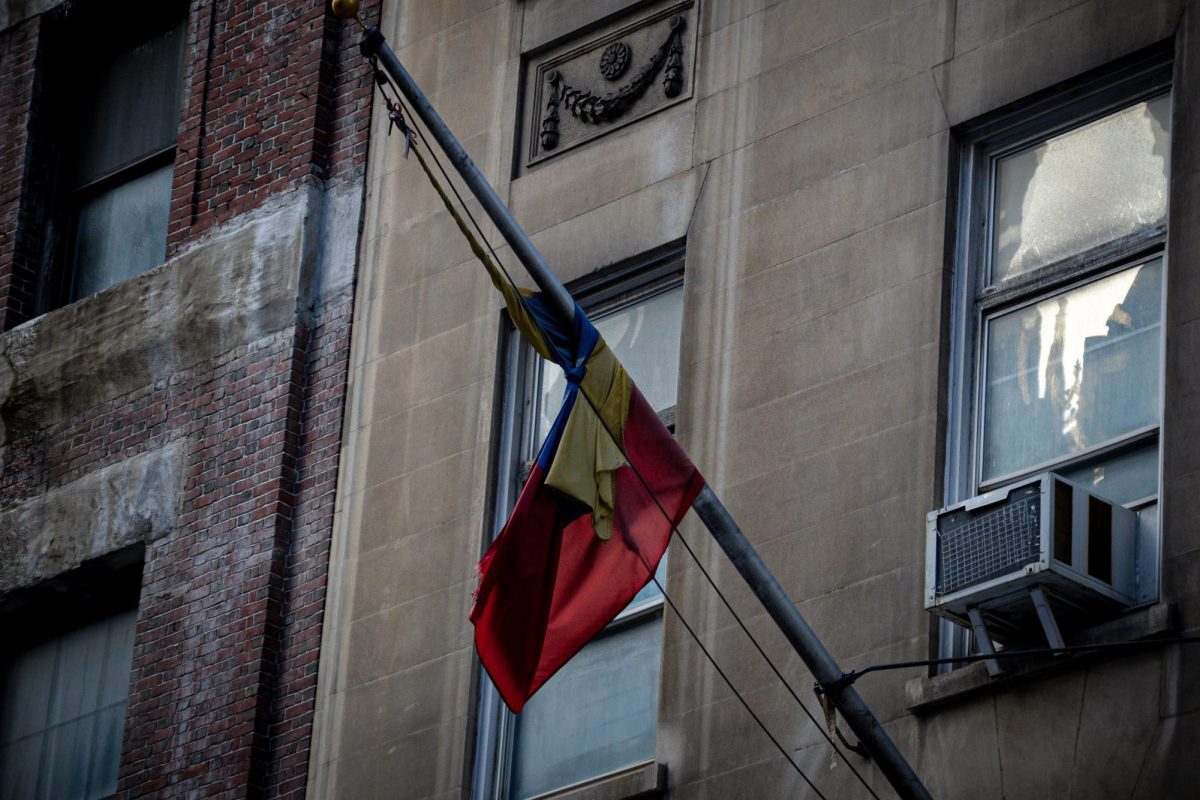
Venezuelan President Nicolás Maduro was extradited from his home in Venezuela on Jan. 3 to the Metropolitan Detention Center (MDC) in Brooklyn by the United States (U.S.) Army Delta Force and is facing charges for narcoterrorism, cocaine importation, conspiracy and weapons offenses.
The Trump administration’s actions have sparked dialogue among nations and the Fordham community about the future of Venezuela’s political structure, and what role the United States should play in shaping it.
Cilia Flores, Maduro’s wife, was arrested on the same charges. Flores is also being accused of collaborating with top Venezuelan officials in a drug trafficking network called “Cartel of the Suns” to move cocaine into the U.S.
U.S. Attorney General Pamela Bondi took to social media after Maduro and Flores were arrested to issue a statement saying that “Nicolas Maduro and his wife, Cilia Flores, have been indicted in the Southern District of New York,” and “they will soon face the full wrath of American justice on American soil in American courts.”
Maduro and Flores pleaded not guilty during their initial court appearance on Jan. 5.
The U.S. District Court for the Southern District of New York will handle the case. Maduro and Flores pleaded not guilty during their initial court appearance on Jan. 5.
That same day, the Supreme Tribunal of Justice, the highest court in Venezuela, appointed Delcy Rodríguez, formerly vice president, as interim president. Rodríguez has previously held other governmental roles, including serving as minister of petroleum and minister of economy and finance. Article 234 of Venezuela’s Constitution states that, if a president is temporarily unable to serve, they shall be replaced by the executive vice president for a period up to 90 days, which can be extended to six months.
Carl Fischer, a professor of Spanish at Fordham specializing in contemporary Latin American literature, said that he questions whether the country’s new president can realistically navigate the conflicting domestic and international demands she may face.
“I’d just say that I’m skeptical that the new president of Venezuela, Delcy Rodríguez, can balance the different pressures that are on her over the long run: how is it possible to have policies that simultaneously satisfy the right-wing Trump administration and also the hard-left leadership that continues to be in power in Venezuela, alongside Rodríguez?” Fischer said.
Venezuelan authorities, however, draw their mandate from an electoral process that did not respect democratic change. So the European Union feels that the future of Venezuela must be based on inclusive dialogue that would include the participation of all actors working on behalf of democracy. Anitta Hipper, EU spokesperson
The European Union (EU) has raised concerns regarding Rodríguez as interim president. Anitta Hipper, spokesperson for the EU, cited the country’s electoral process as being indicative of ae lack of respect towards democratization.
“We said that Delcy Rodríguez has been sworn in as the interim President. The Venezuelan authorities, however, draw their mandate from an electoral process that did not respect democratic change. So the European Union feels that the future of Venezuela must be based on inclusive dialogue that would include the participation of all actors working on behalf of democracy,” Hipper said.
On Jan. 30, Rodríguez announced an “amnesty law” for prisoners in Venezuela that could result in the release of hundreds of political prisoners. The U.S. Embassy for Venezuela released a statement on the same day saying that all U.S. citizens who were detained in Venezuela had been released, a claim that was difficult for some news organizations to confirm.
Rodríguez also announced that the El Helicoide Detention Center, a well-known prison facility in Caracas, will be shut down and converted into a center for sports and social services. El Helicoide was originally constructed to be a shopping mall, which was never completed. It was used during the Maduro administration for regular criminals and political prisoners. The facility is infamous for harsh conditions and human rights violations documented by various international human rights organizations.
We express our deep concern and rejection of the military actions carried out unilaterally in the territory of Venezuela, which contravene fundamental principles of international law. Such actions set an extremely dangerous precedent for regional peace and security and for the rules-based international order, in addition to endangering the civilian population,” the statement said. Joint Statement from Brazil, Chile, Colombia, Mexico, and Uruguay
Diego Henesy-Rodriguez, Fordham College at Lincoln Center ’28, is an American citizen who was born and raised in Panama. He is also the president of the Political Lens club, an organization that allows students to write about international foreign policy issues and grow their skills as writers.
Henesy-Rodriguez expressed skepticism regarding the sincerity of the interim president’s decisions, arguing that the prisoners’ releases should not be interpreted as a genuine act of democratization.
“It doesn’t take a lot of investigation to see that that’s almost like a tactic in a sense, like a way of making themselves be perceived as better and more free than the past,” Henesy-Rodriguez said.
Leaders from various Latin American countries have shared their reactions to Flores and Maduro’s extradition. Brazil, Chile, Colombia, Mexico and Uruguay released a joint statement, which was also signed by Spain.
“We express our deep concern and rejection of the military actions carried out unilaterally in the territory of Venezuela, which contravene fundamental principles of international law. Such actions set an extremely dangerous precedent for regional peace and security and for the rules-based international order, in addition to endangering the civilian population,” the statement said.
Venezuela’s oil isn’t a justifiable target for intervention, not by a long shot. Risking war or the further aggrandizement of presidential power, for such a spurious reason or even less spurious ones, is illegitimate and dangerous. Chris Dietrich, Professor of history
While many countries criticized the U.S.’s approach to the situation, there were some that praised the Trump administration’s actions, such as Israel and Argentina. Israeli Prime Minister Benjamin Netanyahu took to social media to congratulate Trump on his “bold and historic leadership on behalf of freedom and justice.” also writing, “I salute your decisive resolve and the brilliant action of your brave soldiers.”
The relationship between the U.S. and Venezuela has been complex for the last 26 years following former Venezuelan President Hugo Chávez’s election in 1999, after which he launched the Bolivarian Revolution, a highly controversial socialist movement.
Chris Dietrich, a professor of history at Fordham who studies U.S. foreign relations, placed the current political moment within this broader history and said the U.S. intervention in Venezuela is an exercise of imperial power rather than isolated diplomatic action.
“The United States has a long history of intervening in Latin American and the Caribbean. Indeed, one way to think about inter-American history is through the concept of U.S. empire, and to ask precisely how different presidential administrations have limited other nations’ economic sovereignty and justified intervention,” Dietrich said. “Venezuela’s oil isn’t a justifiable target for intervention, not by a long shot. Risking war or the further aggrandizement of presidential power, for such a spurious reason or even less spurious ones, is illegitimate and dangerous.”
People really oppose the Maduro regime, particularly outside of Venezuela where opponents can express themselves more freely than within it, and some of those people clearly have the ear of Marco Rubio and Trump. Carl Fischer, Professor of Spanish
When discussing Venezuela’s political evolution, Fischer noted that the nation’s governance has grown increasingly repressive under Maduro.
“They’ve become even more authoritarian since the Chávez era, meaning that there’s been more repression and a smaller concentration of power in fewer hands. People really oppose the Maduro regime, particularly outside of Venezuela where opponents can express themselves more freely than within it, and some of those people clearly have the ear of Marco Rubio and Trump,” Fischer said.
Henesy-Rodriguez shared a similar perspective that Maduro’s administration was a continuation of Chávez’s authoritarian governing.
“I can tell you right now, Maduro is like the second iteration of the authoritarian communism in Venezuela because the first was Chávez, and right now what we’re seeing is the disciple of Chávez continue on,” Henesy-Rodriguez said. “Tenure from Chávez to now has been the same sort of … benefit of the leadership at the sharp expense of the citizens including now a lot of oppressive anti-free speech.”
Venezuela is not the only country that the U.S currently has conflict with. In 2019, Trump first shared his desire to purchase Greenland, a proposition which was turned down by Denmark. Now, in his second term, Trump has increased his efforts to obtain the territory. Trump has threatened to increase tariffs on Denmark, Germany, France and the United Kingdom by 25% unless Denmark decides to sell Greenland to the U.S.
President Emmanuel Macron of France, Chancellor Friedrich Merz of Germany, Prime Minister Giorgia Meloni of Italy, Prime Minister Donald Tusk of Poland, Prime Minister Pedro Sánchez of Spain, Prime Minister Keir Starmer of the United Kingdom and Prime Minister Mette Frederiksen of Denmark have all issued a joint statement on Greenland.
“NATO has made clear that the Arctic region is a priority and European Allies are stepping up. We and many other Allies have increased our presence, activities and investments, to keep the Arctic safe and to deter adversaries. The Kingdom of Denmark – including Greenland – is part of NATO,” the statement said.
Maduro and Flores will make their next appearance in court on March 17, where defense attorneys will file motions challenging the legality of their arrest and pushing for immunity as former state officials.
