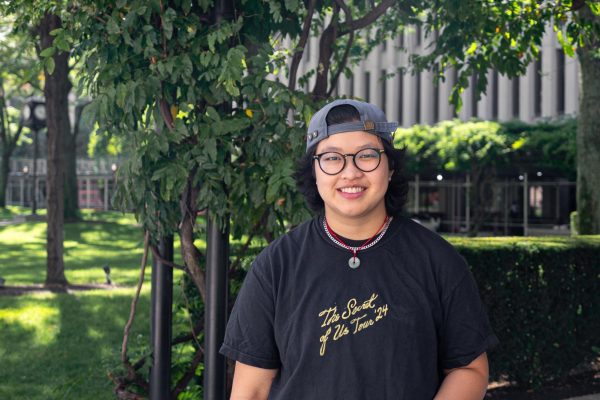

On Nov. 10, the 2025 Ann M. Sperber Prize was awarded to Ali Velshi, a Canadian journalist, senior economic and business correspondent for NBC News, and anchor for MSNBC News.
Velshi’s book “Small Acts of Courage: A Legacy of Endurance and the Fight for Democracy” was published in 2024. The book is both a family memoir and a meditation on democratic values: It details his ancestral roots tracing back to India, his birth in Nairobi, Kenya, and ultimately his immigration to Canada and then the United States.
Connie Chung, American journalist and reporter for multiple news networks, was also recognized at the event and awarded the Distinguished Career Award in honor of the prize’s 25th anniversary.
In 2024, Chung published her book “Connie: A Memoir,” which chronicles her career as a journalist spanning over 50 years. She gives an account of her experience as one of the first prominent woman journalists and the first Asian-American journalist to ever anchor a major network’s evening newscast.
The Sperber Prize is an annual award established at Fordham that selects titles published a year before the ceremony.
Chung’s career has included notable interviews with former President Richard Nixon after the Watergate scandal broke and with Magic Johnson shortly after he revealed his HIV-positive diagnosis.
“Small Acts of Courage” and “Connie: A Memoir” were in competition with several other finalists for the 2025 Sperber Prize: Stephan A. Smith’s “Straight Shooter: A Memoir of Second Chances and First Takes,” Calvin Trillin’s “The Lede: Dispatches From a Life in the Press,” and Larry Heinzerling and Randy Herschaft’s “Newshawks in Berlin: The Associated Press in Nazi Germany.” This year, 51 titles were considered for the award, with only five finalists chosen.
The Sperber Prize is an annual award established at Fordham that selects titles published a year before the ceremony. The winner receives a plaque and an honorarium of $1,000. The Sperber Prize money is given directly to the recipient in accordance with the original funding agreement with the Sperber family.
Members of the selection jury included Amy Aronson, Beth Knobel, John Matteson, Alan Sperber (brother of Ann M. Sperber), Charity C. Elder and Kathryn Olmsted.
Previous winners of the Sperber Prize include Seymour M. Hersh in 2019, whose memoir “Reporter” covered his career as an investigative journalist. In 2013, Douglas Brinkley won for his biography titled “Cronkite,” which detailed the life of Walter Cronkite, the distinguished news anchor often referred to as “the most trusted man in America.” In 2007, Myra MacPherson won for her biography “All Governments Lie! The Life and Times of Rebel Journalist I.F. Stone.” This book covered the life of I.F. Stone, an investigative journalist known for his newsletter in which he exposed government deception and corporate and political corruption.
The Sperber Prize was established in 1999, honoring Ann M. Sperber, the author of a biography on Edward R. Murrow titled “Murrow: His Life and Times.” Sperber spent 30 years writing her novel on Murrow, which covered his life and career. The book was one of four finalists for the Pulitzer Prize for Biography or Autobiography in 1987. Sperber passed away in 1994, and the award was established to honor her life and work.
“This year’s honorees, Connie Chung for her beautiful memoir and Ali Velshi for ‘Small Acts of Courage,’ show us how truth-telling can become a form of hope.” Tania Tetlow, University President
Murrow, who was a pioneer in broadcast journalism, was best known for his courageous coverage of World War II. Murrow is also known for his confrontation with Senator Joseph McCarthy during his March 9, 1954, broadcast segment on his show “See It Now.” Instead of interviewing McCarthy, Murrow ran his program “A Report on Senator Joseph R. McCarthy,” using clips from previous speeches McCarthy had given in regards to his stance on communism in the United States.
“The actions of the junior senator from Wisconsin have caused alarm and dismay amongst our allies abroad, and given considerable comfort to our enemies. And whose fault is that? Not really his. He didn’t create this situation of fear. He merely exploited it, and rather successfully,” Murrow said.
McCarthy, who is known for leading the anti-communist campaign in the U.S., gained national attention by claiming, in a speech, to have a list of 205 communists working in the U.S. State Department. Though he never provided any proof of these alleged communists, this spiraled into a Red Scare, a period of widespread fear of communism in the U.S. Murrow was able to use his platform to highlight McCarthy’s actions, which he deemed fearmongering and abusive.
“These books show how those who gather the news become translators of history. They capture the split-second judgments and quiet persistence that hold open a space for truth in public life,” Jessica Lang, Dean of the College of Arts and Science
Sperber was born in Vienna on June 20, 1935. Her parents, Manfred and Liselotte, had moved from Germany to Austria in 1933 after Adolf Hitler was appointed Chancellor of Germany. Manfred served as an accountant for the Jewish community in Vienna. Sperber and her mother moved to the United States in 1939, later joined by her father in 1940.
After graduating from Barnard College in 1956, Sperber began collecting information and researching during her time as a Fulbright Scholar in Berlin. Before Sperber started writing the biography, she was a children’s book editor working for Putnam and McGraw-Hill.
Sperber passed away on Feb. 11, 1994, from a heart attack. Sperber’s mother, Liselotte, established the Ann M. Sperber Prize here at Fordham.
University President Tania Tetlow began the event by delivering a welcome speech via video. Tetlow recognized the honorees and their dedication to protecting democracy throughout their careers.
“This year’s honorees, Connie Chung for her beautiful memoir and Ali Velshi for ‘Small Acts of Courage,’ show us how truth-telling can become a form of hope. Through their words and witness, they remind us that integrity still matters and that every act of honest storytelling helps keep democracy alive,” Tetlow said.
To introduce the significance of the honor, Dean of the College of Arts and Sciences Jessica Lang followed Tetlow, delivering a speech that reflected on the impact of the works celebrated by the Sperber Prize.
“Over a quarter (of a) century, Sperber Prize recipients have taken us from war zones to editorial rooms, from small local news desks to global centers of power. These books show how those who gather the news become translators of history. They capture the split-second judgments and quiet persistence that hold open a space for truth in public life,” Lang said.
Introducing Velshi, Aronson drew a direct connection between his mission and the principles Murrow championed.
“Murrow believed truth-telling is the duty of a free people. Velshi continues that work every day, informing, challenging and refusing to look away.” Amy Aronson, Selection Jury Member
“Murrow believed truth-telling is the duty of a free people. Velshi continues that work every day, informing, challenging and refusing to look away. And in doing so, he inspires us to find within ourselves those same small acts of courage that remind us who we are as a democratic society,” Aronson said.
After accepting the award from Alan Sperber, Velshi framed his speech around his understanding of citizenship. Having lived in five countries, Velshi shared his family’s journey: moving to a new continent, then to different countries, and again to another new continent, ultimately ending up in Canada.
“I didn’t become an American until 2015, long after I’ve been working here as a journalist, and technically, I’m a citizen of five nations. … I’m a citizen of India, the country of my family’s origin. I’m a citizen of South Africa, the country in which my family immigrated before I was born. I’m a citizen of Kenya, the country of my birth. I’m a citizen of Canada, my family’s adopted home, and for the last 11 years, I’m a citizen of the United States,” Velshi said.
A commonality between Velshi and Sperber is that they were both born abroad, but ultimately naturalized as American citizens.
Chung spoke on how structural discrimination shaped newsroom culture and how collective action helped her to overcome those hurdles.
When introducing Chung, Aronson shared highlights from Chung’s over half a century of experience, calling her “a voice as indelible as any in American broadcast news, evocative of the clarity of Edward R. Murrow and the steady moral compass of her mentor, Walter Cronkite.” She noted that over a career stretching across multiple newsrooms and networks, Chung “reported from Washington during Watergate, interviewed presidents and world leaders, and became the first woman to co-anchor the CBS Evening News.”
After receiving the award, Chung recalled the barriers that women faced in the early days of her career. She spoke on how structural discrimination shaped newsroom culture and how collective action helped her to overcome those hurdles. Before sharing her own path in journalism, Chung recounted a moment when a group of women at Newsweek challenged the system that kept them from advancing.
“All the women were only hired as researchers. They were not allowed to be reporters, writers, editors, anything. They were pigeonholed as researchers; they were very annoyed with this. They decided that they would meet in the ladies’ room — the only place they could get some privacy — and they met and decided to file a class-action lawsuit against Newsweek, and it was only because the 1964 civil rights law was passed and created the Equal Employment Opportunities Commission,” Chung said.
During the question-and-answer portion of the event, Chung and Velshi shared a similar sentiment about the state of journalism today.
“We’ve seen the consequence of (news media) becoming unreliable … (the public) don’t trust us; they don’t watch us.” Ali Velshi, Ann M. Sperber Prize Winner
“I think Connie and I probably share the same view that the moment we’re most distraught about is right now in journalism … and when I say ‘this moment,’ I mean the last couple of years, the idea that the interests of our news organizations are not aligned with what the interests of the American people should be — they’re aligned with something else. … We’ve seen the consequence of (news media) becoming unreliable … (the public) don’t trust us; they don’t watch us,” Velshi said.
Velshi and Chung also shared their understanding that journalism is constantly changing and how that is reflected in this point in American history.
“You are seeing the best in some journalists and … you are seeing the worst in them on the very same day in many cases. … The battle for the soul of this country and this world is also the battle for the soul of journalism right now,” Velshi said.
After the ceremony, Velshi reflected on the milestone anniversary and what the Sperber Prize represents at a time when there is a lot of pressure on the press. He emphasized that the award’s significance extends beyond professional recognition, touching directly on the health of a democratic society.
“Listen to that conversation that we had tonight. I mean, these are people who care about the future of democracy. This is not about journalism anymore, right?” Velshi said. “It’s this idea that if journalism fails, democracy fails. So in this moment, to be awarded this, I mean I’m very proud of my book, but to be awarded by an institution like Fordham … and to be able to get into this discussion (at) this moment in time, has got to be one of the most valuable discussions I’ve had in a very, very long time.”
Aronson reflected on the importance of the Sperber Awards celebrating 25 years, and the values that the award has championed.
“This milestone affirms the Sperber Prize’s commitment to journalism that pairs courage with conscience — reporting that meets the moment without flinching and enables democracy to recognize itself in full,” Aronson said.
Aronson confirmed that the Sperber Prize Jury has already started to receive nominations for 2026.
Aronson explained that the research process for potential entrants in this year’s ceremony began in January 2025. Every year, the nomination period ends on Feb. 1, and the jury then receives a narrower list of titles in April. The decision is made in early September and announced by Oct. 1.