
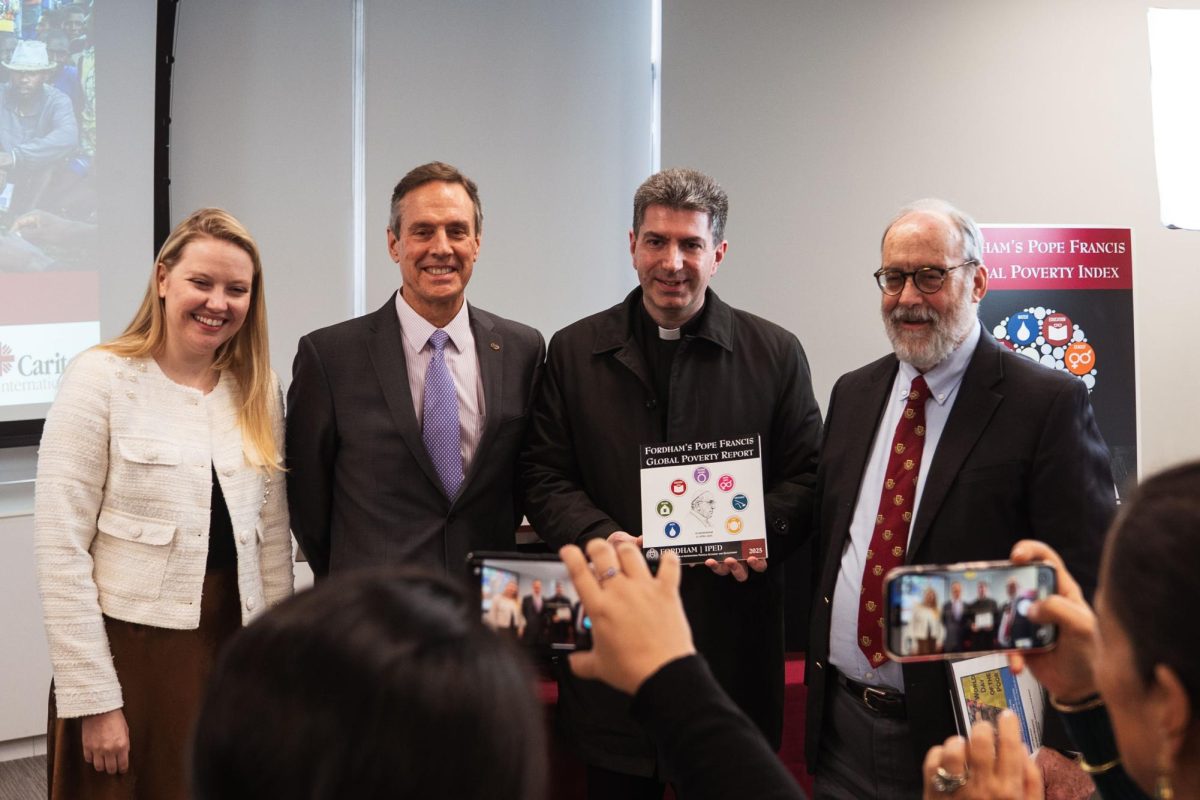
The 2025 Fordham Francis Index (FFI), a multidimensional global poverty report, found that global poverty has stagnated at 25.5% over the last two years following an initial recovery from the acute effects of COVID-19. This indicates that the poor are still worse off after the pandemic than they were before. These findings were presented by Fordham’s Graduate Program in International Political Economy and Development (IPED) at a forum at the Church Center for the United Nations (UN) on the morning of Nov. 14.
Around 100 professors, graduate students and members of the UN and various charities attended in person and over the livestream.
The yearly event commemorates the World Day of the Poor, which falls on the 33rd Sunday of Ordinary Time (Nov. 16 this year). This observance was created by the late Pope Francis in 2017 to encourage Catholics to reflect on how alleviating the suffering of those in need lies at the core of the Church’s teachings.
“To enable these real men and women to escape from extreme poverty, we must allow them to be dignified agents of their own destiny.” Pope Francis
This year’s FFI also marks the decade anniversary of Francis’ Sept. 2015 address to the UN, which urged global leaders to address spiritual and material poverty. The FFI was created in 2016 in response to this call and is part of a spring course taught by Henry Schwalbenberg, associate professor of economics at Fordham and editor of the FFI.
“To enable these real men and women to escape from extreme poverty, we must allow them to be dignified agents of their own destiny,” Francis said. “At the same time, government leaders must do everything possible to ensure that all can have the minimum spiritual and material means needed. … In practical terms, this absolute minimum has three names: lodging, labour, and land; and one spiritual name: spiritual freedom, which includes religious freedom, the right to education and all other civil rights.”
The FFI, pulling from this mission and the Catholic tradition, is distinct from comparable poverty indices because it not only measures four material needs — water, food, housing and employment — but also three immaterial needs — education, gender equity and religious freedom. This focus sits within a broader aid strategy shared by many humanitarian organizations not only to provide emergency relief, but also to give local people and governments the tools to enact systemic change in their own communities.
“We’re providing services to people in need, but we’re (also) trying to empower people in need so they can take charge,” Schwalbenberg said.
“It’s in their hands to make the changes happen and we can help them, but we can’t do it for them and we can’t assume that they can’t do it for themselves.” Sean Callahan, president and CEO of CRS
The event was co-sponsored by Catholic Relief Services (CRS), the official international humanitarian organization of U.S. Catholics, and Caritas Internationalis, a confederation of 162 Catholic aid organizations around the world. Sean Callahan, president and CEO of CRS, delivered a keynote address at the event, which outlined CRS’s new strategy, “In Their Hands.” Their approach recenters the agency and dignity of those in need by working closely with local governments to make foreign aid programs self-sufficient.
“It’s not in our hands. It’s in the hands of the people that we’re working with. It’s in their hands to make the changes happen and we can help them, but we can’t do it for them and we can’t assume that they can’t do it for themselves,” Callahan said. “The IPED study is a tool that we can use to understand different situations and to help people.”
The 2025 FFI found small improvements in access to water, employment and education, while access to food and religious freedom have gone down. Issues with housing and gender equity have not improved.
As of 2022, approximately 707 million people, 8.8% of the global population, did not have access to drinking water. The report defines adequate drinking water as clean and “readily accessible when needed without undue burden,” meaning collection time cannot exceed thirty minutes. Since 2013, there has been a steady decline in access.

The percentage of people suffering from undernourishment went up from 7.6% in 2018 to 9.1% in 2022. Changes in the definition of inadequate housing made the presenters “hesitant” to analyze global trends over the last nine years.
Employment, the fourth indicator of material well-being, is measured by “distressed labor rate” — including both those who are unemployed and those who are employed, but earn less than a minimum daily salary of $3.65 a day. This measure saw improvement from 2013 until a sharp drop in 2020. It has since recovered, but progress has slowed.
The most severe deficiencies for these four material needs were highly concentrated in sub-Saharan Africa and a few countries elsewhere, like Haiti, Afghanistan and Venezuela.
Almost all of the 2025 FFI only shows data up to 2022 or 2023. The FFI pulls from a variety of external statistical sources, which are not immediately updated. According to Schwalbenberg, new developments to the current global aid crisis will not be reflected in the data for approximately two years.
The U.S. Agency for International Development (USAID) was shut down in July after 83% of its programs were systematically cut earlier this year. Elon Musk’s Department of Government Efficiency spearheaded many of these changes to counter alleged “waste, fraud and abuse” in how the programs’ funding was being used.
In August, the Trump administration cut another $4.9 billion in foreign aid that had already been approved by Congress. Additionally, even though the government reopened on Nov. 13 — after the longest shutdown in U.S. history — with a temporary funding measure, much foreign aid is still being debated.
Callahan criticized the narrative of “waste, fraud and abuse” as part of a stream of misinformation on the true impact of humanitarian aid, leading to a public crisis of trust.
“This kind of disinformation that the assistance is being misused was incorrect, but I don’t think we did a good job of telling the story on how we could help and move people forward, and I don’t think we did a good enough job of taking risks to show how we would do things differently,” Callahan said. “We have to show people (that) we’re changing things now, we’re doing things more efficiently and better, we’re helping people, and be able to prove it.”
“When we think about, ‘(Is) international aid in crisis?’, my comment is, ‘Yeah, we’ve been in crisis for a long time.’” Sean Callahan, president and CEO of CRS
CRS’s funding from USAID was cut by 40%, forcing the organization to lay off staff and consolidate programs for greater efficiency. Callahan was optimistic about CRS’s ability to adapt. However, many humanitarian agencies have expressed concerns that the cuts will lead to millions of preventable deaths, particularly given that many European countries have also recently slashed foreign aid spending. They are redirecting funds to defense after the 2025 NATO summit approved Trump’s plan to increase the defense budget to 5% of each nation’s gross domestic product (GDP).
Callahan characterized the global aid crisis in a constructive way, pointing to the long history of both a lack of funding to alleviate global suffering and the dedicated service of organizations like CRS.
“When we think about, ‘(Is) international aid in crisis?’, my comment is, ‘Yeah, we’ve been in crisis for a long time,’” Callahan said.
Significant variations between countries with similar economic constraints are likely due to differences in access to immaterial needs, particularly religious freedom.
Regarding immaterial needs, recent one-year trends show an improvement in education, as illiteracy rates have mostly declined since 2013. Gender inequity, in contrast, has significantly worsened since 2014, though this rise has plateaued in recent years. In 2023, around two billion women lived in countries with severe gender discrimination. This data comes from the Health and Survival Index (HSI), which looks at both the gender gap in life expectancy and female infanticide in countries with strong cultural preferences for male children. Gender inequality was particularly severe in China, despite the nation’s wealth.
“It’s a much deeper cultural component of life rather than something that can be easily fixed by providing some material assistance,” Schwalbenberg said. “So I think that’s going to come over dialogue and long-term dialogue and … education.”
Schwalbenberg pointed to the interconnectedness of many of the seven basic needs and said an increase in one will likely lead to improvements in another.
Religious freedom also saw a decline, with over 4.7 billion people living in countries where it was severely restricted in 2022. The three immaterial needs were most lacking around Asia, North and West Africa, and the Middle East.
For both the material and immaterial needs, the FFI found that GDP accounts for 71% of the changes. The other 29% was attributed to social, cultural and political factors. Significant variations between countries with similar economic constraints are likely due to differences in access to immaterial needs, particularly religious freedom.
The FFI was presented by Schwalbenberg to Francis nearly every year since its creation. This year, it was honorifically presented to Monsignor Marco Formica, permanent observer of the Holy See to the UN, who will pass it on to Pope Leo.