



Fordham Theatre’s second mainstage production of the 2025–26 season opened on Nov. 13 in Pope Auditorium. Guest director Ryan Quinn envisioned a nuanced adaptation of William Shakespeare’s classic play “The Tempest,” a story following the sorcerer Prospero’s plot to restore his dukedom after he has been exiled to a remote island. With various characters embarking on quests to claim ownership of their fate, the play offers a relevant message on controlling one’s own narrative.
At a time when our generation witnesses and participates in “cancel culture,” the play’s themes of forgiveness and agency grow more resonant. Quinn shared his admiration for Shakespeare’s storytelling, as the characters in his works often endure common obstacles that connect humanity from the past to the present.
“I think what this play offers is not actually control, but letting go. I feel that there are narratives that people tell us of what we’re supposed to be, how it is that we’re supposed to act and what it is we’re supposed to do,” Quinn said. “We sometimes become secondary to a story that’s already been told about us.”
“When we play that fast, we as actors stop thinking, and we just let Shakespeare take the wheel,” Ryan Quinn, Guest Director
The show began with an atmospheric tension of island ambience and ominous lighting. Adriana Braganza, Fordham College at Lincoln Center (FCLC) ’29, worked as a member of the deck crew and called the opening sequence “eye-catching.”
In the first scene, the cast of characters are shipwrecked in a tumultuous sea storm brought upon by Prospero’s sorcery. Since Prospero has been exiled, he has taken it upon himself to colonize the island, but his main goal is to restore his power as the duke of Milan. The characters on the ship are all subjected to his ensuing schemes, like being hunted down by his subservient monsters, Ariel and Caliban. His daughter Miranda falls in love with Ferdinand, lost son of the Alonza, queen of Naples, and Prospero grapples with wanting the world for his child while simultaneously craving a return to the throne. Many of the other characters also take their new circumstances as a chance to pursue their desired fate.
Audience members may or may not be familiar with Shakespeare’s work, but the process behind the performance allows anyone to digest and comprehend the complex language. Quinn urged his performers to rehearse in an “Italian style” where they said their lines quickly rather than prolonging emotional beats. He said he prioritized “acting the fullness of every beat, but just at the speed of thought.”
“When we play that fast, we as actors stop thinking, and we just let Shakespeare take the wheel,” Quinn said.
“(The character) are going to discover, they are going to feel, they’re going to suffer, they’re going to find joy, but at the end of it, they just get the part of taking that next step over and over and over again.” Ryan Quinn, Guest Director
One standout example of Quinn’s adaptation of the text was the scene in which the stranded Neapolitans ponder their fate. Gonzalo (played by Maia Mcgowan, FCLC ’26) tries to inspire hope among the dejected crew, and trails after Alonza (played by Fiona Nealis, FCLC ’27), who is preoccupied with the loss of her son. Sebastian and Antonio (played by Avery Ash, FCLC ’28 and Kei Sugae, FCLC ’26) sit at a distance, mocking the futility of Gonzalo’s efforts. Ariel intervenes by putting Gonzalo and Alonza to sleep, and the power-hungry Antonio sees an opportunity to do away with them both. The incapacitated characters wake suddenly with knives held to their throats.
Without careful stage direction and coaching, the attitudes and stakes of this scene could have been lost in the web of dialogue. The actors, however, navigated it deftly — revealing the group’s unspoken turmoil and inner corruption.
An interesting and immersive choice was the specific music incorporated throughout the play. In the last scene of Act 1, moments of banter are complimented by the character Stephano (played by Brian Muñoz-Reyes, FCLC ’28) drunkenly singing “Sweet Caroline” and prompting the audience to sing along. Ariel sings a Nina Simone song later on. Both renditions of modern tunes caught the audience off guard and suffused the play with an irony Shakespeare would tip his hat to.
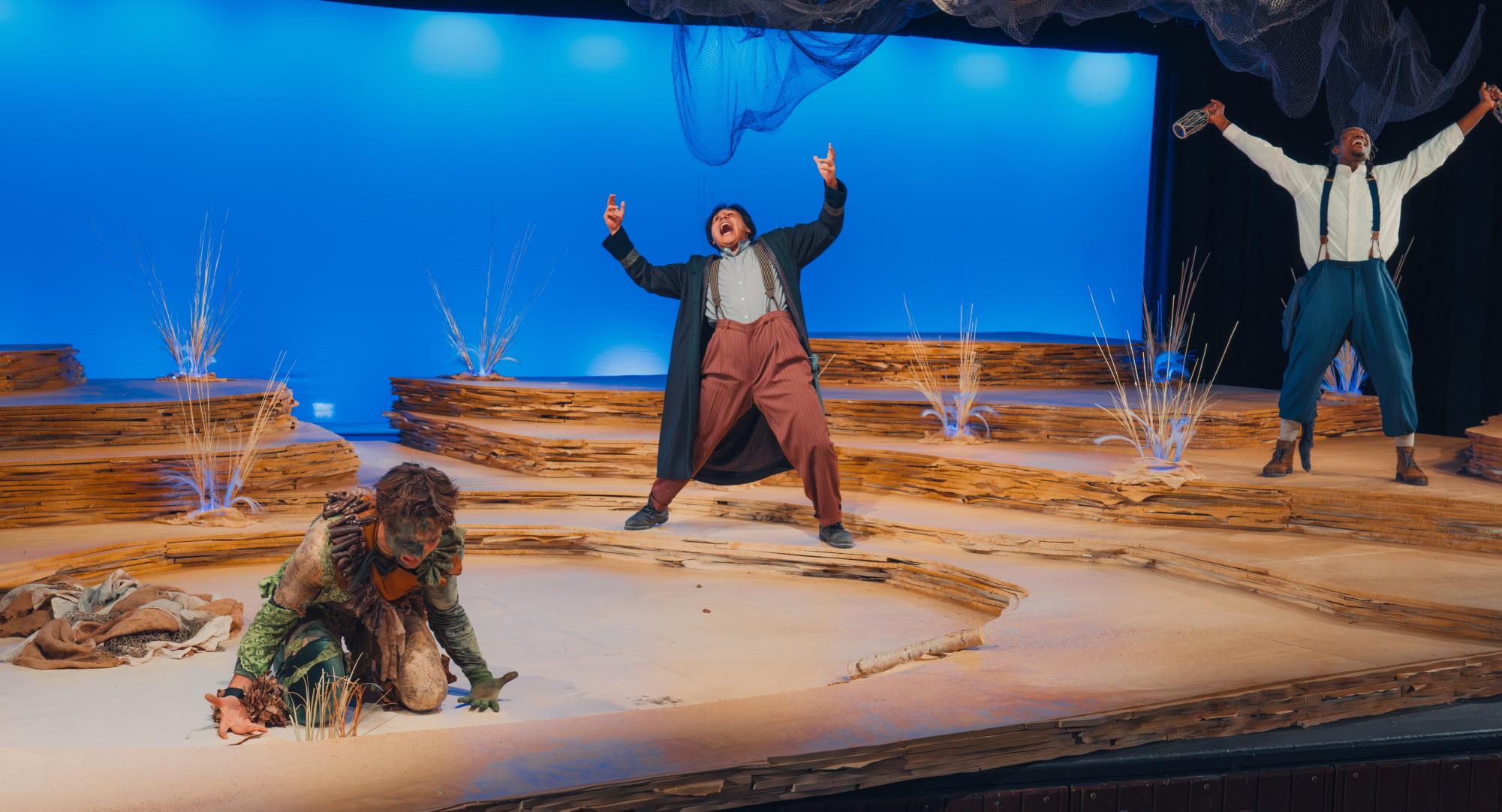
The set design helped transport the audience to a mythical world. A rocky palette on stage and netting that hung above the audience emulated an island terrain. At a few moments in the show, fairy lights twinkled over the house seats. At another, a ring of well-timed LED lights at Prospero’s feet emphasized his sorcery. It was an enchanting sight to see Pope Auditorium completely transformed.
The imaginative costuming added to the effect. Half of the cast wore variations of nautical dresswear, with ballooned trousers, sashes and fashionable vests. Prospero donned a grandiose cape made out of what looked like handwritten letters. The monster Caliban (played by Dylan Stern, FCLC ’28) wore a ragged green and brown ensemble that conveyed his subservient nature. Wardrobe crew member Mary Sullivan, FCLC ’29, said she gained new skills working on the production, like learning to paint someone to disguise them as a tree.
Ariel, a character typically portrayed by one actor, is split into four roles, another example of the innovative nature of this production. Carrie Johnson, FCLC ’28, plays one of the entities, and reflected on the role in light of the current political climate.
“The Ariels are these magical creatures on the island. We have power over our own autonomy, but sometimes it’s taken from us, and we aren’t allowed to use it freely and we have to use it at the will of someone else,” Johnson said. “I am currently, in my own body, under complicit service — not on purpose, but because of the systems that are built around our administration and … those who have significant power over me.”
Johnson said that in embodying the role, she learned to “relinquish that power and take back (her) own controlled autonomy.”
One poignant moment of the show is the wedding scene between Ferdinand and Miranda. The ensemble becomes a vehicle to narrate the story of a budding love that begs to be everlasting. The choreographer Suzanne Millonzi used unique movements to create a figurative language.
Quinn said he hopes the movement conveys that the characters “are going to discover, they are going to feel, they’re going to suffer, they’re going to find joy, but at the end of it, they just get the part of taking that next step over and over and over again.”
There are various points in the show where this physical embodiment of the story acts as a conduit for larger themes.
“When you have people around you who are willing to not only work with you, but help you grow and connect with you, no matter what happens.” Carrie Johnson, FCLC ’28
A supportive rehearsal environment was crucial to developing this intricate production. The actors, creative team and crew worked tirelessly throughout the month of October to develop the tone and look of the show.
Quinn recounted a sentimental memory of a special rehearsal that was scheduled late into Halloween night. As a surprise, everyone came dressed as him.
This is a testament to the community that formed during the rehearsal process, thanks in no small part to Quinn’s strong leadership.
“Our director Ryan Quinn is so uplifting, and I think that’s what makes it so different.” Johnson said. She claimed this sense of community is only possible “when you have people around you who are willing to not only work with you, but help you grow and connect with you, no matter what happens.”
The positive environment that emerged during the development of such a complex text translated to the final product on stage. The actors moved fluidly as one through choreography and shared palpable energy in different scenes. This was the true mark of collaboration toward their common goal of storytelling.
The power to imagine, transform the stage into another world and let the audience into the atmosphere was made clear within this production. Even if none of us can relate to the events of the play, we can identify with Shakespeare’s timeless explorations of human desire and shortcomings. The fresh take on the story provided insight that audience members can take throughout their lives to understand their relationships with their own fates.
“The Tempest” closes Nov. 22 in Pope Auditorium.