

Allow me to enlighten anyone unfamiliar with the age-old tactic of coded language. It is a phenomenon often used by men to socially police women, frequently disguised as a compliment or feedback.
Throughout my adolescence and early adulthood, I have fielded this faux praise with a “thank you,” because it is gift-wrapped and delivered to me in a way that expects that response. “You are so intimidating” implies that being unapproachable is what defines a woman who is extroverted or confident; it is the price she must pay for commanding a room or simply standing tall with her chin held high.
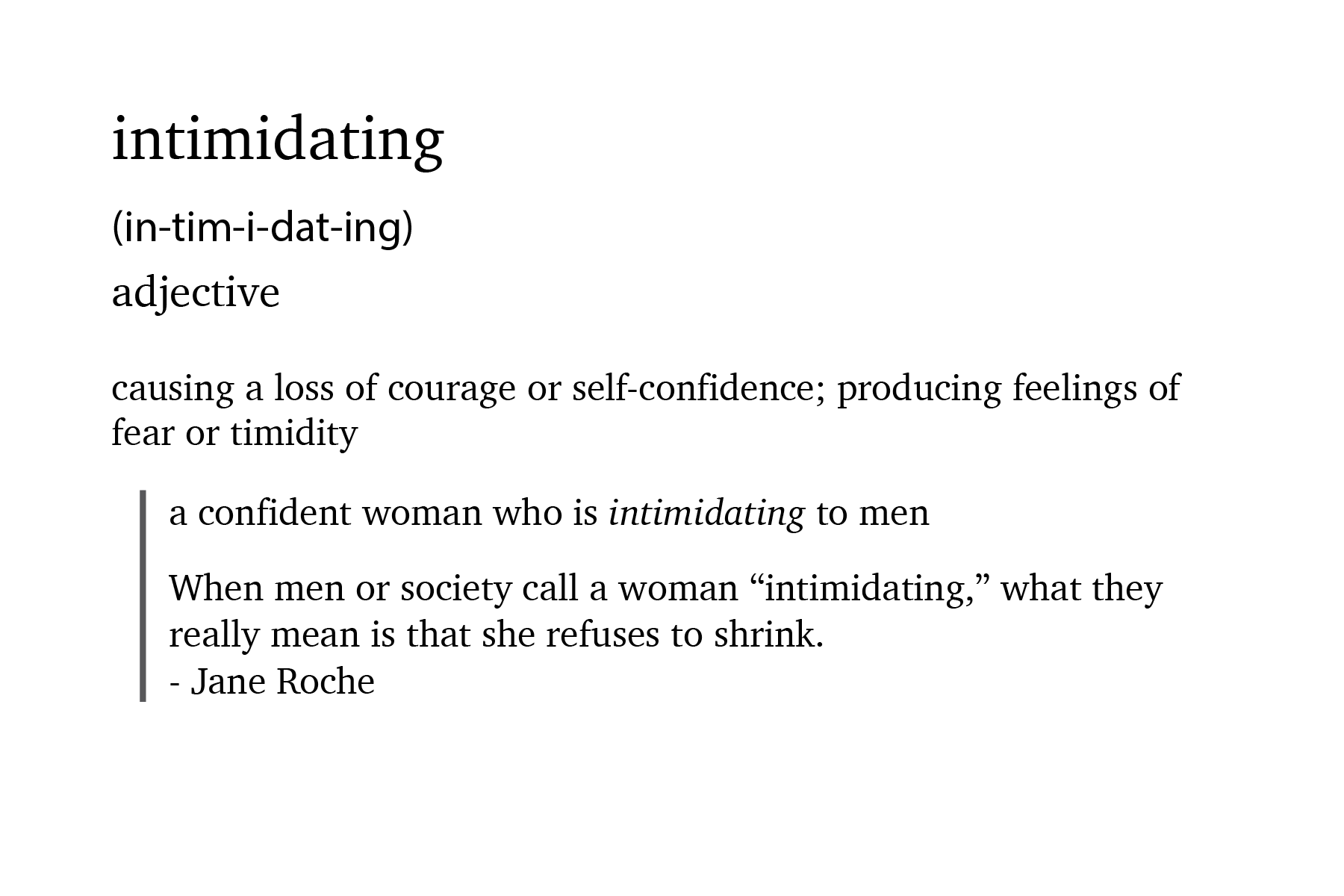
When men or society call a woman “intimidating,” what they really mean is that she refuses to shrink. She does not flatter or appease. She exists outside of the narrow frame that centuries of social conditioning built for her. “Intimidating” becomes a polite way of saying you don’t know your place — the politeness making the dig all the more insidious.
Our culture is fluent in the language of female containment. Most of the women in my life have been confronted with the same language or one of its many variations (“emotional,” “hysterical” and “bossy,” to name a few). This language disproportionately affects women of color, who are often stereotyped as “aggressive” or “abrasive.”
What this language has become is an acceptable way to insult women and control them. It is an accusation that the woman is at fault for the messenger’s insecurities; packaging it as flattery is just another way to compel women to accept abuse from men.
Am I truly intimidating, or are you intimidated by me? Am I bossy, or are you unwilling to take no for an answer? Am I emotional, or are you insensitive?
I would argue that he who heralds the opinion may need to redirect the subject of the sentiment unto himself. Coded language is truly a man’s insecurities and shortcomings repackaged as the responsibility of the woman receiving it. When women refuse to submit to patriarchal roles, they should not then become accustomed to absorbing men’s deficits.
Women are taught to see each other as competition rather than allies and socialized to elbow each other out rather than lift each other up.
To call a woman intimidating is to absolve oneself of introspection. Instead of asking, “Why do powerful women threaten me?”, we ask, “Why can’t she tone it down?” The label becomes a mirror turned the wrong way, projecting male insecurity onto female identity.
Admittedly, it is true that women themselves are guilty of labeling other women with coded language. We are all collectively brainwashed by the patriarchy; we all need to learn to make acceptable judgments of women. Women are taught to see each other as competition rather than allies and socialized to elbow each other out rather than lift each other up.
This game is old and overplayed. For centuries, women have been expected to be modest, agreeable and grateful for permission to exist. When they step beyond those lines, language rushes in to discipline them. A woman who argues is “hysterical.” A woman who commands respect is “difficult.” A woman who demands equality is “radical.” And notoriously, women have been labeled as one thing while the male equivalent grants men valiance; she is a “spinster” (an unmarried woman with a negative connotation), while he is a “bachelor.”
In the workplace, studies of performance reviews show that praise towards women is often limited to maternal terms, such as “warm” and “helpful,” whereas men more frequently receive results-oriented praise (i.e., “confident,” “decisive”). According to an article by the BBC, “‘Compassionate’ was a common descriptor of women, whereas ‘competent’ was frequently used for men. In terms of negative feedback, ‘irresponsible’ was more often applied to men, whereas judgmental and gender-coded terms like ‘frivolous’ and ‘temperamental’ were more likely to be mentioned for women.”
The double standard in the workplace bleeds into how women are perceived socially. Instagram influencer @julionomartello posts videos online revealing all the reasons why women cannot come up for air in the dating pool, claiming a spokesperson role for men in his age group (Gen Z, 20s). In one of his videos, he explains his understanding of why women are rarely approached in public by men. His reason is that “you are very attractive” or “you need to understand that a man’s number one fear of all time is fear of rejection in public.”
Translation: The consequence for strength or beauty is loneliness. Men won’t step up, so women should tone it down.
Redirecting the blame from the wrongdoer to the victim is an old tactic that has manifested into something much more harmful, thanks to the manosphere — a neologism referring to misogynistic male internet groups — screaming in our faces every day. The supposed “tough guys” on the internet whine loudly about what they deem to be women’s flaws that lead to their distaste or lack of attraction towards women.
History has always punished the woman who refuses to be controlled. One of the most haunting examples lies in the 17th-century Salem witch trials
The violent echochamber within the manosphere that bleeds into the algorithm of young boys and girls on social media begs the question of whether or not this language is regressing back into a more explicit “burn the witch” territory.
The “trials” were not trials and the “witches” were not witches. Rather, “intimidating” people were branded sub-human while accusations of sorcery were heaped upon them. It was a slaughtering of individuals who did not conform to societal norms, the vast majority of whom were women. Labeling them as “witches” was never about demonic fear; it was about social order and control. It was a label used to justify violence against outsiders. Many of the women accused lived at the edges of their community as widows, healers, landowners or women without husbands.
Dismantling the age-old myths of hysterical women is crucial to decoding the destructive language used toward women today. The Broadway play “John Proctor is the Villain” does just that. The production is a modern-day feminist interpretation of Arthur Miller’s 1953 play “The Crucible.” In “John Proctor is the Villain,” which ran on Broadway from March 20 to Sept. 7, high school students were tasked with interpreting “The Crucible” in their English class. The students’ real lives end up reflecting the events portrayed in Miller’s play, drawing parallels between the Salem witch trials and contemporary issues of sexual misconduct and power dynamics between men and women.
A young girl, Shelby, is framed as unhinged, “too much” and aggressive, when in reality, she is responding to sexual abuse from her English teacher. It questions John Proctor’s heroic role in “The Crucible” by translating his role into an English teacher. Ultimately, the play challenges society to reexamine who the real villains and victims are. It exposes the systemic issue of labeling a woman a liar when, really, she is a survivor. The man once considered “heroic” is revealed as the true tyrant. The ending was a thematic reclaiming of the narrative as Shelby’s own, making for a cathartic and liberating viewing experience filled with so much emotion. It is a relief to see narratives like this one performed on such a big stage.
It is true that men are also subjected to coded language. Young boys grow up hearing phrases of destruction used to define their success. “You went in guns blazing” and “You’re a killer,” to name a few, are celebratory descriptors often used towards men that define their triumphs in violence, ignited at an early age by comic books and video games marketed towards boys. What then begins to occur is an understanding that the main way men and boys are able to evaluate themselves is through language related to destruction and death. Our culture predetermines how a man should respond to glory through the language of violence. And in turn, it becomes inherent for men and boys to revert to the fail-safe of justifying their failures by elevating women’s flaws.
The use of coded language is ever-evolving. “Witch” became “hysterical,” which then became “intimidating.” The violent echochamber within the manosphere that bleeds into the algorithm of young boys and girls on social media begs the question of whether or not this language is regressing back into a more explicit “burn the witch” territory.
On Nov. 6, The New York Times published the transcript of an episode of one of its podcasts, “Interesting Times,” hosted by opinion columnist Ross Douthat. The original headline was “Did Women Ruin the Workplace?” Since its publication, the headline has been changed several times, likely due to the firestorm of online backlash, before reverting back to its second title “Did Liberal Feminism Ruin the Workplace?” The New York Times and Douthat attempted to masquerade overt misogyny as inquiry or critique. What they really did was publish an exposé of how the “burn the witch” theory remains alive today. What was once conveyed through an underlying meaning is now published explicitly, in plain words, by a major news outlet.
The New York Times threw a linguistic dagger at all women, reminding us that the age-old mechanisms used to socially police in Salem have not disappeared, but have simply found new forms. Language has evolved, but the underlying impulse to punish women who refuse to submit has not. And historically, history has a tendency to repeat itself.