
Every year, tens of thousands of New Yorkers head to Staten Island early in the morning to traverse the five boroughs for 26.2 miles. While that might sound like a nightmare to some New Yorkers, for many others, it is the rewarding escape from busy city life that they long for.
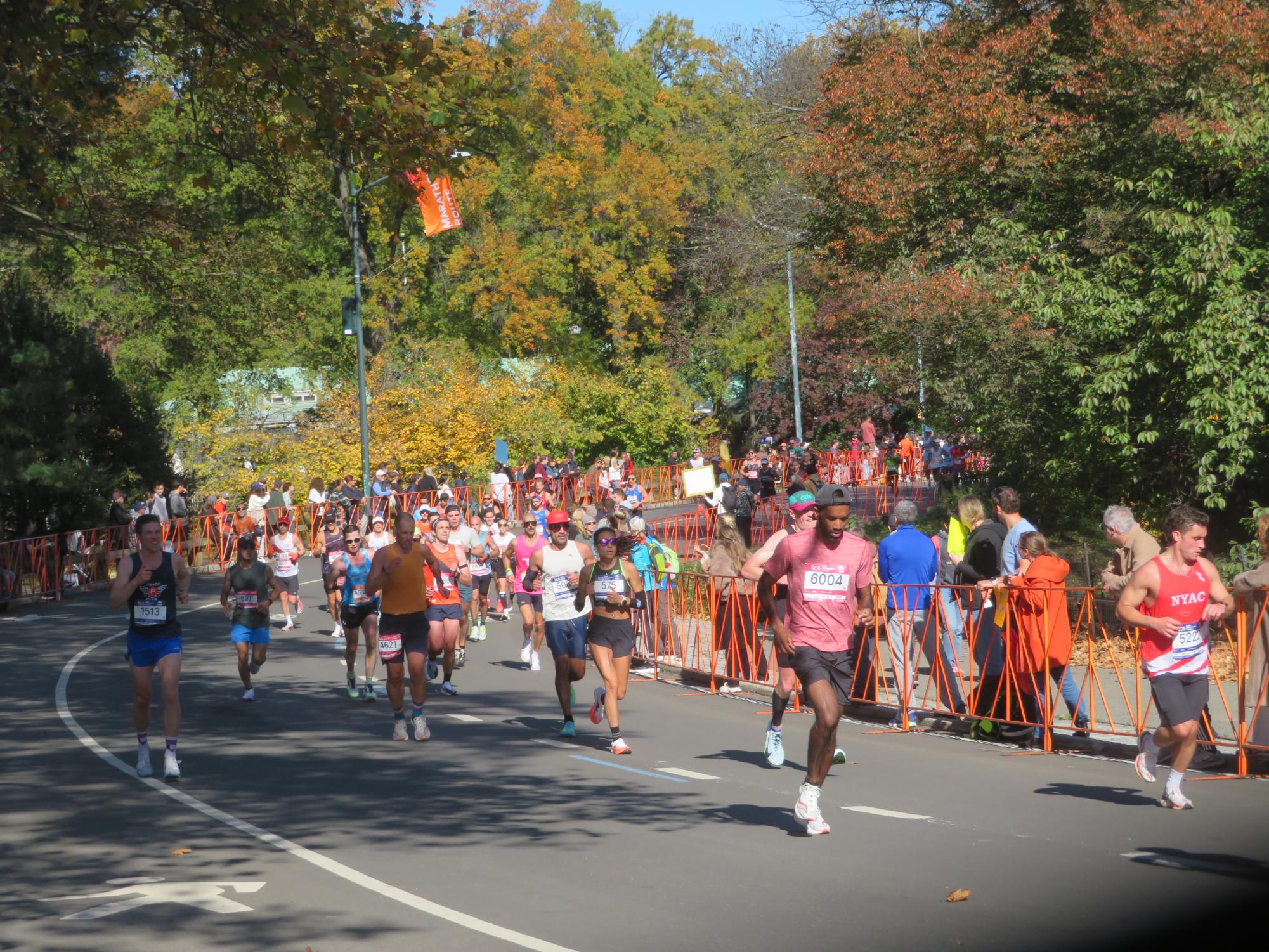
On Sunday, Nov. 2, the Tata Consultancy Services (TCS) New York City Marathon kicked off at 8 a.m in Fort Wadsworth, Staten Island. It set a new record as the world’s largest marathon ever with 59,226 finishers, topping last year’s world record-setting 55,646.
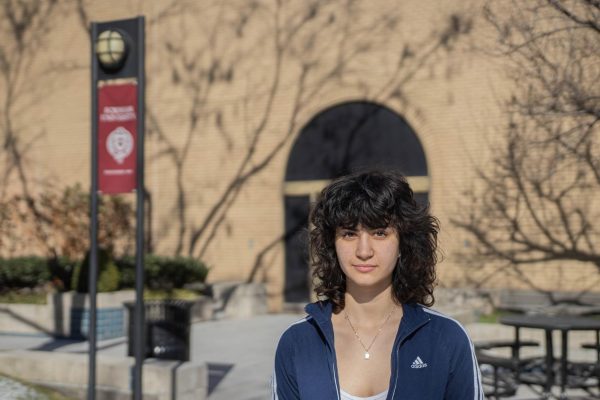
Three of those finishers included current Fordham students and first-time New York City marathon runners Avery Ash, Valerie Ramirez Salgado and Averi Schirmers.
“Everyone cheering for strangers — that’s just kind of a crazy experience.” Avery Ash, FCLC ’28
The marathon is hosted every first Sunday of November by New York Road Runners (NYRR), a New York City-based nonprofit organization that holds fundraising races throughout the year. The organization has raised $600 million for charity since 2006, including $122 million since 2002 for Team for Kids, a charity that funds community youth programs, alone. In total, NYRR is partnered with 614 charity organizations.
To enter the marathon, in addition to an entry fee, participants must select an NYRR-partnered charity to raise a threshold amount of money for.
For Ash, Fordham College at Lincoln Center (FCLC) ’28, this was her first marathon. She spent 18 weeks training and over a year fundraising for Team for Kids.
Asking for donations was initially daunting, Ash said, but she quickly found that people “were so into it, and they were all so generous.” Although the qualifying amount for Team for Kids was $3,000, Ash raised around $3,500.
“It really is like that one big block party (for) the entire city.” Ramirez Salgado, FCLC ’28 and Run@LC E-board member
Almost as famous as the marathon itself is the buzz that it brings to New York City. Throughout its length, participants are surrounded by friends, family and eager onlookers.
“I’m so excited to see the energy and having people cheering for my name,” Ash said ahead of the race.
She kept her goal time a “secret” to prioritize the marathon as an experience rather than a competition.
“I literally cried so many times. Every time I saw someone, I was so emotional; it was just so crazy it was actually happening,” Ash said. “Everyone cheering for strangers — that’s just kind of a crazy experience.”
This was also the first marathon for Valerie Ramirez Salgado, FCLC ’28, an E-board member of Run@LC, FCLC’s run club. The task at hand did not inhibit her enthusiasm, either.
“I’m seeing all the TikToks and it sounds so fun. It’s like, ‘Oh wait, that’s gonna be me,’” she said prior to the race.
Salgado was introduced to running and granted entry to this year’s race by an NYRR partner program, Run for the Future, which she joined in high school. The program’s goal is to empower young women to run, and for Salgado, she “just continued running nonstop” after joining.
She is already qualified for next year’s marathon through the NYRR 9+1 Membership Program, which dictates that if you run nine NYRR races and volunteer for one, you have guaranteed entry rather than having to fundraise or enter a lottery.
Salgado found some of the fun she was looking forward to even before the race began. On the ferry to Staten Island and at the start village, she spoke with several other participants.
“It really is like that one big block party (for) the entire city,” Salgado said.
For Schirmers, running has always been a crucial community builder.
She was brought to tears by her family who were stationed at several points along the course, including in the grandstands that overlook the finish line.
Schirmers, FCLC ’27, the president of Run@LC, participated in the New York City marathon for the first time this year, qualifying through the 9+1 Membership Program.
Although it was not her first marathon, she said it was nothing like the one she completed in her hometown in Minnesota. She only took a week off of training after her first before beginning another 18 weeks of training.
“Everything I eat, what time I wake up, what time I go to bed, I’m always thinking about running the marathon, and then all of a sudden it just ends,” Schirmers said days out from the race. “A lot of people go through a post-marathon depression.”
Salgado said that she felt some “post-marathon blues” herself.
“After having a set training block for so long now, it’s like this week, I basically just do nothing,” she said. “What do I do now?”
For Schirmers, running has always been a crucial community builder. Coming to college after being on a local running team for six years, she struggled to find a sense of community until she joined the Upper West Side Run Club. Her peers in the club were cheering her on, along with her family and her boyfriend.
“It’s just the most selfless act to go out and watch strangers run. Even if you’re there for somebody or one of your friends is running … my parents waited 40 minutes to see me for 10 seconds when I ran past,” she said.
The turnout for the marathon this year was impressive, but its energy alone was palpable. The next TCS New York City marathon is about a year from now, but it might already be time to start fundraising.
As Schirmers said, nobody should “feel like they’re not a runner enough to run the New York City marathon.”